 Add to Chrome
 Add to Firefox
 Add to Edge
Distributed Massive MIMO with 1-Bit Radio-over-Fiber Fronthaul: Uplink Spectral Efficiency and Power Control
Jun 25, 2026
We analyze the uplink spectral efficiency achievable in a distributed multiple-input multiple-output (D-MIMO) architecture employing a 1-bit radio-over-fiber fronthaul. This architecture eliminates the need for local oscillators at the access points, hence enabling coherent-phase transmission without costly over-the-air synchronization. With this fronthaul architecture, the uplink signal at the central processing unit is a dithered, oversampled, and 1-bit quantized version of the passband signal received at the access points. This makes some of the conventional spectral-efficiency expressions used in the D-MIMO literature not directly applicable for two key reasons: the nonlinearity of the input-output relation and the practical unavailability of minimum mean square error (MMSE) channel estimates. To address this issue, we propose novel achievable-rate expressions that do not require MMSE channel estimates and rely on the Bussgang decomposition to linearize the input-output relation. We use these expressions to determine the optimal signal-to-dither ratio (SDR) that maximizes the achievable rates in both single- and multiuser scenarios and to assess the impact of oversampling. We then use one of the proposed achievable-rate expressions to investigate the max-min fairness problem when the access points cannot maintain the optimal SDR because of limitations in their dynamic range.

Fast and Low-Memory Deep Neural Networks Using Binary Matrix Factorization
Oct 24, 2022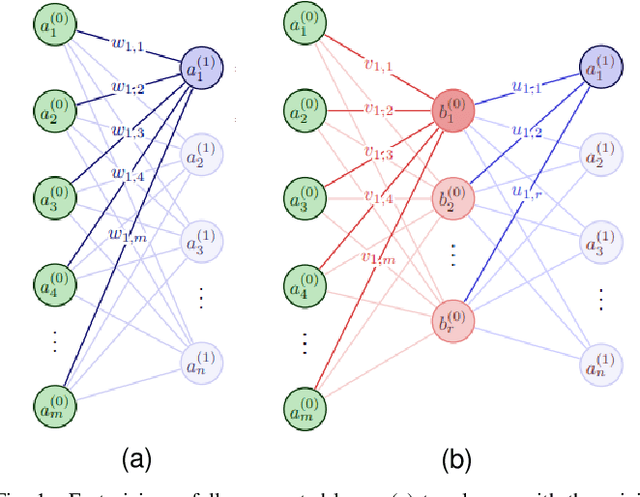
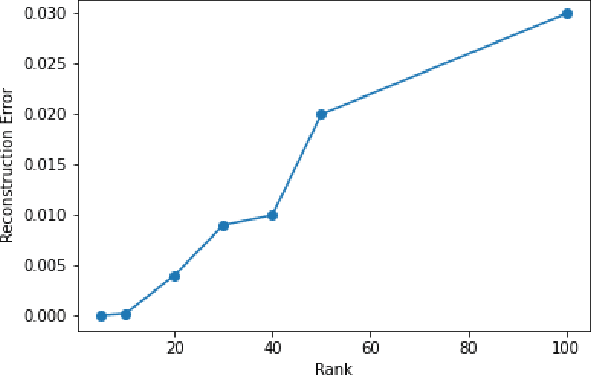
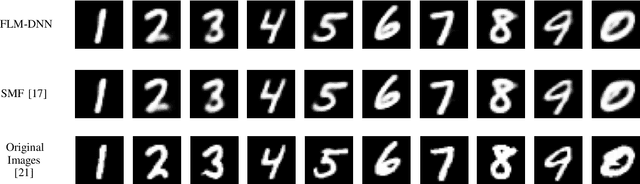
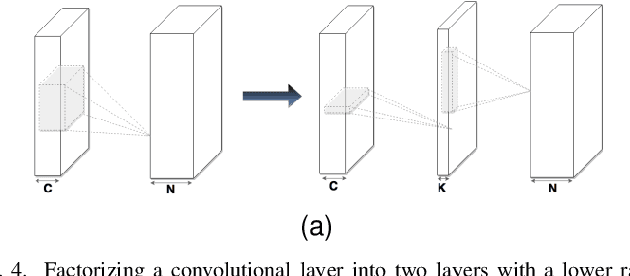
Despite the outstanding performance of deep neural networks in different applications, they are still computationally extensive and require a great number of memories. This motivates more research on reducing the resources required for implementing such networks. An efficient approach addressed for this purpose is matrix factorization, which has been shown to be effective on different networks. In this paper, we utilize binary matrix factorization and show its great efficiency in reducing the required number of resources in deep neural networks. In effect, this technique can lead to the practical implementation of such networks.