 Add to Chrome
 Add to Firefox
 Add to Edge
Which private attributes do VLMs agree on and predict well?
Feb 08, 2026
Visual Language Models (VLMs) are often used for zero-shot detection of visual attributes in the image. We present a zero-shot evaluation of open-source VLMs for privacy-related attribute recognition. We identify the attributes for which VLMs exhibit strong inter-annotator agreement, and discuss the disagreement cases of human and VLM annotations. Our results show that when evaluated against human annotations, VLMs tend to predict the presence of privacy attributes more often than human annotators. In addition to this, we find that in cases of high inter-annotator agreement between VLMs, they can complement human annotation by identifying attributes overlooked by human annotators. This highlights the potential of VLMs to support privacy annotations in large-scale image datasets.

Cross-modal Counterfactual Explanations: Uncovering Decision Factors and Dataset Biases in Subjective Classification
Dec 21, 2025Concept-driven counterfactuals explain decisions of classifiers by altering the model predictions through semantic changes. In this paper, we present a novel approach that leverages cross-modal decompositionality and image-specific concepts to create counterfactual scenarios expressed in natural language. We apply the proposed interpretability framework, termed Decompose and Explain (DeX), to the challenging domain of image privacy decisions, which are contextual and subjective. This application enables the quantification of the differential contributions of key scene elements to the model prediction. We identify relevant decision factors via a multi-criterion selection mechanism that considers both image similarity for minimal perturbations and decision confidence to prioritize impactful changes. This approach evaluates and compares diverse explanations, and assesses the interdependency and mutual influence among explanatory properties. By leveraging image-specific concepts, DeX generates image-grounded, sparse explanations, yielding significant improvements over the state of the art. Importantly, DeX operates as a training-free framework, offering high flexibility. Results show that DeX not only uncovers the principal contributing factors influencing subjective decisions, but also identifies underlying dataset biases allowing for targeted mitigation strategies to improve fairness.
Specializing General-purpose LLM Embeddings for Implicit Hate Speech Detection across Datasets
Aug 28, 2025Implicit hate speech (IHS) is indirect language that conveys prejudice or hatred through subtle cues, sarcasm or coded terminology. IHS is challenging to detect as it does not include explicit derogatory or inflammatory words. To address this challenge, task-specific pipelines can be complemented with external knowledge or additional information such as context, emotions and sentiment data. In this paper, we show that, by solely fine-tuning recent general-purpose embedding models based on large language models (LLMs), such as Stella, Jasper, NV-Embed and E5, we achieve state-of-the-art performance. Experiments on multiple IHS datasets show up to 1.10 percentage points improvements for in-dataset, and up to 20.35 percentage points improvements in cross-dataset evaluation, in terms of F1-macro score.
Image-guided topic modeling for interpretable privacy classification
Sep 27, 2024
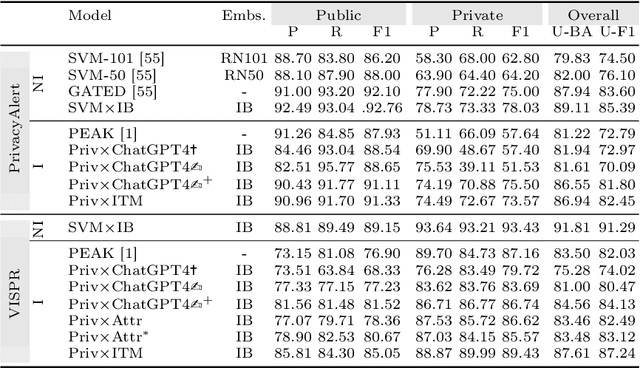
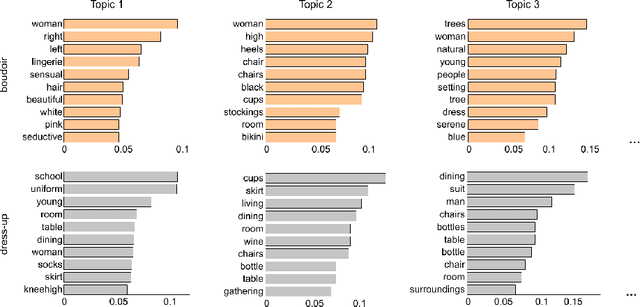
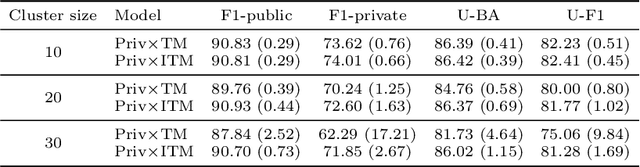
Predicting and explaining the private information contained in an image in human-understandable terms is a complex and contextual task. This task is challenging even for large language models. To facilitate the understanding of privacy decisions, we propose to predict image privacy based on a set of natural language content descriptors. These content descriptors are associated with privacy scores that reflect how people perceive image content. We generate descriptors with our novel Image-guided Topic Modeling (ITM) approach. ITM leverages, via multimodality alignment, both vision information and image textual descriptions from a vision language model. We use the ITM-generated descriptors to learn a privacy predictor, Priv$\times$ITM, whose decisions are interpretable by design. Our Priv$\times$ITM classifier outperforms the reference interpretable method by 5 percentage points in accuracy and performs comparably to the current non-interpretable state-of-the-art model.
Black-box Attacks on Image Activity Prediction and its Natural Language Explanations
Sep 30, 2023Explainable AI (XAI) methods aim to describe the decision process of deep neural networks. Early XAI methods produced visual explanations, whereas more recent techniques generate multimodal explanations that include textual information and visual representations. Visual XAI methods have been shown to be vulnerable to white-box and gray-box adversarial attacks, with an attacker having full or partial knowledge of and access to the target system. As the vulnerabilities of multimodal XAI models have not been examined, in this paper we assess for the first time the robustness to black-box attacks of the natural language explanations generated by a self-rationalizing image-based activity recognition model. We generate unrestricted, spatially variant perturbations that disrupt the association between the predictions and the corresponding explanations to mislead the model into generating unfaithful explanations. We show that we can create adversarial images that manipulate the explanations of an activity recognition model by having access only to its final output.