 Add to Chrome
 Add to Firefox
 Add to Edge
Residualized Temporal Sparse Autoencoders for Interpreting Diffusion Models
May 27, 2026
Text-to-image diffusion models generate images through an iterative denoising process, so internal neural layers produce trajectories of activations rather than single static representations. Sparse autoencoders (SAEs) have recently been used to decompose diffusion activations into interpretable feature directions, but most approaches analyze activations at individual timesteps or condition on time rather than learning directly from full activation trajectories. In this work, we introduce residualized temporal SAEs for diffusion activation trajectories. We collect activations across denoising time, fit linear predictors between neighboring timesteps, and represent each trajectory using an initial activation together with residual components not explained by these linear dynamics. Training an SAE on this residualized representation encourages sparse latents to capture structure beyond what is linearly predictable. The residualized decoder directions can be mapped back into activation space, allowing each latent to be analyzed as a feature trajectory over denoising time. Through reconstruction and ablation studies, spatiotemporal feature analysis, and qualitative steering experiments on Stable Diffusion~1.5, we show that residualized temporal SAEs provide a useful framework for studying temporally structured diffusion activations.

Coupled Inference in Diffusion Models for Semantic Decomposition
Feb 10, 2026Many visual scenes can be described as compositions of latent factors. Effective recognition, reasoning, and editing often require not only forming such compositional representations, but also solving the decomposition problem. One popular choice for constructing these representations is through the binding operation. Resonator networks, which can be understood as coupled Hopfield networks, were proposed as a way to perform decomposition on such bound representations. Recent works have shown notable similarities between Hopfield networks and diffusion models. Motivated by these observations, we introduce a framework for semantic decomposition using coupled inference in diffusion models. Our method frames semantic decomposition as an inverse problem and couples the diffusion processes using a reconstruction-driven guidance term that encourages the composition of factor estimates to match the bound vector. We also introduce a novel iterative sampling scheme that improves the performance of our model. Finally, we show that attention-based resonator networks are a special case of our framework. Empirically, we demonstrate that our coupled inference framework outperforms resonator networks across a range of synthetic semantic decomposition tasks.
HDReason: Algorithm-Hardware Codesign for Hyperdimensional Knowledge Graph Reasoning
Mar 09, 2024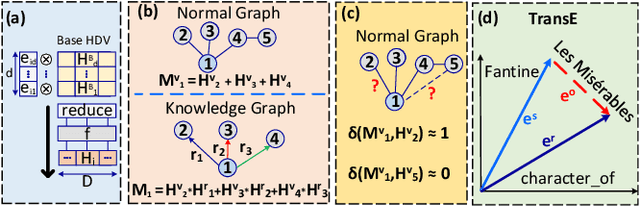
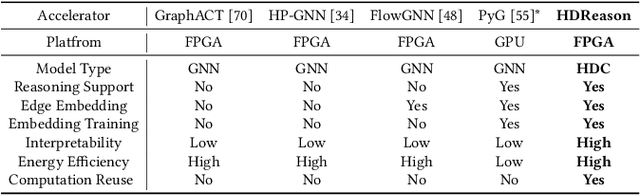

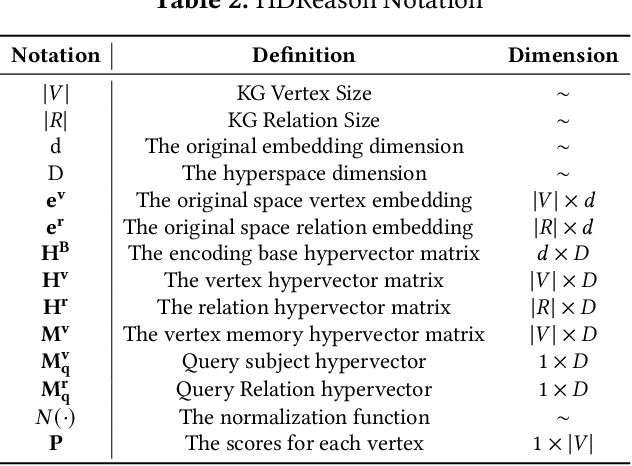
In recent times, a plethora of hardware accelerators have been put forth for graph learning applications such as vertex classification and graph classification. However, previous works have paid little attention to Knowledge Graph Completion (KGC), a task that is well-known for its significantly higher algorithm complexity. The state-of-the-art KGC solutions based on graph convolution neural network (GCN) involve extensive vertex/relation embedding updates and complicated score functions, which are inherently cumbersome for acceleration. As a result, existing accelerator designs are no longer optimal, and a novel algorithm-hardware co-design for KG reasoning is needed. Recently, brain-inspired HyperDimensional Computing (HDC) has been introduced as a promising solution for lightweight machine learning, particularly for graph learning applications. In this paper, we leverage HDC for an intrinsically more efficient and acceleration-friendly KGC algorithm. We also co-design an acceleration framework named HDReason targeting FPGA platforms. On the algorithm level, HDReason achieves a balance between high reasoning accuracy, strong model interpretability, and less computation complexity. In terms of architecture, HDReason offers reconfigurability, high training throughput, and low energy consumption. When compared with NVIDIA RTX 4090 GPU, the proposed accelerator achieves an average 10.6x speedup and 65x energy efficiency improvement. When conducting cross-models and cross-platforms comparison, HDReason yields an average 4.2x higher performance and 3.4x better energy efficiency with similar accuracy versus the state-of-the-art FPGA-based GCN training platform.