 Add to Chrome
 Add to Firefox
 Add to Edge
Adaptive Initial Residual Connections for GNNs with Theoretical Guarantees
Nov 10, 2025
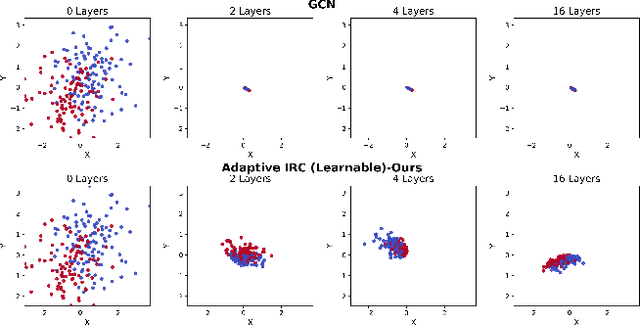
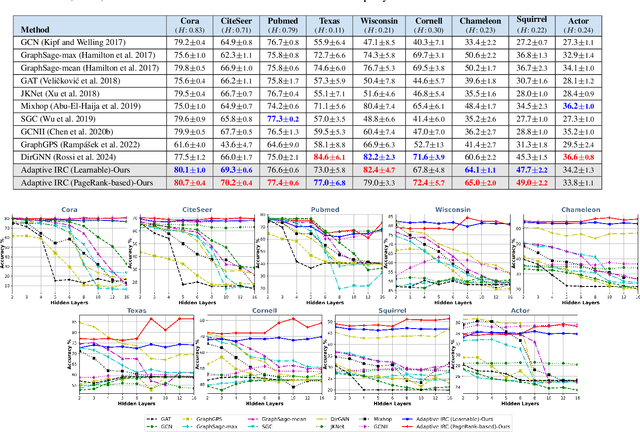
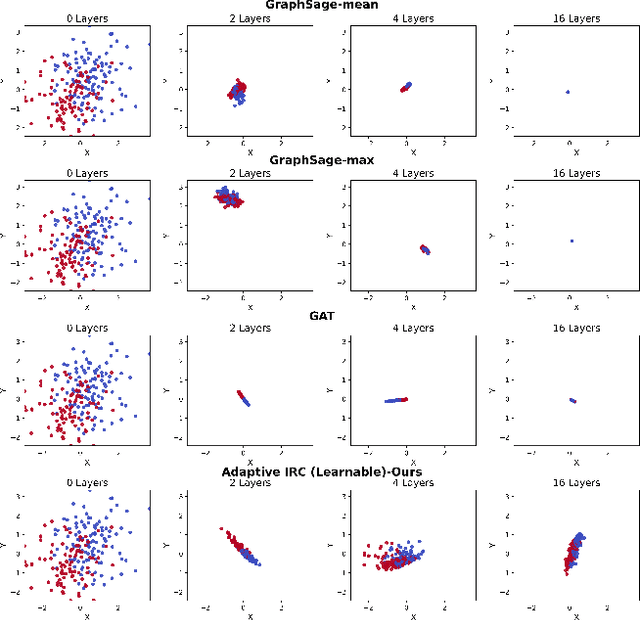
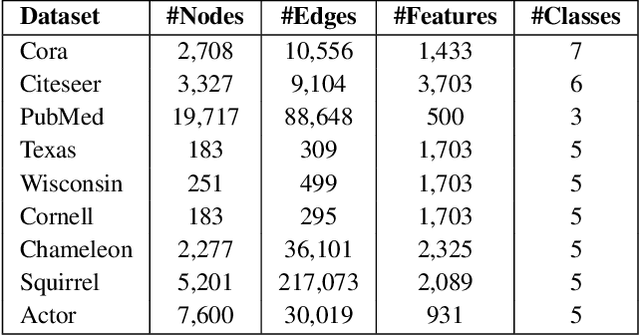
Message passing is the core operation in graph neural networks, where each node updates its embeddings by aggregating information from its neighbors. However, in deep architectures, this process often leads to diminished expressiveness. A popular solution is to use residual connections, where the input from the current (or initial) layer is added to aggregated neighbor information to preserve embeddings across layers. Following a recent line of research, we investigate an adaptive residual scheme in which different nodes have varying residual strengths. We prove that this approach prevents oversmoothing; particularly, we show that the Dirichlet energy of the embeddings remains bounded away from zero. This is the first theoretical guarantee not only for the adaptive setting, but also for static residual connections (where residual strengths are shared across nodes) with activation functions. Furthermore, extensive experiments show that this adaptive approach outperforms standard and state-of-the-art message passing mechanisms, especially on heterophilic graphs. To improve the time complexity of our approach, we introduce a variant in which residual strengths are not learned but instead set heuristically, a choice that performs as well as the learnable version.

Graph-based Fake Account Detection: A Survey
Jul 09, 2025In recent years, there has been a growing effort to develop effective and efficient algorithms for fake account detection in online social networks. This survey comprehensively reviews existing methods, with a focus on graph-based techniques that utilise topological features of social graphs (in addition to account information, such as their shared contents and profile data) to distinguish between fake and real accounts. We provide several categorisations of these methods (for example, based on techniques used, input data, and detection time), discuss their strengths and limitations, and explain how these methods connect in the broader context. We also investigate the available datasets, including both real-world data and synthesised models. We conclude the paper by proposing several potential avenues for future research.