 Add to Chrome
 Add to Firefox
 Add to Edge
BifDet: A 3D Bifurcation Detection Dataset for Airway-Tree Modeling
Apr 27, 2026
Thoracic Computed Tomography (CT) scans offer detailed insights into the intricate branching network of the airway tree, which is essential for understanding various respiratory diseases. Airway bifurcations, where airway branches split, are crucial landmarks for understanding lung physiology, disease mechanisms and lesion localization. Despite the significance of bifurcation analysis, a notable lack of datasets annotated for this task hinders the development of advanced automated specialized detection or segmentation tools. In this paper, we introduce BifDet, the first publicly-available dataset specialized for 3D airway bifurcation detection, filling a critical gap in existing resources. Our dataset comprises carefully annotated CT scans from the ATM22 open-access cohort with bifurcation bounding boxes covering the parent and daughter branches. As a use-case for demonstrating the potential of BifDet, we fine-tune and evaluate RetinaNet and DETR for 3D airway bifurcations detection on CT scans. We provide detailed pipelines, including preprocessing steps and specific implementation design choices. Results are detailed over various categories of minimal bounding box sizes to serve as baseline to benchmark future research.

Curriculum Learning for Few-Shot Domain Adaptation in CT-based Airway Tree Segmentation
Nov 08, 2024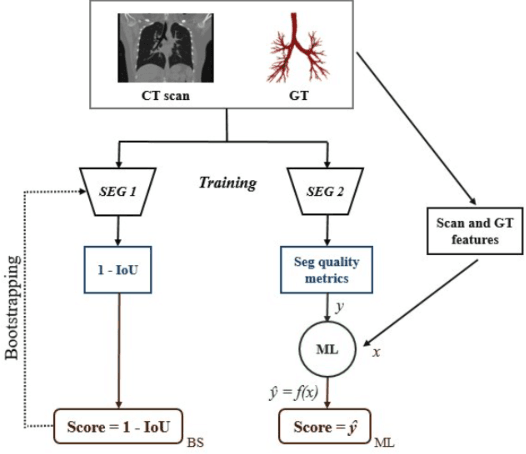
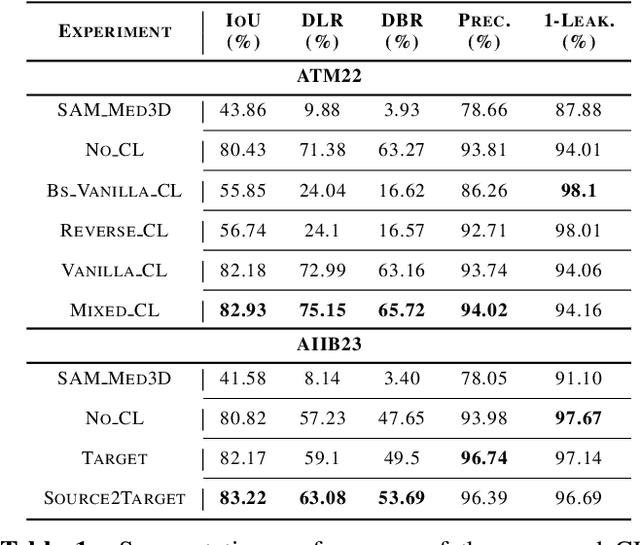
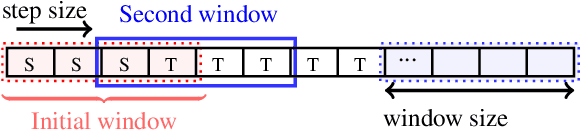
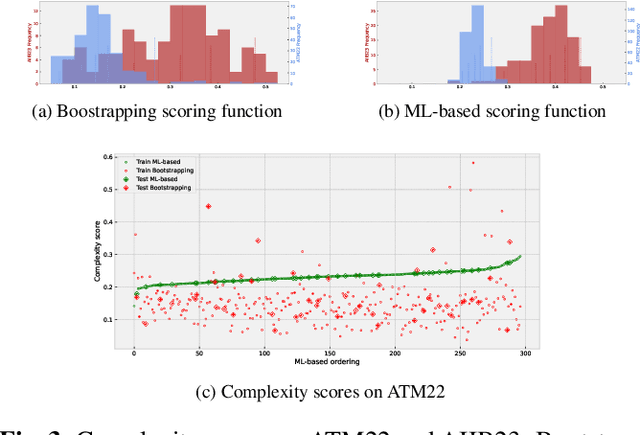
Despite advances with deep learning (DL), automated airway segmentation from chest CT scans continues to face challenges in segmentation quality and generalization across cohorts. To address these, we propose integrating Curriculum Learning (CL) into airway segmentation networks, distributing the training set into batches according to ad-hoc complexity scores derived from CT scans and corresponding ground-truth tree features. We specifically investigate few-shot domain adaptation, targeting scenarios where manual annotation of a full fine-tuning dataset is prohibitively expensive. Results are reported on two large open-cohorts (ATM22 and AIIB23) with high performance using CL for full training (Source domain) and few-shot fine-tuning (Target domain), but with also some insights on potential detrimental effects if using a classic Bootstrapping scoring function or if not using proper scan sequencing.
Few-Shot Airway-Tree Modeling using Data-Driven Sparse Priors
Jul 05, 2024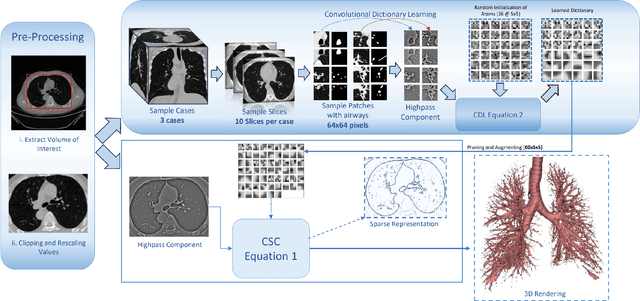
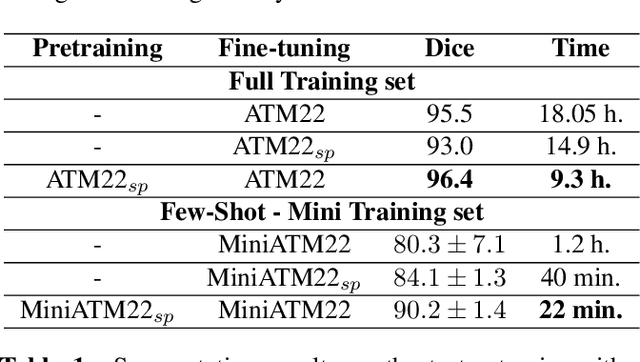
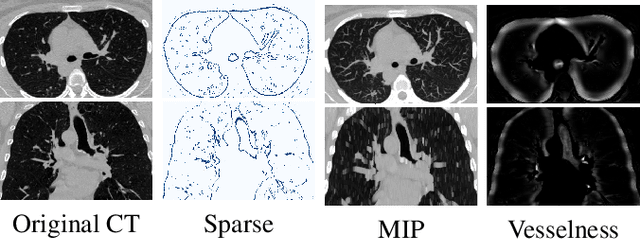
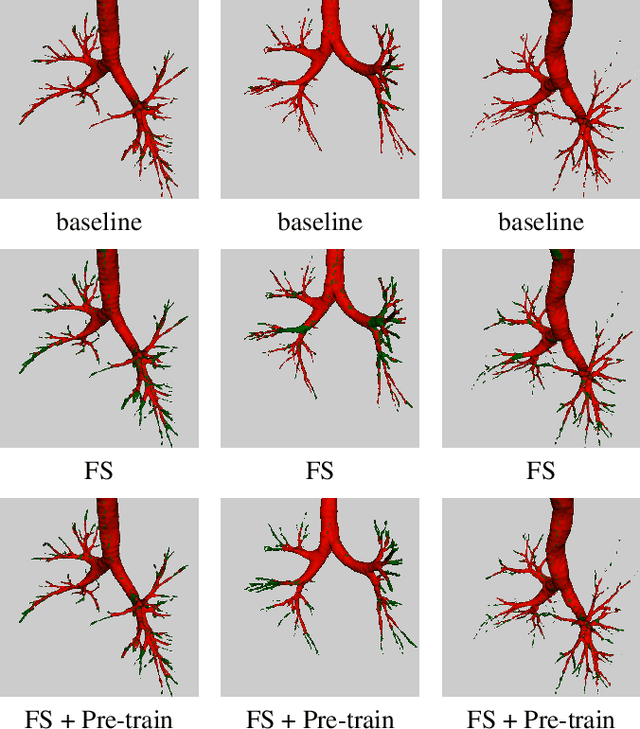
The lack of large annotated datasets in medical imaging is an intrinsic burden for supervised Deep Learning (DL) segmentation models. Few-shot learning approaches are cost-effective solutions to transfer pre-trained models using only limited annotated data. However, such methods can be prone to overfitting due to limited data diversity especially when segmenting complex, diverse, and sparse tubular structures like airways. Furthermore, crafting informative image representations has played a crucial role in medical imaging, enabling discriminative enhancement of anatomical details. In this paper, we initially train a data-driven sparsification module to enhance airways efficiently in lung CT scans. We then incorporate these sparse representations in a standard supervised segmentation pipeline as a pretraining step to enhance the performance of the DL models. Results presented on the ATM public challenge cohort show the effectiveness of using sparse priors in pre-training, leading to segmentation Dice score increase by 1% to 10% in full-scale and few-shot learning scenarios, respectively.