 Add to Chrome
 Add to Firefox
 Add to Edge
TabNSM: Neural Sparse Mixer for Tabular Regression
Aug 18, 2026
Large-scale, high-dimensional tabular regression remains challenging: tree-based models are robust but lack end-to-end representation learning, while deep models enable flexible feature learning but often incur costly interaction modeling and sensitivity to noisy or redundant features. We propose TabNSM, a scalable regression framework that extends our earlier sparse-attention and mixer architectures. At its core, the Adaptive Sparse Interaction Module (ASIM) integrates foreground feature discovery, sparse local interaction encoding, and Feature-Token Mixing, providing near-linear complexity under fixed sparse configurations. For regression, TabNSM introduces three complementary components: a Multi-Stage Regression Head for progressive prediction refinement; GridLoss, an ordinal-aware soft-binning objective that incorporates target structure into representation learning; and RISE (Reweighted Instance Sampling by Error), a difficulty-aware sampling strategy based on loss-quantile bins. Across nine real-world regression benchmarks, TabNSM delivers strong predictive performance and practical scalability, with particularly consistent gains on high-dimensional and heterogeneous datasets. These results demonstrate that selective interaction modeling, structured regression supervision, and difficulty-aware sampling provide an effective and scalable approach to deep tabular regression.

Predicting When Random Low-Dimensional Reparameterizations Train Neural Networks
Aug 12, 2026Neural networks can often be trained or fine-tuned through random low-dimensional reparameterization, where a small latent vector is mapped into a full parameter update by a frozen random map. This raises a practical question: how large must the latent search space be to reach a low-loss region? We first express the known accessibility transition in an equivalent conic form, centered for compact convex targets at the statistical dimension of the polar cone. Our main theoretical contribution is an orientation-resolved quadratic master formula that predicts the random-slice residual from both the curvature spectrum and the reference-to-solution displacement profile. It yields a self-consistent isotropic-orientation predictor and, in a conservative radius-only specialization, recovers the earlier Gaussian-width quadratic bound. Building on this analysis, we introduce Random Mapping Networks (RaMaN), which instantiate the predicted latent dimension using structured Hadamard or seed-regenerated Gaussian maps. These constructions avoid the O(dP) storage of dense random maps and reduce optimizer-state memory from O(P) to O(d). We also develop matrix-free curvature approximations and sweep-free dimension selection. Across controlled quadratic and neural-curvature experiments, the orientation-resolved predictor closely tracks measured transition locations and outperforms orientation-agnostic approximations when displacement direction matters. End-to-end experiments further show sharp, protocol-dependent training transitions across image and language models.
TabKAN: Advancing Tabular Data Analysis using Kolmograv-Arnold Network
Apr 09, 2025Tabular data analysis presents unique challenges due to its heterogeneous feature types, missing values, and complex interactions. While traditional machine learning methods, such as gradient boosting, often outperform deep learning approaches, recent advancements in neural architectures offer promising alternatives. This paper introduces TabKAN, a novel framework that advances tabular data modeling using Kolmogorov-Arnold Networks (KANs). Unlike conventional deep learning models, KANs leverage learnable activation functions on edges, enhancing both interpretability and training efficiency. Our contributions include: (1) the introduction of modular KAN-based architectures tailored for tabular data analysis, (2) the development of a transfer learning framework for KAN models, enabling effective knowledge transfer between domains, (3) the development of model-specific interpretability for tabular data learning, reducing reliance on post hoc and model-agnostic analysis, and (4) comprehensive evaluation of vanilla supervised learning across binary and multi-class classification tasks. Through extensive benchmarking on diverse public datasets, TabKAN demonstrates superior performance in supervised learning while significantly outperforming classical and Transformer-based models in transfer learning scenarios. Our findings highlight the advantage of KAN-based architectures in efficiently transferring knowledge across domains, bridging the gap between traditional machine learning and deep learning for structured data.
TabNSA: Native Sparse Attention for Efficient Tabular Data Learning
Mar 12, 2025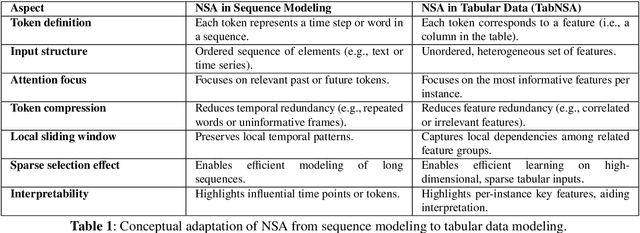
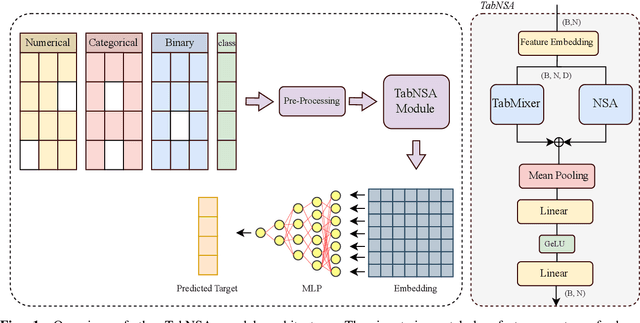
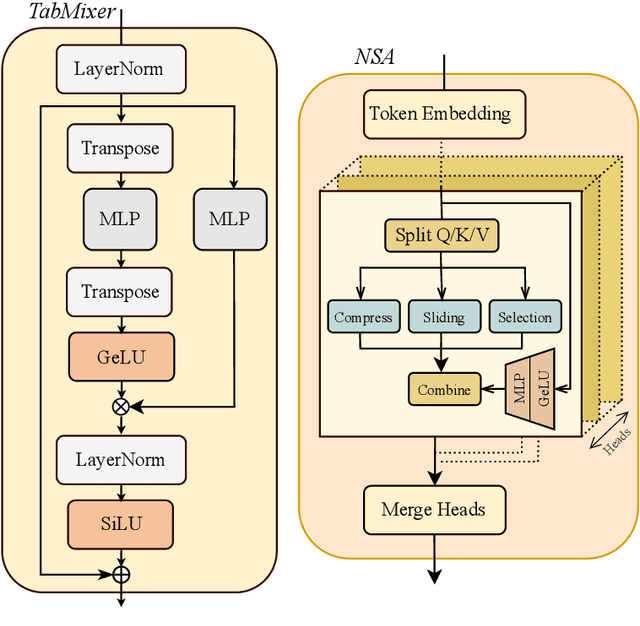
Tabular data poses unique challenges for deep learning due to its heterogeneous features and lack of inherent spatial structure. This paper introduces TabNSA, a novel deep learning architecture leveraging Native Sparse Attention (NSA) specifically for efficient tabular data processing. TabNSA incorporates a dynamic hierarchical sparse strategy, combining coarse-grained feature compression with fine-grained feature selection to preserve both global context awareness and local precision. By dynamically focusing on relevant subsets of features, TabNSA effectively captures intricate feature interactions. Extensive experiments demonstrate that TabNSA consistently outperforms existing methods, including both deep learning architectures and ensemble decision trees, achieving state-of-the-art performance across various benchmark datasets.
Comparative Analysis of Transfer Learning Models for Breast Cancer Classification
Aug 29, 2024The classification of histopathological images is crucial for the early and precise detection of breast cancer. This study investigates the efficiency of deep learning models in distinguishing between Invasive Ductal Carcinoma (IDC) and non-IDC in histopathology slides. We conducted a thorough comparison examination of eight sophisticated models: ResNet-50, DenseNet-121, ResNeXt-50, Vision Transformer (ViT), GoogLeNet (Inception v3), EfficientNet, MobileNet, and SqueezeNet. This analysis was carried out using a large dataset of 277,524 image patches. Our research makes a substantial contribution to the field by offering a comprehensive assessment of the performance of each model. We particularly highlight the exceptional efficacy of attention-based mechanisms in the ViT model, which achieved a remarkable validation accuracy of 93\%, surpassing conventional convolutional networks. This study highlights the promise of advanced machine learning approaches in clinical settings, offering improved precision as well as efficiency in breast cancer diagnosis.
Enhanced Unscented Kalman Filter-Based SLAM in Dynamic Environments: Euclidean Approach
Dec 19, 2023This paper introduces an innovative approach to Simultaneous Localization and Mapping (SLAM) using the Unscented Kalman Filter (UKF) in a dynamic environment. The UKF is proven to be a robust estimator and demonstrates lower sensitivity to sensor data errors compared to alternative SLAM algorithms. However, conventional algorithms are primarily concerned with stationary landmarks, which might prevent localization in dynamic environments. This paper proposes an Euclidean-based method for handling moving landmarks, calculating and estimating distances between the robot and each moving landmark, and addressing sensor measurement conflicts. The approach is evaluated through simulations in MATLAB and comparing results with the conventional UKF-SLAM algorithm. We also introduce a dataset for filter-based algorithms in dynamic environments, which can be used as a benchmark for evaluating of future algorithms. The outcomes of the proposed algorithm underscore that this simple yet effective approach mitigates the disruptive impact of moving landmarks, as evidenced by a thorough examination involving parameters such as the number of moving and stationary landmarks, waypoints, and computational efficiency. We also evaluated our algorithms in a realistic simulation of a real-world mapping task. This approach allowed us to assess our methods in practical conditions and gain insights for future enhancements. Our algorithm surpassed the performance of all competing methods in the evaluation, showcasing its ability to excel in real-world mapping scenarios.
Det-SLAM: A semantic visual SLAM for highly dynamic scenes using Detectron2
Oct 01, 2022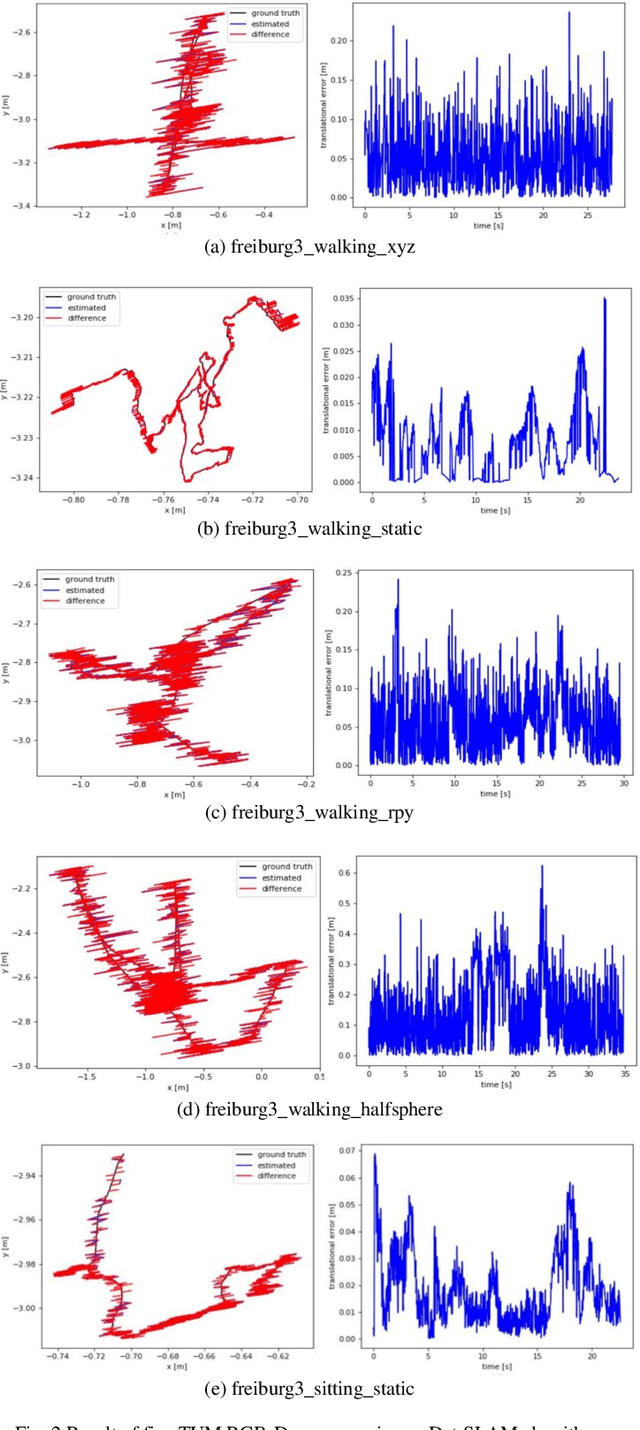
According to experts, Simultaneous Localization and Mapping (SLAM) is an intrinsic part of autonomous robotic systems. Several SLAM systems with impressive performance have been invented and used during the last several decades. However, there are still unresolved issues, such as how to deal with moving objects in dynamic situations. Classic SLAM systems depend on the assumption of a static environment, which becomes unworkable in highly dynamic situations. Several methods have been presented to tackle this issue in recent years, but each has its limitations. This research combines the visual SLAM systems ORB-SLAM3 and Detectron2 to present the Det-SLAM system, which employs depth information and semantic segmentation to identify and eradicate dynamic spots to accomplish semantic SLAM for dynamic situations. Evaluation of public TUM datasets indicates that Det-SLAM is more resilient than previous dynamic SLAM systems and can lower the estimated error of camera posture in dynamic indoor scenarios.