 Add to Chrome
 Add to Firefox
 Add to Edge
Scaling Laws of Global Weather Models
Feb 26, 2026
Data-driven models are revolutionizing weather forecasting. To optimize training efficiency and model performance, this paper analyzes empirical scaling laws within this domain. We investigate the relationship between model performance (validation loss) and three key factors: model size ($N$), dataset size ($D$), and compute budget ($C$). Across a range of models, we find that Aurora exhibits the strongest data-scaling behavior: increasing the training dataset by 10x reduces validation loss by up to 3.2x. GraphCast demonstrates the highest parameter efficiency, yet suffers from limited hardware utilization. Our compute-optimal analysis indicates that, under fixed compute budgets, allocating resources to longer training durations yields greater performance gains than increasing model size. Furthermore, we analyze model shape and uncover scaling behaviors that differ fundamentally from those observed in language models: weather forecasting models consistently favor increased width over depth. These findings suggest that future weather models should prioritize wider architectures and larger effective training datasets to maximize predictive performance.

Performance Embeddings: A Similarity-based Approach to Automatic Performance Optimization
Mar 14, 2023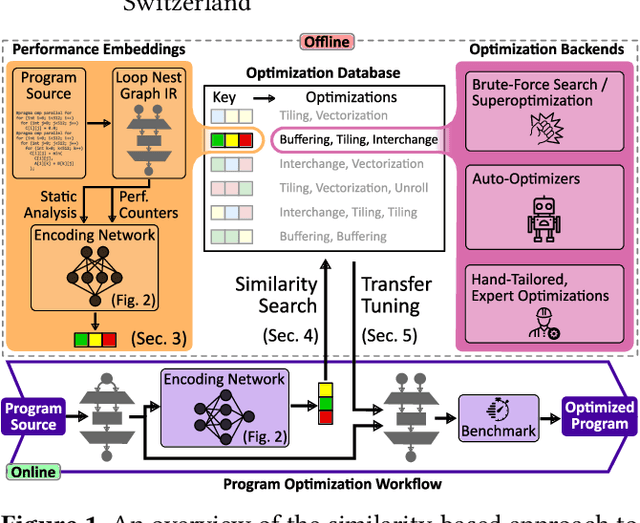
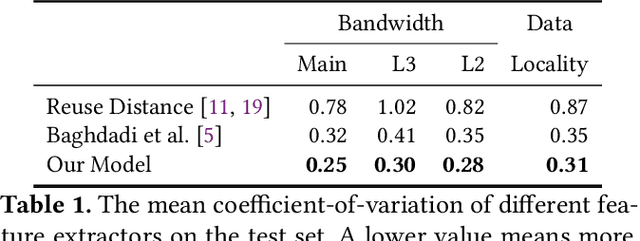
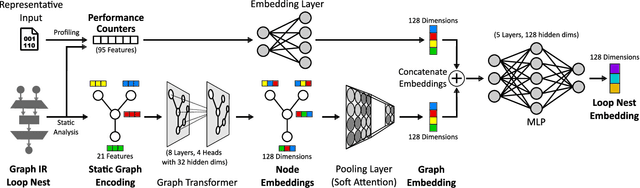
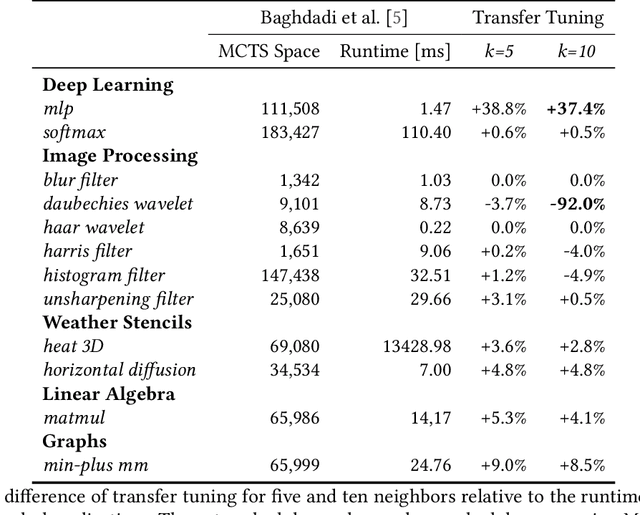
Performance optimization is an increasingly challenging but often repetitive task. While each platform has its quirks, the underlying code transformations rely on data movement and computational characteristics that recur across applications. This paper proposes to leverage those similarities by constructing an embedding space for subprograms. The continuous space captures both static and dynamic properties of loop nests via symbolic code analysis and performance profiling, respectively. Performance embeddings enable direct knowledge transfer of performance tuning between applications, which can result from autotuning or tailored improvements. We demonstrate this transfer tuning approach on case studies in deep neural networks, dense and sparse linear algebra compositions, and numerical weather prediction stencils. Transfer tuning reduces the search complexity by up to four orders of magnitude and outperforms the MKL library in sparse-dense matrix multiplication. The results exhibit clear correspondences between program characteristics and optimizations, outperforming prior specialized state-of-the-art approaches and generalizing beyond their capabilities.