 Add to Chrome
 Add to Firefox
 Add to Edge
Mind the Prompt: Self-adaptive Generation of Task Plan Explanations via LLMs
Apr 22, 2026
Integrating Large Language Models (LLMs) into complex software systems enables the generation of human-understandable explanations of opaque AI processes, such as automated task planning. However, the quality and reliability of these explanations heavily depend on effective prompt engineering. The lack of a systematic understanding of how diverse stakeholder groups formulate and refine prompts hinders the development of tools that can automate this process. We introduce COMPASS (COgnitive Modelling for Prompt Automated SynthesiS), a proof-of-concept self-adaptive approach that formalises prompt engineering as a cognitive and probabilistic decision-making process. COMPASS models unobservable users' latent cognitive states, such as attention and comprehension, uncertainty, and observable interaction cues as a POMDP, whose synthesised policy enables adaptive generation of explanations and prompt refinements. We evaluate COMPASS using two diverse cyber-physical system case studies to assess the adaptive explanation generation and their qualities, both quantitatively and qualitatively. Our results demonstrate the feasibility of COMPASS integrating human cognition and user profile's feedback into automated prompt synthesis in complex task planning systems.

Adaptive Human-Robot Collaborative Missions using Hybrid Task Planning
Apr 09, 2025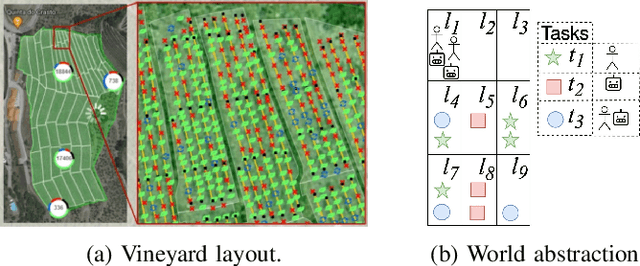
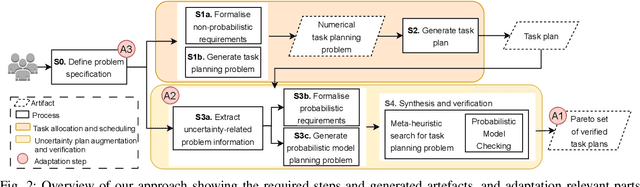


Producing robust task plans in human-robot collaborative missions is a critical activity in order to increase the likelihood of these missions completing successfully. Despite the broad research body in the area, which considers different classes of constraints and uncertainties, its applicability is confined to relatively simple problems that can be comfortably addressed by the underpinning mathematically-based or heuristic-driven solver engines. In this paper, we introduce a hybrid approach that effectively solves the task planning problem by decomposing it into two intertwined parts, starting with the identification of a feasible plan and followed by its uncertainty augmentation and verification yielding a set of Pareto optimal plans. To enhance its robustness, adaptation tactics are devised for the evolving system requirements and agents' capabilities. We demonstrate our approach through an industrial case study involving workers and robots undertaking activities within a vineyard, showcasing the benefits of our hybrid approach both in the generation of feasible solutions and scalability compared to native planners.
MULTIGAIN 2.0: MDP controller synthesis for multiple mean-payoff, LTL and steady-state constraints
May 26, 2023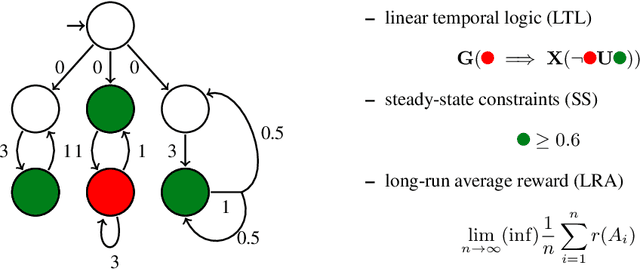

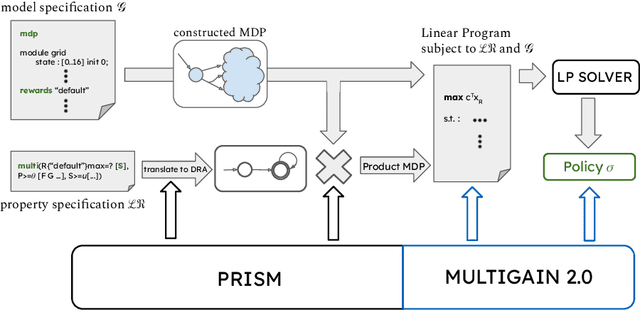
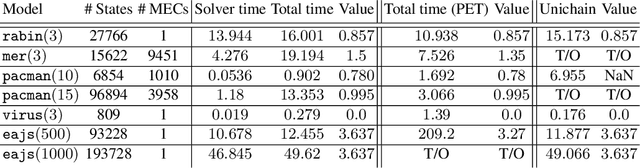
We present MULTIGAIN 2.0, a major extension to the controller synthesis tool MultiGain, built on top of the probabilistic model checker PRISM. This new version extends MultiGain's multi-objective capabilities, by allowing for the formal verification and synthesis of controllers for probabilistic systems with multi-dimensional long-run average reward structures, steady-state constraints, and linear temporal logic properties. Additionally, MULTIGAIN 2.0 provides an approach for finding finite memory solutions and the capability for two- and three-dimensional visualization of Pareto curves to facilitate trade-off analysis in multi-objective scenarios