 Add to Chrome
 Add to Firefox
 Add to Edge
M3T: Discrete Multi-Modal Motion Tokens for Sign Language Production
Mar 24, 2026
Sign language production requires more than hand motion generation. Non-manual features, including mouthings, eyebrow raises, gaze, and head movements, are grammatically obligatory and cannot be recovered from manual articulators alone. Existing 3D production systems face two barriers to integrating them: the standard body model provides a facial space too low-dimensional to encode these articulations, and when richer representations are adopted, standard discrete tokenization suffers from codebook collapse, leaving most of the expression space unreachable. We propose SMPL-FX, which couples FLAME's rich expression space with the SMPL-X body, and tokenize the resulting representation with modality-specific Finite Scalar Quantization VAEs for body, hands, and face. M3T is an autoregressive transformer trained on this multi-modal motion vocabulary, with an auxiliary translation objective that encourages semantically grounded embeddings. Across three standard benchmarks (How2Sign, CSL-Daily, Phoenix14T) M3T achieves state-of-the-art sign language production quality, and on NMFs-CSL, where signs are distinguishable only by non-manual features, reaches 58.3% accuracy against 49.0% for the strongest comparable pose baseline.

SignSparK: Efficient Multilingual Sign Language Production via Sparse Keyframe Learning
Mar 12, 2026Generating natural and linguistically accurate sign language avatars remains a formidable challenge. Current Sign Language Production (SLP) frameworks face a stark trade-off: direct text-to-pose models suffer from regression-to-the-mean effects, while dictionary-retrieval methods produce robotic, disjointed transitions. To resolve this, we propose a novel training paradigm that leverages sparse keyframes to capture the true underlying kinematic distribution of human signing. By predicting dense motion from these discrete anchors, our approach mitigates regression-to-the-mean while ensuring fluid articulation. To realize this paradigm at scale, we first introduce FAST, an ultra-efficient sign segmentation model that automatically mines precise temporal boundaries. We then present SignSparK, a large-scale Conditional Flow Matching (CFM) framework that utilizes these extracted anchors to synthesize 3D signing sequences in SMPL-X and MANO spaces. This keyframe-driven formulation also uniquely unlocks Keyframe-to-Pose (KF2P) generation, making precise spatiotemporal editing of signing sequences possible. Furthermore, our adopted reconstruction-based CFM objective also enables high-fidelity synthesis in fewer than ten sampling steps; this allows SignSparK to scale across four distinct sign languages, establishing the largest multilingual SLP framework to date. Finally, by integrating 3D Gaussian Splatting for photorealistic rendering, we demonstrate through extensive evaluation that SignSparK establishes a new state-of-the-art across diverse SLP tasks and multilingual benchmarks.
VisualSpeaker: Visually-Guided 3D Avatar Lip Synthesis
Jul 08, 2025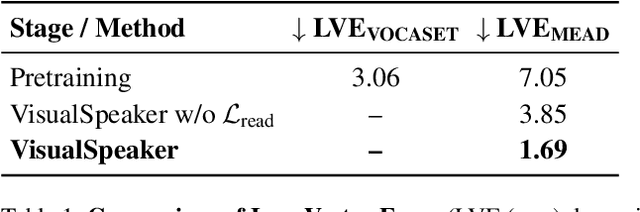
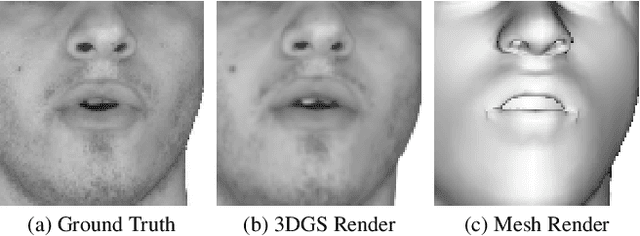
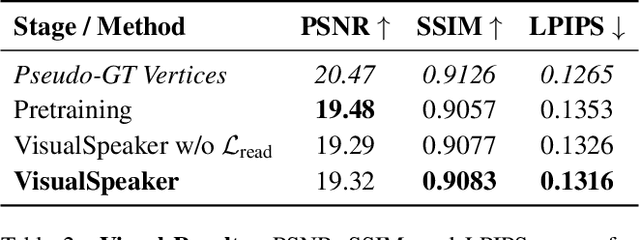
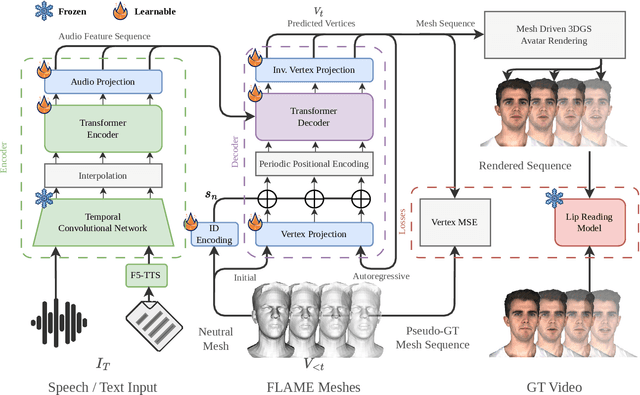
Realistic, high-fidelity 3D facial animations are crucial for expressive avatar systems in human-computer interaction and accessibility. Although prior methods show promising quality, their reliance on the mesh domain limits their ability to fully leverage the rapid visual innovations seen in 2D computer vision and graphics. We propose VisualSpeaker, a novel method that bridges this gap using photorealistic differentiable rendering, supervised by visual speech recognition, for improved 3D facial animation. Our contribution is a perceptual lip-reading loss, derived by passing photorealistic 3D Gaussian Splatting avatar renders through a pre-trained Visual Automatic Speech Recognition model during training. Evaluation on the MEAD dataset demonstrates that VisualSpeaker improves both the standard Lip Vertex Error metric by 56.1% and the perceptual quality of the generated animations, while retaining the controllability of mesh-driven animation. This perceptual focus naturally supports accurate mouthings, essential cues that disambiguate similar manual signs in sign language avatars.