 Add to Chrome
 Add to Firefox
 Add to Edge
Top-$k$ Pareto Bandits: Hypervolume Regret for Multi-Objective Slate Selection
Jul 28, 2026
We consider a stochastic multi-objective bandit problem where, at each round, the agent selects a slate of $k$ arms and observes their $d$-dimensional reward vectors under semi-bandit feedback. We do not aim at identifying a single optimal arm; instead, we consider the problem of maintaining a small set of actions that jointly approximate the Pareto frontier. We formalize this objective through the dominated hypervolume induced by the selected subset of arms, and define an $α$-approximate hypervolume regret with respect to the best size-$k$ subset achievable in hindsight, where $α= 1 - 1/e$ reflects the approximation guarantee of greedy maximization for monotone submodular functions. To address this problem, we introduce \textit{THV-UCB}, an optimistic algorithm that selects arms greedily based on optimistic estimates of their marginal hypervolume contributions. We establish a gap-free regret bound $\tilde{O}(d\sqrt{nkT})$ that holds on every instance, together with a gap-dependent bound $\tilde{O}(nk^{2.5}/Δ_{\min})$ that becomes polylogarithmic in $T$ once the arms are sufficiently well separated. Our results provide theoretical support for using small subsets to approximate Pareto fronts in various multi-objective applications.

Partial Bandit and Semi-Bandit: Making the Most Out of Scarce Users' Feedback
Sep 16, 2020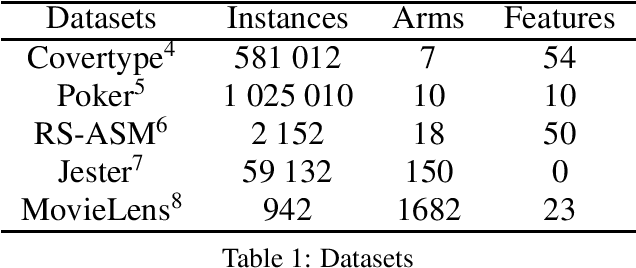
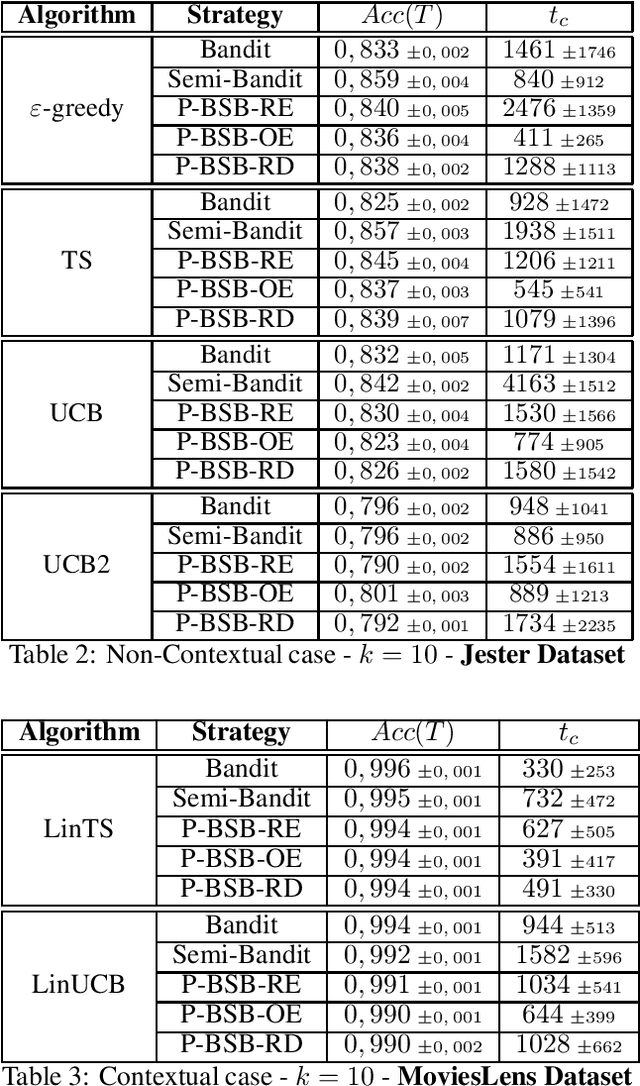
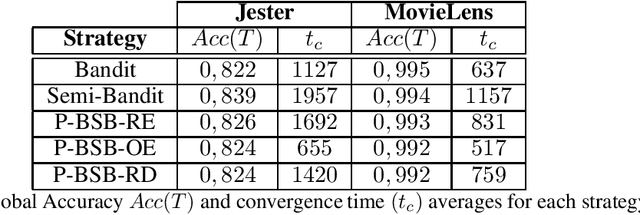
Recent works on Multi-Armed Bandits (MAB) and Combinatorial Multi-Armed Bandits (COM-MAB) show good results on a global accuracy metric. This can be achieved, in the case of recommender systems, with personalization. However, with a combinatorial online learning approach, personalization implies a large amount of user feedbacks. Such feedbacks can be hard to acquire when users need to be directly and frequently solicited. For a number of fields of activities undergoing the digitization of their business, online learning is unavoidable. Thus, a number of approaches allowing implicit user feedback retrieval have been implemented. Nevertheless, this implicit feedback can be misleading or inefficient for the agent's learning. Herein, we propose a novel approach reducing the number of explicit feedbacks required by Combinatorial Multi Armed bandit (COM-MAB) algorithms while providing similar levels of global accuracy and learning efficiency to classical competitive methods. In this paper we present a novel approach for considering user feedback and evaluate it using three distinct strategies. Despite a limited number of feedbacks returned by users (as low as 20% of the total), our approach obtains similar results to those of state of the art approaches.