 Add to Chrome
 Add to Firefox
 Add to Edge
Therapist-Robot-Patient Physical Interaction is Worth a Thousand Words: Enabling Intuitive Therapist Guidance via Remote Haptic Control
Feb 25, 2026
Robotic systems can enhance the amount and repeatability of physically guided motor training. Yet their real-world adoption is limited, partly due to non-intuitive trainer/therapist-trainee/patient interactions. To address this gap, we present a haptic teleoperation system for trainers to remotely guide and monitor the movements of a trainee wearing an arm exoskeleton. The trainer can physically interact with the exoskeleton through a commercial handheld haptic device via virtual contact points at the exoskeleton's elbow and wrist, allowing intuitive guidance. Thirty-two participants tested the system in a trainer-trainee paradigm, comparing our haptic demonstration system with conventional visual demonstration in guiding trainees in executing arm poses. Quantitative analyses showed that haptic demonstration significantly reduced movement completion time and improved smoothness, while speech analysis using large language models for automated transcription and categorization of verbal commands revealed fewer verbal instructions. The haptic demonstration did not result in higher reported mental and physical effort by trainers compared to the visual demonstration, while trainers reported greater competence and trainees lower physical demand. These findings support the feasibility of our proposed interface for effective remote human-robot physical interaction. Future work should assess its usability and efficacy for clinical populations in restoring clinicians' sense of agency during robot-assisted therapy.

Tactile Weight Rendering: A Review for Researchers and Developers
Feb 20, 2024Haptic rendering of weight plays an essential role in naturalistic object interaction in virtual environments. While kinesthetic devices have traditionally been used for this aim by applying forces on the limbs, tactile interfaces acting on the skin have recently offered potential solutions to enhance or substitute kinesthetic ones. Here, we aim to provide an in-depth overview and comparison of existing tactile weight rendering approaches. We categorized these approaches based on their type of stimulation into asymmetric vibration and skin stretch, further divided according to the working mechanism of the devices. Then, we compared these approaches using various criteria, including physical, mechanical, and perceptual characteristics of the reported devices and their potential applications. We found that asymmetric vibration devices have the smallest form factor, while skin stretch devices relying on the motion of flat surfaces, belts, or tactors present numerous mechanical and perceptual advantages for scenarios requiring more accurate weight rendering. Finally, we discussed the selection of the proposed categorization of devices and their application scopes, together with the limitations and opportunities for future research. We hope this study guides the development and use of tactile interfaces to achieve a more naturalistic object interaction and manipulation in virtual environments.
Design and evaluation of a multi-finger skin-stretch tactile interface for hand rehabilitation robots
Feb 19, 2024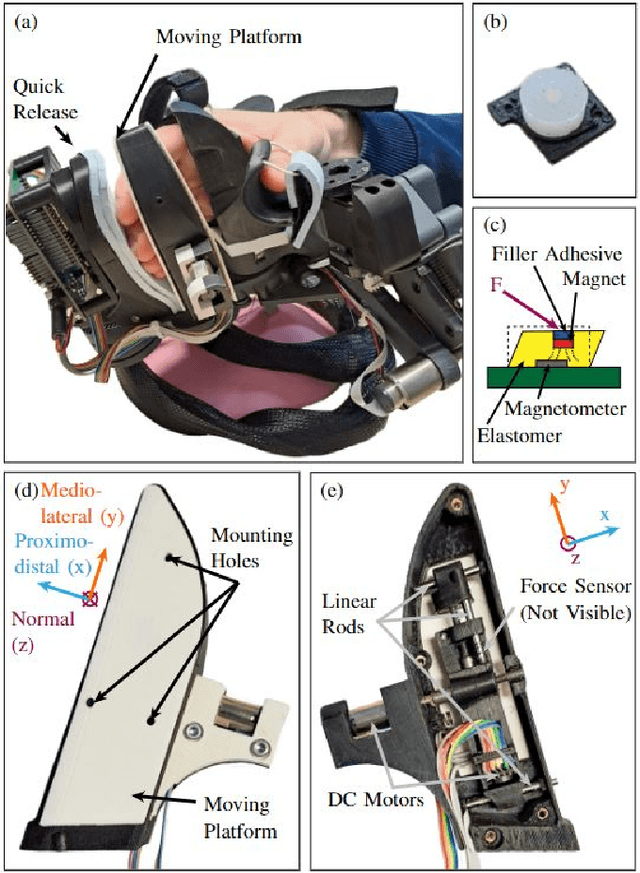
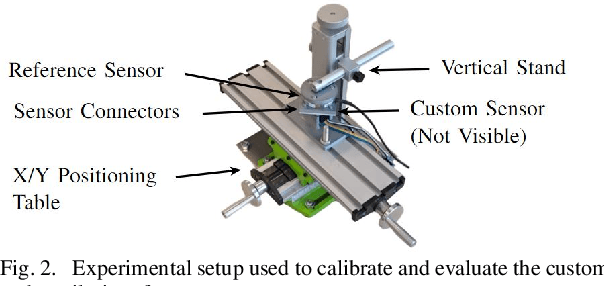
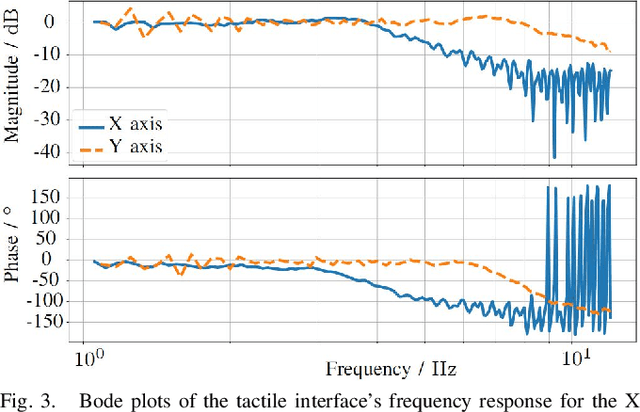
Object properties perceived through the tactile sense, such as weight, friction, and slip, greatly influence motor control during manipulation tasks. However, the provision of tactile information during robotic training in neurorehabilitation has not been well explored. Therefore, we designed and evaluated a tactile interface based on a two-degrees-of-freedom moving platform mounted on a hand rehabilitation robot that provides skin stretch at four fingertips, from the index through the little finger. To accurately control the rendered forces, we included a custom magnetic-based force sensor to control the tactile interface in a closed loop. The technical evaluation showed that our custom force sensor achieved measurable shear forces of +-8N with accuracies of 95.2-98.4% influenced by hysteresis, viscoelastic creep, and torsional deformation. The tactile interface accurately rendered forces with a step response steady-state accuracy of 97.5-99.4% and a frequency response in the range of most activities of daily living. Our sensor showed the highest measurement-range-to-size ratio and comparable accuracy to sensors of its kind. These characteristics enabled the closed-loop force control of the tactile interface for precise rendering of multi-finger two-dimensional skin stretch. The proposed system is a first step towards more realistic and rich haptic feedback during robotic sensorimotor rehabilitation, potentially improving therapy outcomes.