 Add to Chrome
 Add to Firefox
 Add to Edge
Gotta Catch them all: the modes of Sycophancy
Jul 22, 2026
Large language models often align with users' beliefs at the expense of factual accuracy, a behavior known as sycophancy. Prior mechanistic studies largely treat sycophancy as a single behavioral dimension that can be uniformly amplified or suppressed. We challenge this assumption by analyzing three hypothesized modes of sycophancy across 948 social pressure situations. Although the modes produce highly similar outputs, with a text-only classifier achieving just 57.8 percent accuracy, their internal representations are perfectly linearly separable from layer 14 onward. We further find the modes emerge at different processing stages, rely on distinct attention circuitry, and fire strongest on different inputs. These results show that sycophancy is not a monolithic tendency, but a structured family of representationally and computationally distinct modes, motivating more precise measurement and intervention.

Sycophancy as compositions of Atomic Psychometric Traits
Aug 26, 2025
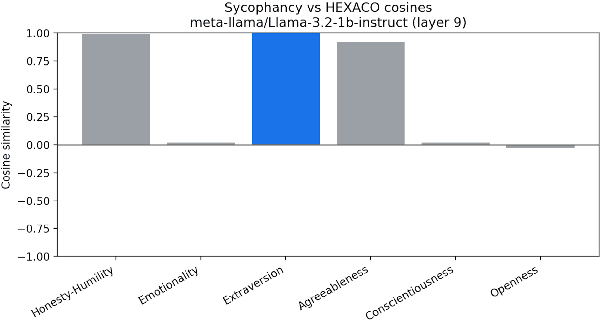
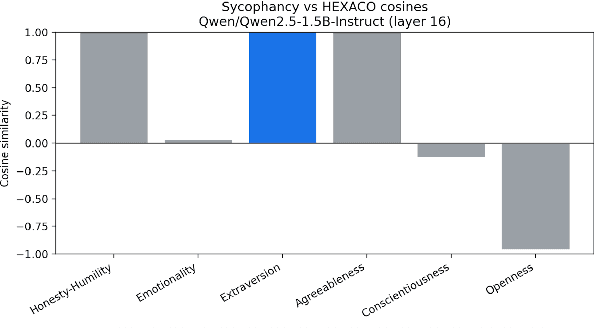

Sycophancy is a key behavioral risk in LLMs, yet is often treated as an isolated failure mode that occurs via a single causal mechanism. We instead propose modeling it as geometric and causal compositions of psychometric traits such as emotionality, openness, and agreeableness - similar to factor decomposition in psychometrics. Using Contrastive Activation Addition (CAA), we map activation directions to these factors and study how different combinations may give rise to sycophancy (e.g., high extraversion combined with low conscientiousness). This perspective allows for interpretable and compositional vector-based interventions like addition, subtraction and projection; that may be used to mitigate safety-critical behaviors in LLMs.