 Add to Chrome
 Add to Firefox
 Add to Edge
An Affordable,Wearable Stereo-Eye-Tracking Platform
Apr 27, 2026
Research on video-based eye-tracking has long explored stereo and glint-based methods, yet existing wearable eye trackers - both commercial and open-source - offer limited flexibility for algorithm development and comparative evaluation. We present an affordable, wearable stereo eye-tracking platform built from off-the-shelf and 3D-printable components that explicitly targets this gap. The system combines four infrared eye cameras, infrared illumination, an optional scene camera, and software support for calibration and synchronized data acquisition. By design, the platform supports multiple eye-tracking paradigms, including stereo, glint-based, and binocular approaches, within a single hardware configuration. Rather than optimizing for end-user robustness, the platform prioritizes modularity and extensibility for research use. This paper focuses on the hardware architecture and calibration pipeline and demonstrates the feasibility of the approach using a prototype implementation. All hardware designs and documentation are made openly available.

A Novel Signal Processing Strategy for Short-Range Laser Feedback Interferometry Sensors
Jun 12, 2025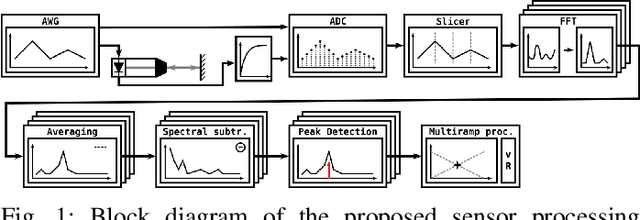
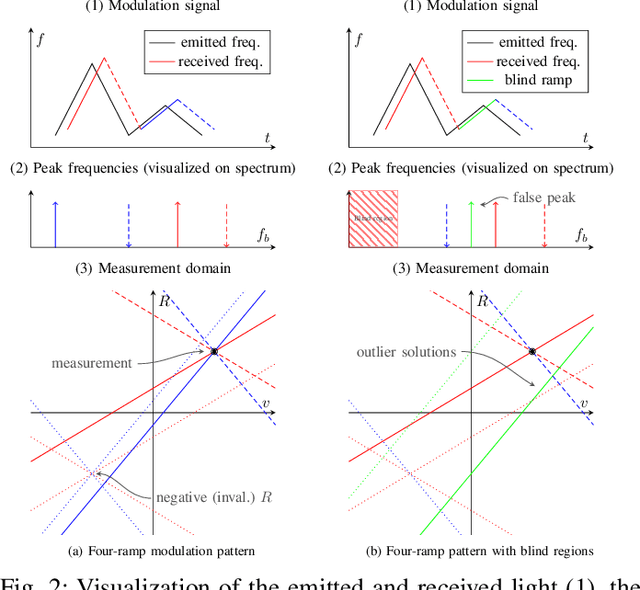
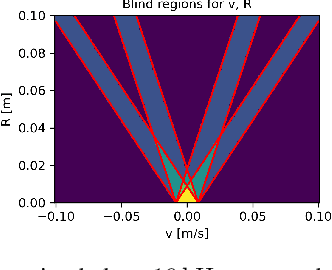
The rapid evolution of wearable technologies, such as AR glasses, demands compact, energy-efficient sensors capable of high-precision measurements in dynamic environments. Traditional Frequency-Modulated Continuous Wave (FMCW) Laser Feedback Interferometry (LFI) sensors, while promising, falter in applications that feature small distances, high velocities, shallow modulation, and low-power constraints. We propose a novel sensor-processing pipeline that reliably extracts distance and velocity measurements at distances as low as 1 cm. As a core contribution, we introduce a four-ramp modulation scheme that resolves persistent ambiguities in beat frequency signs and overcomes spectral blind regions caused by hardware limitations. Based on measurements of the implemented pipeline, a noise model is defined to evaluate its performance and sensitivity to several algorithmic and working point parameters. We show that the pipeline generally achieves robust and low-noise measurements using state-of-the-art hardware.