 Add to Chrome
 Add to Firefox
 Add to Edge
Decision-Value Attribution in Predict-then-Optimize Systems
Jun 29, 2026
Predictive models are increasingly embedded in operational decision-making, yet standard explanation methods typically explain forecasts rather than the decisions those forecasts induce. This distinction is important in predict-then-optimize systems: large forecast changes may leave the optimizer's action unchanged, while small changes can alter the selected decision and its realized value. We propose Decision Value Attribution (DVA), a Shapley-based framework for attributing the value of a fixed prediction--optimization pipeline. The framework defines cooperative games whose payoff is the downstream decision value, allowing the players to be information sources, optimization or design parameters, or both. We present three variants: InfoDVA attributes value to features, DesignDVA attributes value to operational configurations, and Decision-Value Interactions (DVI) quantifies how information and design jointly create value. We further distinguish post-DVA, which evaluates decisions using realized outcomes, from pre-DVA, which evaluates decisions under the model's full prediction. This separation turns attribution into a decision-level diagnostic of whether the model's operational beliefs align with realized performance. The resulting attributions are expressed in the units of the operational objective and decompose the gain or loss relative to a baseline. Case studies in electricity storage arbitrage and emergency medical service coverage show that predictive explanations can be poor proxies for operational value, that DVA can guide targeted information-control interventions, and that optimization configurations determine when predictive information is decision-relevant.

Decision-Focused Federated Learning Under Heterogeneous Objectives and Constraints
Apr 21, 2026We consider what we refer to as {Decision-Focused Federated Learning (DFFL)} framework, i.e., a predict-then-optimize approach employed by a collection of agents, where each agent's predictive model is an input to a downstream linear optimization problem, and no direct exchange of raw data is allowed. Importantly, clients can differ both in objective functions and in feasibility constraints. We build on the well-known SPO+ approach and develop heterogeneity bounds for the SPO+ surrogate loss in this case. This is accomplished by employing a support function representation of the feasible region, separating (i) objective shift via norm distances between the cost vectors and (ii) feasible-set shift via shape distances between the constraint sets. In the case of strongly convex feasible regions, sharper bounds are derived due to the optimizer stability. Building on these results, we define a heuristic local-versus-federated excess risk decision rule which, under SPO+ risk, gives a condition for when federation can be expected to improve decision quality: the heterogeneity penalty must be smaller than the statistical advantage of pooling data. We implement a FedAvg-style DFFL set of experiments on both polyhedral and strongly convex problems and show that federation is broadly robust in the strongly convex setting, while performance in the polyhedral setting degrades primarily with constraint heterogeneity, especially for clients with many samples. In other words, especially for the strongly convex case, an approach following a direct implementation of FedAvg and SPO+ can still yield promising performance even when the downstream optimization problems are noticeably different.
Predictive machine learning for prescriptive applications: a coupled training-validating approach
Oct 22, 2021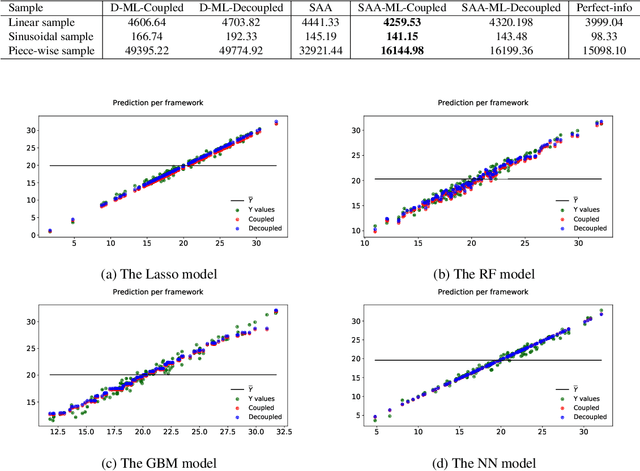


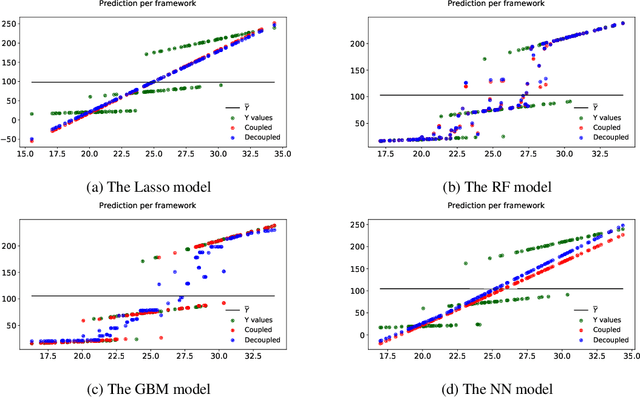
In this research we propose a new method for training predictive machine learning models for prescriptive applications. This approach, which we refer to as coupled validation, is based on tweaking the validation step in the standard training-validating-testing scheme. Specifically, the coupled method considers the prescription loss as the objective for hyper-parameter calibration. This method allows for intelligent introduction of bias in the prediction stage to improve decision making at the prescriptive stage, and is generally applicable to most machine learning methods, including recently proposed hybrid prediction-stochastic-optimization techniques, and can be easily implemented without model-specific mathematical modeling. Several experiments with synthetic and real data demonstrate promising results in reducing the prescription costs in both deterministic and stochastic models.
Benchmarking Graph Neural Networks on Link Prediction
Feb 24, 2021
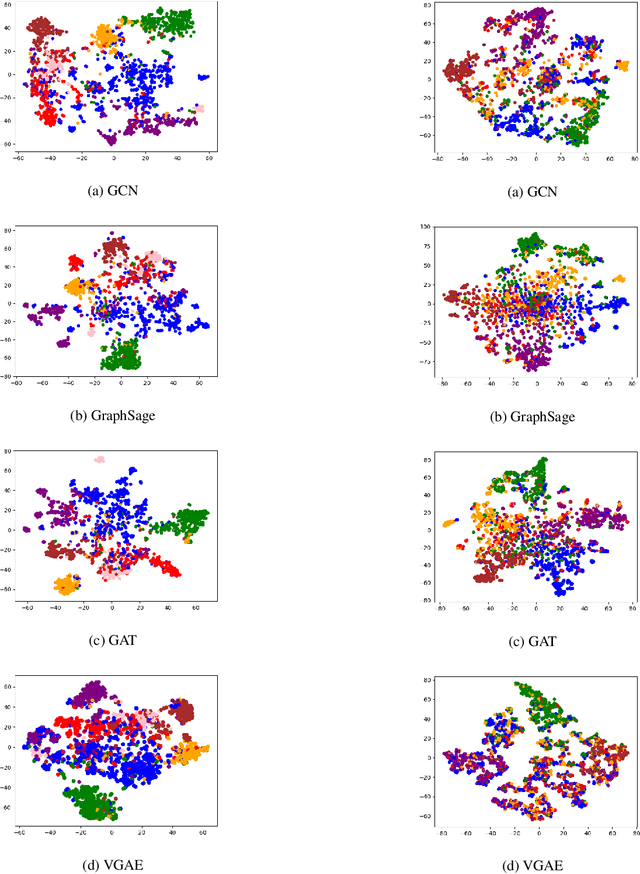

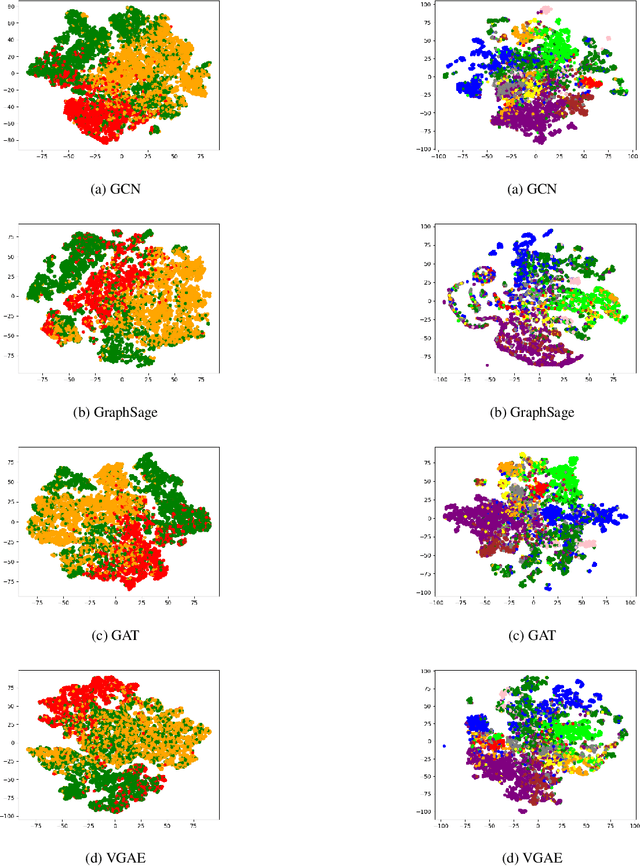
In this paper, we benchmark several existing graph neural network (GNN) models on different datasets for link predictions. In particular, the graph convolutional network (GCN), GraphSAGE, graph attention network (GAT) as well as variational graph auto-encoder (VGAE) are implemented dedicated to link prediction tasks, in-depth analysis are performed, and results from several different papers are replicated, also a more fair and systematic comparison are provided. Our experiments show these GNN architectures perform similarly on various benchmarks for link prediction tasks.
Reannealing of Decaying Exploration Based On Heuristic Measure in Deep Q-Network
Sep 29, 2020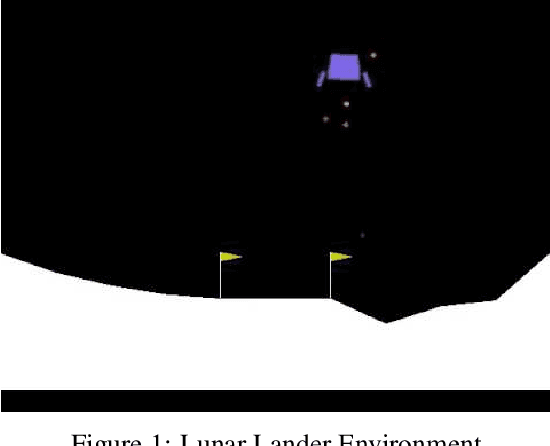
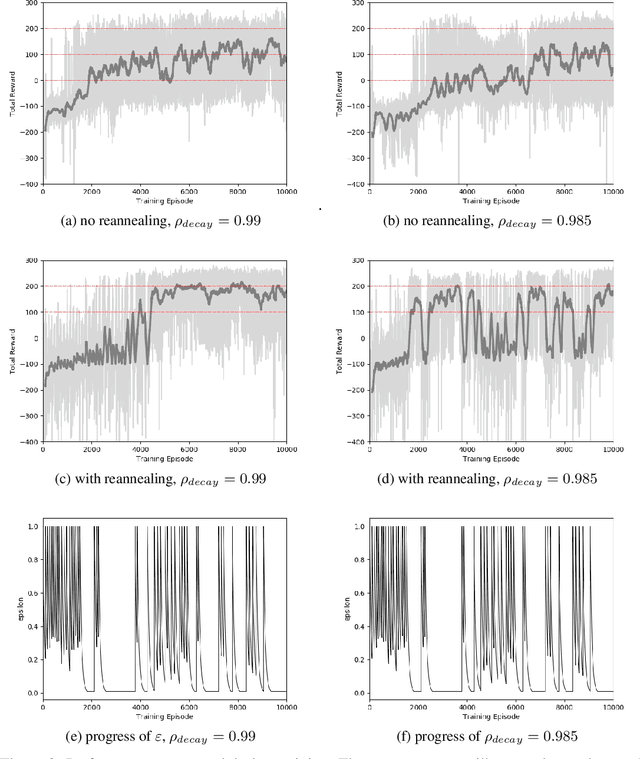
Existing exploration strategies in reinforcement learning (RL) often either ignore the history or feedback of search, or are complicated to implement. There is also a very limited literature showing their effectiveness over diverse domains. We propose an algorithm based on the idea of reannealing, that aims at encouraging exploration only when it is needed, for example, when the algorithm detects that the agent is stuck in a local optimum. The approach is simple to implement. We perform an illustrative case study showing that it has potential to both accelerate training and obtain a better policy.
Cross Learning in Deep Q-Networks
Sep 29, 2020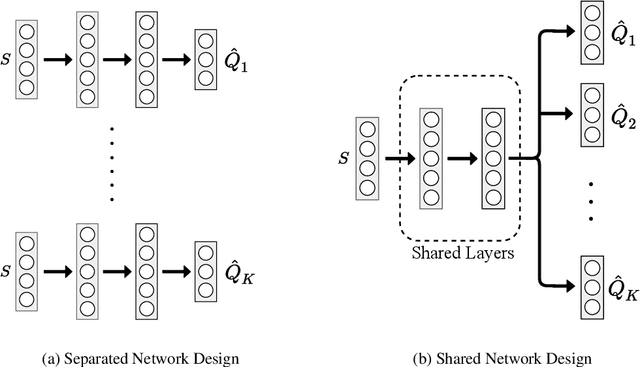
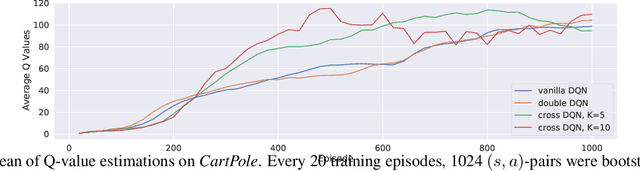
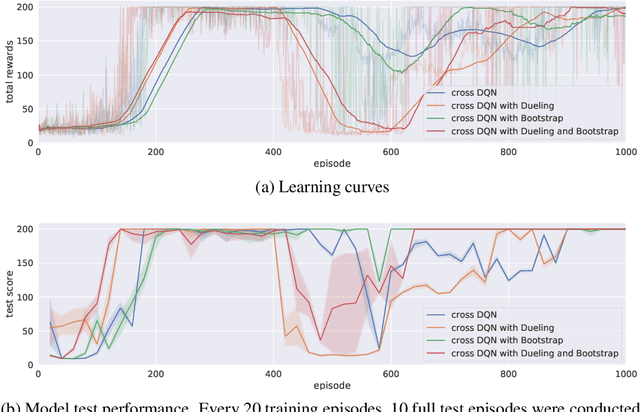
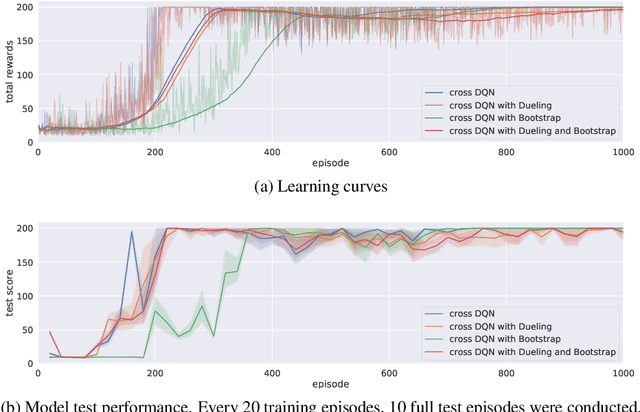
In this work, we propose a novel cross Q-learning algorithm, aim at alleviating the well-known overestimation problem in value-based reinforcement learning methods, particularly in the deep Q-networks where the overestimation is exaggerated by function approximation errors. Our algorithm builds on double Q-learning, by maintaining a set of parallel models and estimate the Q-value based on a randomly selected network, which leads to reduced overestimation bias as well as the variance. We provide empirical evidence on the advantages of our method by evaluating on some benchmark environment, the experimental results demonstrate significant improvement of performance in reducing the overestimation bias and stabilizing the training, further leading to better derived policies.