 Add to Chrome
 Add to Firefox
 Add to Edge
GONDOR to the Rescue: Satisficing Planning with Low Memory
May 27, 2026
Greedy Best-First Search (GBFS) is the dominant approach for solving search problems where the goal can be estimated with a heuristic, such as planning, route finding, navigation, and pathfinding. This is especially true when the memory is tightly constrained, such as planning on edge devices. To alleviate that, we present GONDOR (Greedy Online Navigation with Dynamic Outpost-based Re-search), a memory-efficient extension of GBFS that allows search to continue under strict memory limits by periodically compressing the search tree while retaining a sparse set of anchor states, then upon reaching the goal reconstructs the path by re-searching between the sparse states. We analyze the algorithm and discuss several variants defined by different outpost selection policies. In addition, we explore using Bloom filters for compact duplicate detection in the closed list. Experiments across numeric planning domains and heuristic configurations show that GONDOR consistently improves coverage under low memory budgets compared to standard GBFS. We release the implementation of GONDOR and the Bloom-filter variant to facilitate further research on memory-efficient heuristic search.

Personalized Medication Planning via Direct Domain Modeling and LLM-Generated Heuristics
Jan 07, 2026Personalized medication planning involves selecting medications and determining a dosing schedule to achieve medical goals specific to each individual patient. Previous work successfully demonstrated that automated planners, using general domain-independent heuristics, are able to generate personalized treatments, when the domain and problems are modeled using a general domain description language (\pddlp). Unfortunately, this process was limited in practice to consider no more than seven medications. In clinical terms, this is a non-starter. In this paper, we explore the use of automatically-generated domain- and problem-specific heuristics to be used with general search, as a method of scaling up medication planning to levels allowing closer work with clinicians. Specifically, we specify the domain programmatically (specifying an initial state and a successor generation procedure), and use an LLM to generate a problem specific heuristic that can be used by a fixed search algorithm (GBFS). The results indicate dramatic improvements in coverage and planning time, scaling up the number of medications to at least 28, and bringing medication planning one step closer to practical applications.
LLM-Generated Heuristics for AI Planning: Do We Even Need Domain-Independence Anymore?
Jan 30, 2025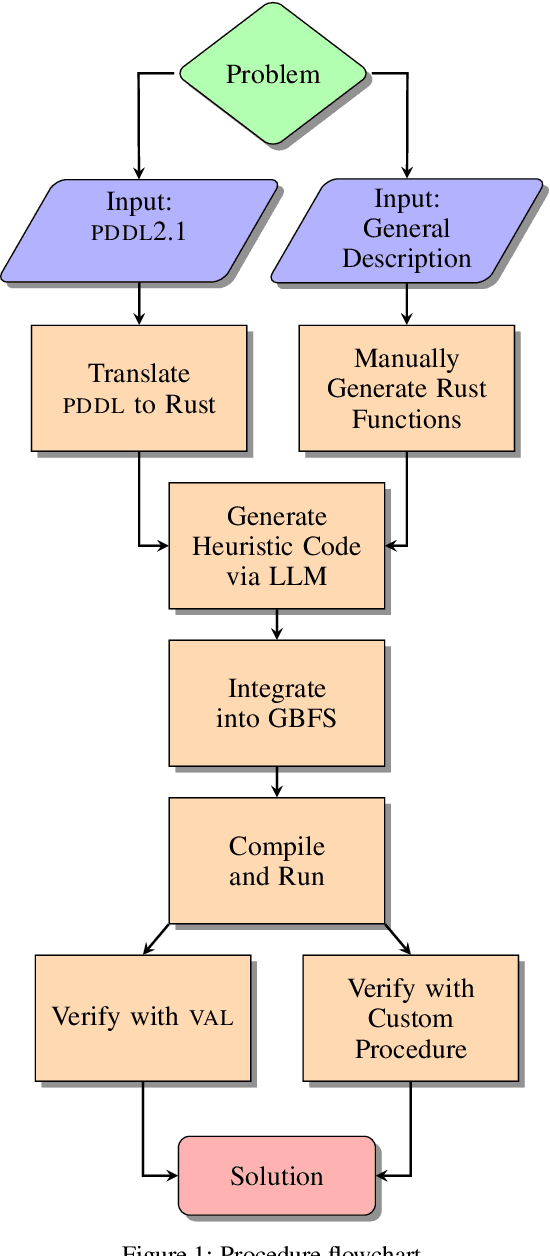
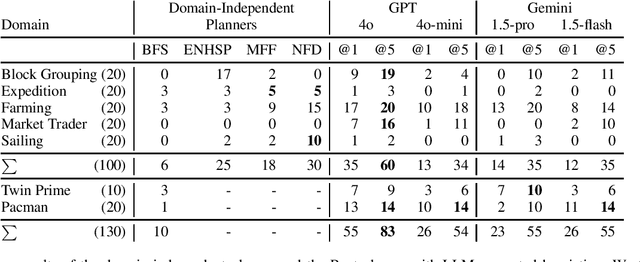
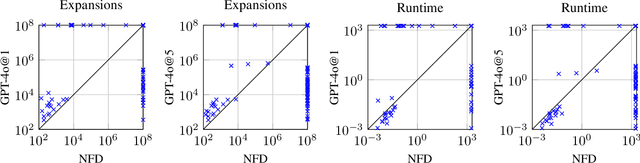

Domain-independent heuristics have long been a cornerstone of AI planning, offering general solutions applicable across a wide range of tasks without requiring domain-specific engineering. However, the advent of large language models (LLMs) presents an opportunity to generate heuristics tailored to specific planning problems, potentially challenging the necessity of domain independence as a strict design principle. In this paper, we explore the use of LLMs to automatically derive planning heuristics from task descriptions represented as successor generators and goal tests written in general purpose programming language. We investigate the trade-offs between domain-specific LLM-generated heuristics and traditional domain-independent methods in terms of computational efficiency and explainability. Our experiments demonstrate that LLMs can create heuristics that achieve state-of-the-art performance on some standard IPC domains, as well as their ability to solve problems that lack an adequate Planning Domain Definition Language ({\sc pddl}) representation. We discuss whether these results signify a paradigm shift and how they can complement existing approaches.