 Add to Chrome
 Add to Firefox
 Add to Edge
Accelerating NeurASP with vectorization and caching
Jun 09, 2026
Neurosymbolic AI combines neural networks with symbolic programs to create robust and explainable predictions. One such framework is NeurASP, which trains a neural network to predict concepts and reasons over them using rules written in answer set programming (ASP) to solve downstream tasks. Crucially, labels are only provided for the downstream prediction produced by the symbolic rules, not for the latent concepts themselves.Backpropagation through the non-differentiable ASP component requires expensive probability and gradient calculations, which has hindered scalability to more sophisticated tasks.In this paper, we address the current limitations of NeurASP by improving its computational performance through vectorization, batch processing and caching of intermediate computations during training. We compare computation speeds between the original and our new implementation of NeurASP and report speedups of multiple orders of magnitude for larger tasks. To this end, we propose a new dataset of difficult tasks involving playing cards, which we use to test the capabilities of NeurASP's enhanced learning function.

Learning Implicitly with Noisy Data in Linear Arithmetic
Oct 23, 2020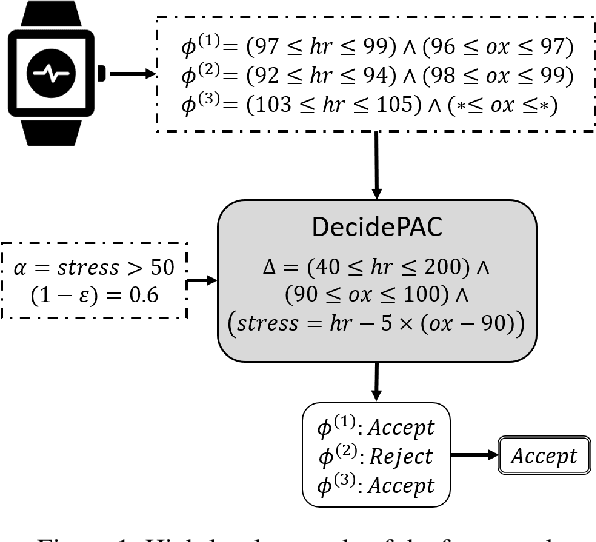
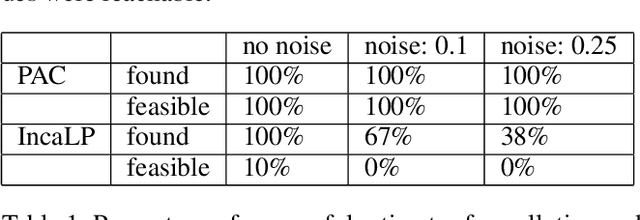
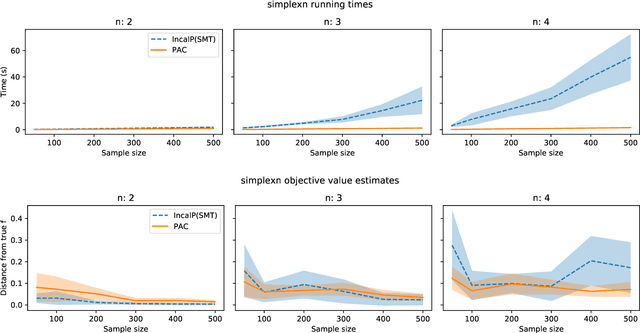
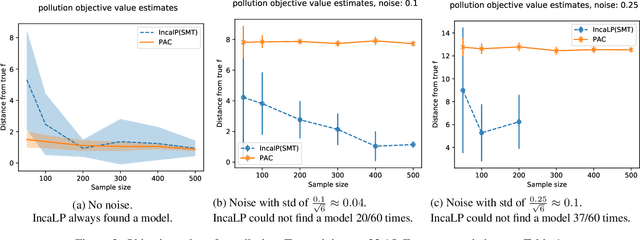
Robustly learning in expressive languages with real-world data continues to be a challenging task. Numerous conventional methods appeal to heuristics without any assurances of robustness. While PAC-Semantics offers strong guarantees, learning explicit representations is not tractable even in a propositional setting. However, recent work on so-called "implicit" learning has shown tremendous promise in terms of obtaining polynomial-time results for fragments of first-order logic. In this work, we extend implicit learning in PAC-Semantics to handle noisy data in the form of intervals and threshold uncertainty in the language of linear arithmetic. We prove that our extended framework keeps the existing polynomial-time complexity guarantees. Furthermore, we provide the first empirical investigation of this hitherto purely theoretical framework. Using benchmark problems, we show that our implicit approach to learning optimal linear programming objective constraints significantly outperforms an explicit approach in practice.