 Add to Chrome
 Add to Firefox
 Add to Edge
Evaluating the Deformation Measurement Accuracy Using Low-SNR Radars for Future InSAR Missions
Dec 09, 2025
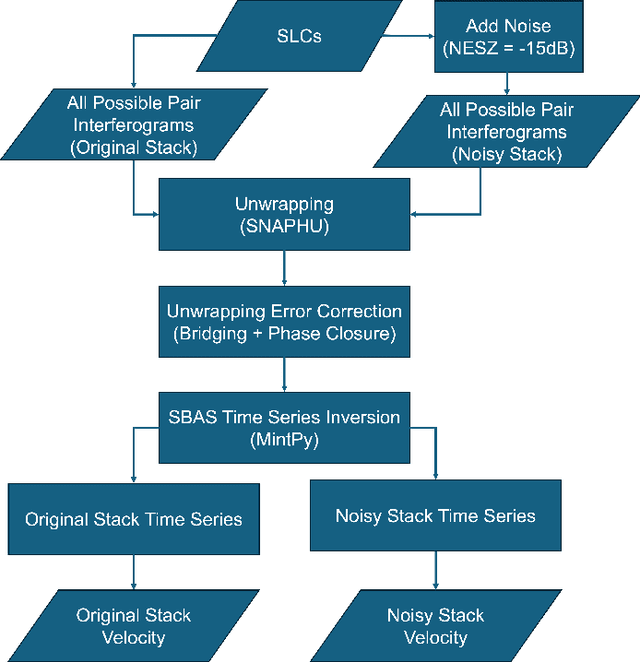
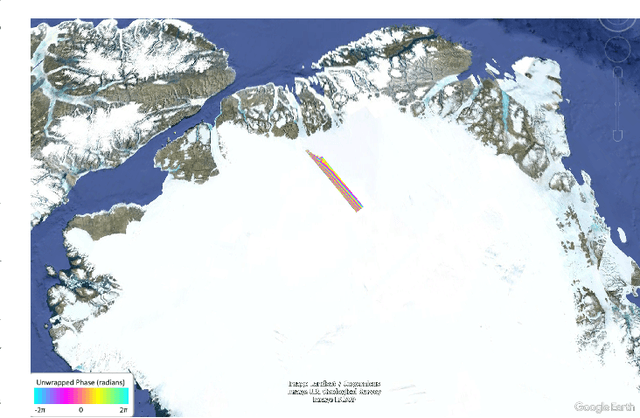
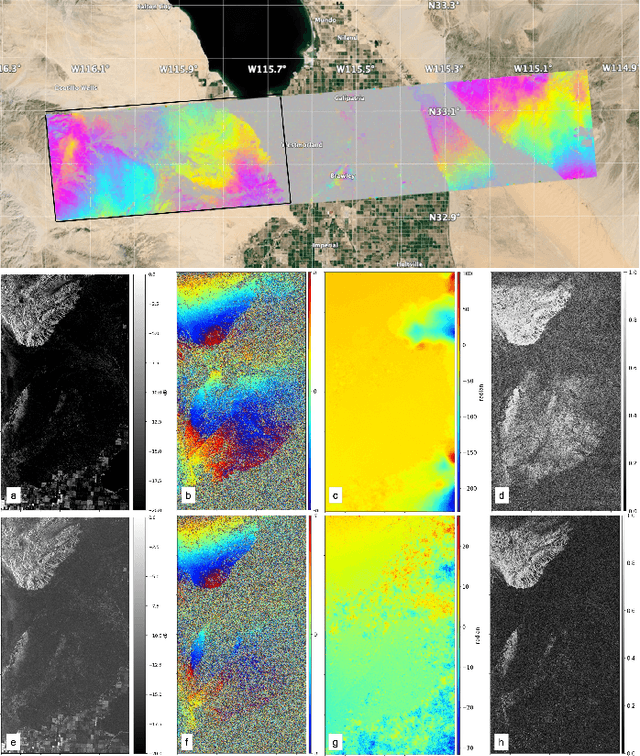
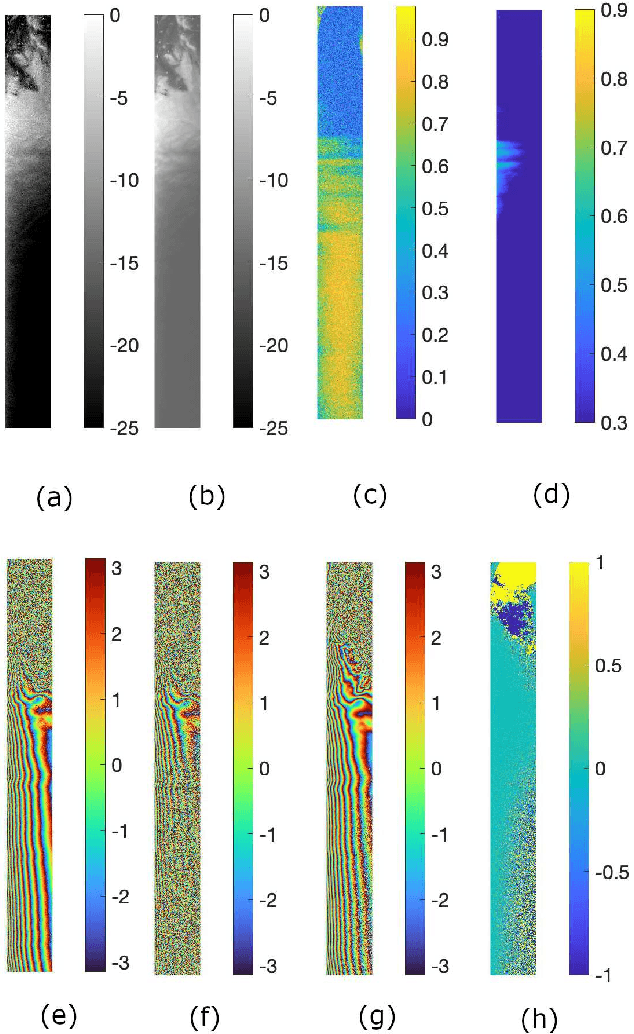
Interferometric Synthetic Aperture Radar (InSAR) is a powerful tool for monitoring surface deformation with high precision. However, low Signal-to-Noise Ratio (SNR) conditions, common in regions with low backscatter, can degrade phase coherence and compromise displacement accuracy. In this study, we quantify the impact of low-SNR conditions on InSAR-derived displacement using L-band UAVSAR data collected over the San Andreas Fault and Greenland ice sheet. We simulate low-SNR conditions by degrading the Noise-Equivalent Sigma Zero (NESZ) to $-15~\mathrm{dB}$ and assess the resulting effects on interferometric coherence, phase unwrapping, and time series inversion. The displacement accuracy of 4mm in single interferogram can be achieved by taking looks for the signal decorrelation of 0.6 and SNR between -9dB to -10dB. Our findings indicate that even under low-SNR conditions, a velocity precision of $0.5~\mathrm{cm/yr}$ can be achieved in comparison to high-SNR conditions. By applying multilooking with an 8x8 window, we significantly improve coherence and eliminate this bias, demonstrating that low-SNR systems can achieve comparable precision to high-SNR systems at the expense of spatial resolution. These results have important implications for the design of future cost-effective SAR missions, such as Surface Deformation and Change (SDC), and the optimization of InSAR processing techniques in challenging environments.

Near-Real-Time InSAR Phase Estimation for Large-Scale Surface Displacement Monitoring
Nov 15, 2025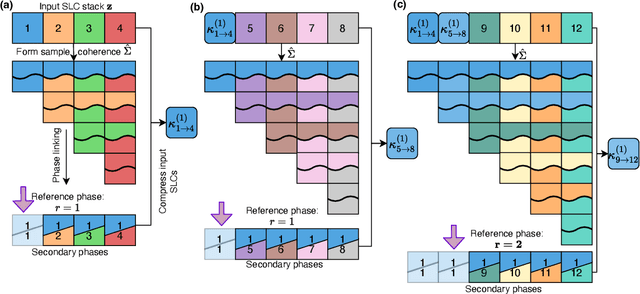
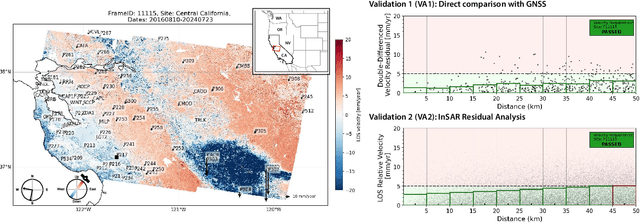
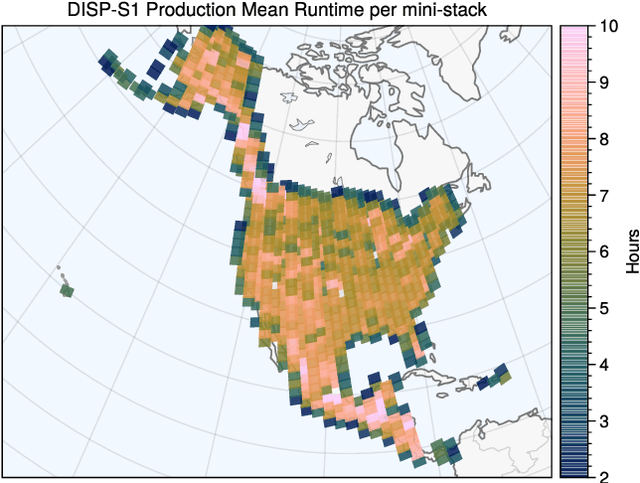
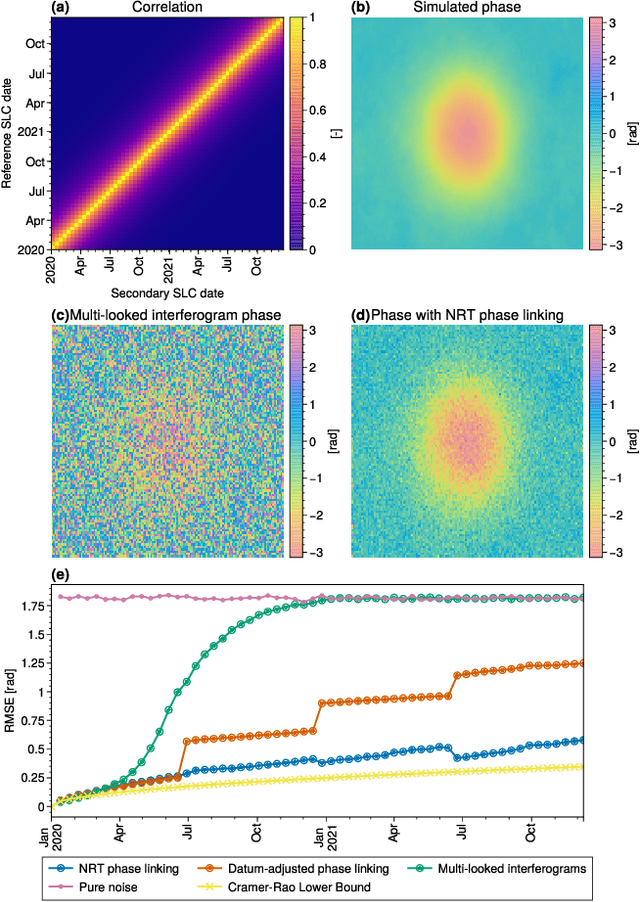
Operational near-real-time monitoring of Earth's surface deformation using Interferometric Synthetic Aperture Radar (InSAR) requires processing algorithms that efficiently incorporate new acquisitions without reprocessing historical archives. We present sequential phase linking approach using compressed single-look-complex images (SLCs) capable of producing surface displacement estimates within hours of the time of a new acquisition. Our key algorithmic contribution is a mini-stack reference scheme that maintains phase consistency across processing batches without adjusting or re-estimating previous time steps, enabling straightforward operational deployment. We introduce online methods for persistent and distributed scatterer identification that adapt to temporal changes in surface properties through incremental amplitude statistics updates. The processing chain incorporates multiple complementary metrics for pixel quality that are reliable for small SLC stack sizes, and an L1-norm network inversion to limit propagation of unwrapping errors across the time series. We use our algorithm to produce OPERA Surface Displacement from Sentinel-1 product, the first continental-scale surface displacement product over North America. Validation against GPS measurements and InSAR residual analysis demonstrates millimeter-level agreement in velocity estimates in varying environmental conditions. We demonstrate our algorithm's capabilities with a successful recovery of meter-scale co-eruptive displacement at Kilauea volcano during the 2018 eruption, as well as detection of subtle uplift at Three Sisters volcano, Oregon- a challenging environment for C-band InSAR due to dense vegetation and seasonal snow. We have made all software available as open source libraries, providing a significant advancement to the open scientific community's ability to process large InSAR data sets in a cloud environment.