 Add to Chrome
 Add to Firefox
 Add to Edge
Online Monitoring Framework for Automotive Time Series Data using JEPA Embeddings
Feb 10, 2026
As autonomous vehicles are rolled out, measures must be taken to ensure their safe operation. In order to supervise a system that is already in operation, monitoring frameworks are frequently employed. These run continuously online in the background, supervising the system status and recording anomalies. This work proposes an online monitoring framework to detect anomalies in object state representations. Thereby, a key challenge is creating a framework for anomaly detection without anomaly labels, which are usually unavailable for unknown anomalies. To address this issue, this work applies a self-supervised embedding method to translate object data into a latent representation space. For this, a JEPA-based self-supervised prediction task is constructed, allowing training without anomaly labels and the creation of rich object embeddings. The resulting expressive JEPA embeddings serve as input for established anomaly detection methods, in order to identify anomalies within object state representations. This framework is particularly useful for applications in real-world environments, where new or unknown anomalies may occur during operation for which there are no labels available. Experiments performed on the publicly available, real-world nuScenes dataset illustrate the framework's capabilities.

Hybrid Machine Learning Model with a Constrained Action Space for Trajectory Prediction
Jan 07, 2025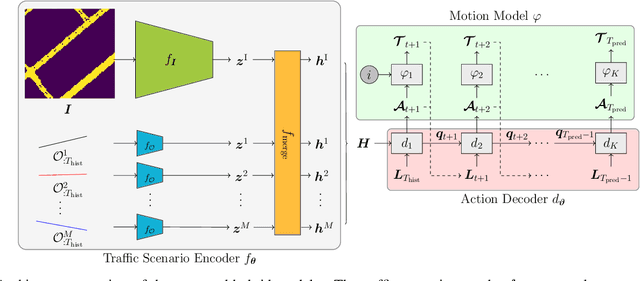
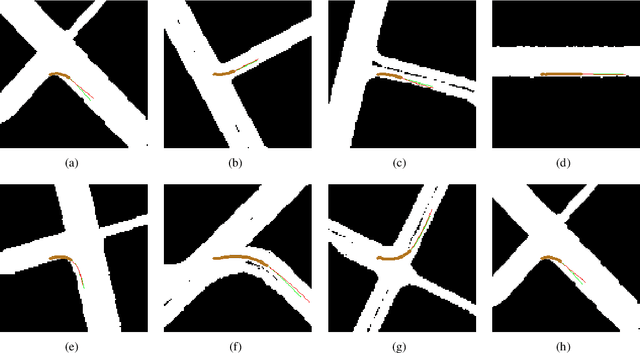
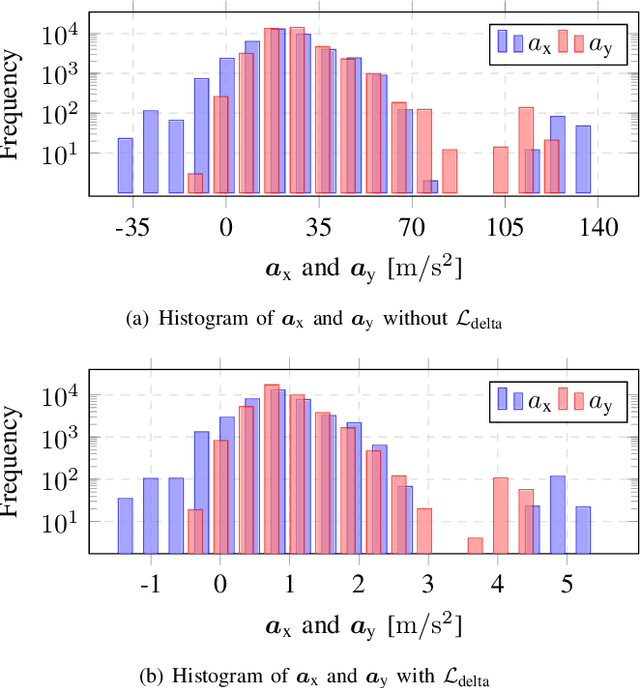
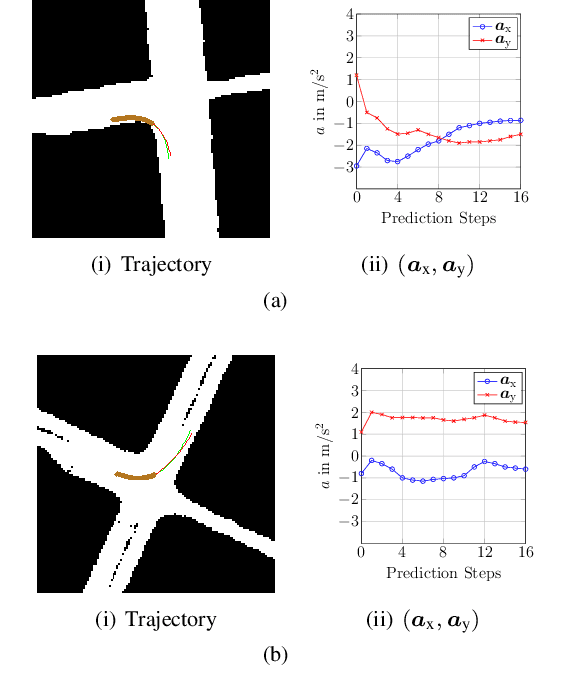
Trajectory prediction is crucial to advance autonomous driving, improving safety, and efficiency. Although end-to-end models based on deep learning have great potential, they often do not consider vehicle dynamic limitations, leading to unrealistic predictions. To address this problem, this work introduces a novel hybrid model that combines deep learning with a kinematic motion model. It is able to predict object attributes such as acceleration and yaw rate and generate trajectories based on them. A key contribution is the incorporation of expert knowledge into the learning objective of the deep learning model. This results in the constraint of the available action space, thus enabling the prediction of physically feasible object attributes and trajectories, thereby increasing safety and robustness. The proposed hybrid model facilitates enhanced interpretability, thereby reinforcing the trustworthiness of deep learning methods and promoting the development of safe planning solutions. Experiments conducted on the publicly available real-world Argoverse dataset demonstrate realistic driving behaviour, with benchmark comparisons and ablation studies showing promising results.