 Add to Chrome
 Add to Firefox
 Add to Edge
Scalable Secure Biometric Authentication without Auxiliary Identifiers
Apr 27, 2026
The prevalence of biometric authentication has been on the rise due to its ease of use and elimination of weak passwords. To date, most biometric authentication systems have been designed for on-device authentication of the device owner (e.g., smartphones and laptops). Recently, biometric authentication systems have started to emerge that are designed to authenticate users against cloud databases storing representations of biometrics for large numbers of users (potentially millions), such as those facilitating biometric payments. However, the use of a large cloud database introduces a significant attack vector, as a breach of the database could lead to the compromise of all enrolled users' sensitive biometric data. Indeed, all such existing systems either do not adequately protect against such a breach, or are impractical to deploy and use due to their high computational overhead. In this work, we present a new biometric authentication system that provides provable security guarantees against data breaches, while remaining scalable and performant. To do so, we marry artificial intelligence with advanced cryptographic techniques in a novel fashion, providing several optimizations along the way. Our work is the first to show that real-world scalable privacy-preserving biometric authentication without auxiliary identifiers is feasible, and we believe that it will spur widespread industrial adoption and further research in this area.

DMM: Distributed Matrix Mechanism for Differentially-Private Federated Learning using Packed Secret Sharing
Oct 21, 2024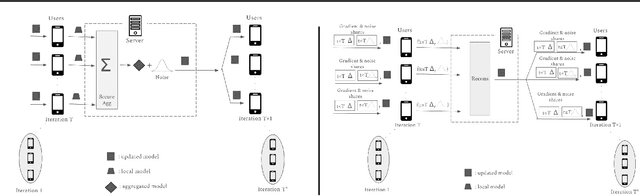
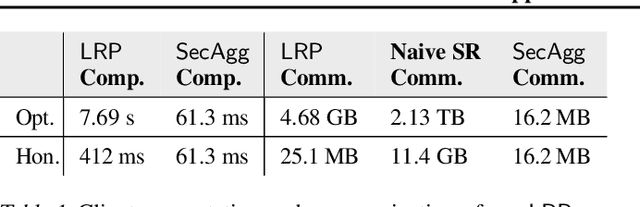
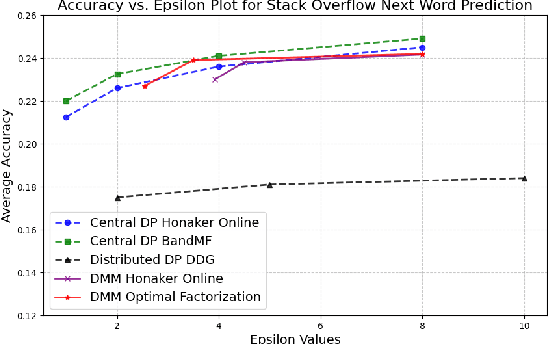
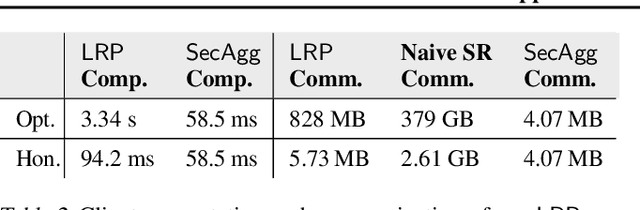
Federated Learning (FL) has gained lots of traction recently, both in industry and academia. In FL, a machine learning model is trained using data from various end-users arranged in committees across several rounds. Since such data can often be sensitive, a primary challenge in FL is providing privacy while still retaining utility of the model. Differential Privacy (DP) has become the main measure of privacy in the FL setting. DP comes in two flavors: central and local. In the former, a centralized server is trusted to receive the users' raw gradients from a training step, and then perturb their aggregation with some noise before releasing the next version of the model. In the latter (more private) setting, noise is applied on users' local devices, and only the aggregation of users' noisy gradients is revealed even to the server. Great strides have been made in increasing the privacy-utility trade-off in the central DP setting, by utilizing the so-called matrix mechanism. However, progress has been mostly stalled in the local DP setting. In this work, we introduce the distributed matrix mechanism to achieve the best-of-both-worlds; local DP and also better privacy-utility trade-off from the matrix mechanism. We accomplish this by proposing a cryptographic protocol that securely transfers sensitive values across rounds, which makes use of packed secret sharing. This protocol accommodates the dynamic participation of users per training round required by FL, including those that may drop out from the computation. We provide experiments which show that our mechanism indeed significantly improves the privacy-utility trade-off of FL models compared to previous local DP mechanisms, with little added overhead.