 Add to Chrome
 Add to Firefox
 Add to Edge
Equilibrium Forcing: Adaptive Video Generation Without Noise Conditioning
Aug 11, 2026
Standard autoregressive video generation algorithms based on Diffusion and Flow Matching rely on rigid training objectives and static sampling schedules, limiting inference procedures from adapting to the data. We introduce Equilibrium Forcing (EqF), a simplified framework for video denoising generative models without noise level conditioning. EqF pioneers modular training- and inference-time designs for noise-unconditional generation that decouple learning the denoising field from sampling. This flexibility allows for inference-time algorithms that operate in a closed loop by adapting to feedback from the sample, improving video quality and consistency on challenging autoregressive video generation benchmarks. Extensive analysis elucidates exactly how removing the noise level conditioning enables EqF's data-dependent inference properties to surpass the performance of standard noise level-conditional denoising video methods.

Understanding the Role of Functional Diversity in Weight-Ensembling with Ingredient Selection and Multidimensional Scaling
Sep 04, 2024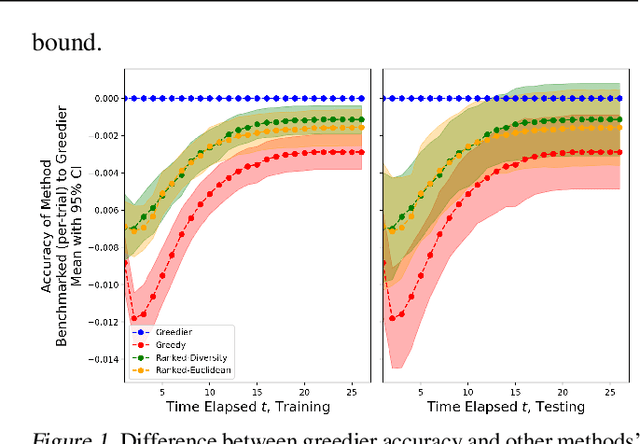

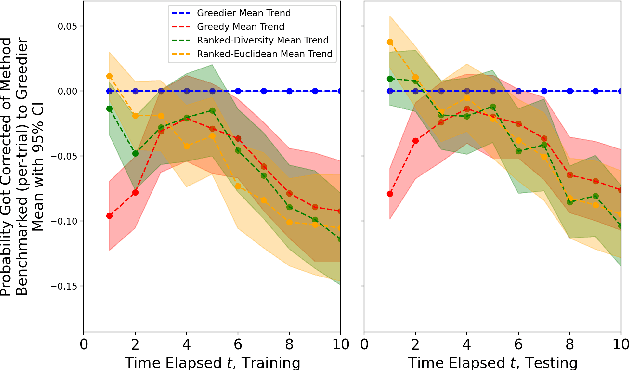

Weight-ensembles are formed when the parameters of multiple neural networks are directly averaged into a single model. They have demonstrated generalization capability in-distribution (ID) and out-of-distribution (OOD) which is not completely understood, though they are thought to successfully exploit functional diversity allotted by each distinct model. Given a collection of models, it is also unclear which combination leads to the optimal weight-ensemble; the SOTA is a linear-time ``greedy" method. We introduce two novel weight-ensembling approaches to study the link between performance dynamics and the nature of how each method decides to use apply the functionally diverse components, akin to diversity-encouragement in the prediction-ensemble literature. We develop a visualization tool to explain how each algorithm explores various domains defined via pairwise-distances to further investigate selection and algorithms' convergence. Empirical analyses shed perspectives which reinforce how high-diversity enhances weight-ensembling while qualifying the extent to which diversity alone improves accuracy. We also demonstrate that sampling positionally distinct models can contribute just as meaningfully to improvements in a weight-ensemble.