 Add to Chrome
 Add to Firefox
 Add to Edge
ZK-APEX: Zero-Knowledge Approximate Personalized Unlearning with Executable Proofs
Dec 09, 2025
Machine unlearning aims to remove the influence of specific data points from a trained model to satisfy privacy, copyright, and safety requirements. In real deployments, providers distribute a global model to many edge devices, where each client personalizes the model using private data. When a deletion request is issued, clients may ignore it or falsely claim compliance, and providers cannot check their parameters or data. This makes verification difficult, especially because personalized models must forget the targeted samples while preserving local utility, and verification must remain lightweight on edge devices. We introduce ZK APEX, a zero-shot personalized unlearning method that operates directly on the personalized model without retraining. ZK APEX combines sparse masking on the provider side with a small Group OBS compensation step on the client side, using a blockwise empirical Fisher matrix to create a curvature-aware update designed for low overhead. Paired with Halo2 zero-knowledge proofs, it enables the provider to verify that the correct unlearning transformation was applied without revealing any private data or personalized parameters. On Vision Transformer classification tasks, ZK APEX recovers nearly all personalization accuracy while effectively removing the targeted information. Applied to the OPT125M generative model trained on code data, it recovers around seventy percent of the original accuracy. Proof generation for the ViT case completes in about two hours, more than ten million times faster than retraining-based checks, with less than one gigabyte of memory use and proof sizes around four hundred megabytes. These results show the first practical framework for verifiable personalized unlearning on edge devices.

TeleSparse: Practical Privacy-Preserving Verification of Deep Neural Networks
Apr 27, 2025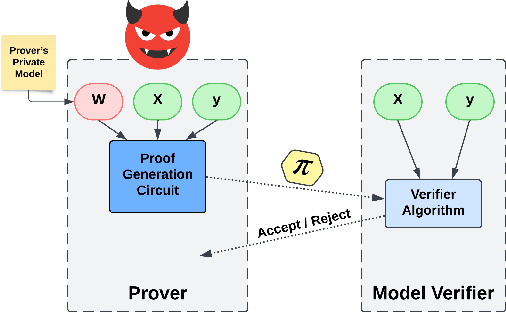

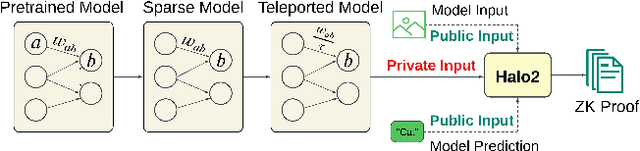
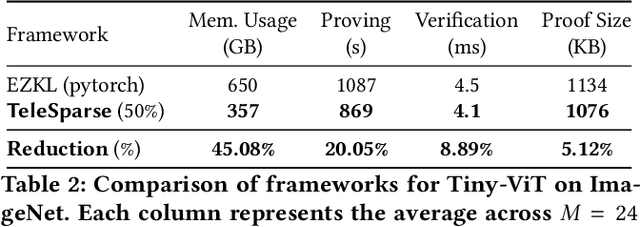
Verification of the integrity of deep learning inference is crucial for understanding whether a model is being applied correctly. However, such verification typically requires access to model weights and (potentially sensitive or private) training data. So-called Zero-knowledge Succinct Non-Interactive Arguments of Knowledge (ZK-SNARKs) would appear to provide the capability to verify model inference without access to such sensitive data. However, applying ZK-SNARKs to modern neural networks, such as transformers and large vision models, introduces significant computational overhead. We present TeleSparse, a ZK-friendly post-processing mechanisms to produce practical solutions to this problem. TeleSparse tackles two fundamental challenges inherent in applying ZK-SNARKs to modern neural networks: (1) Reducing circuit constraints: Over-parameterized models result in numerous constraints for ZK-SNARK verification, driving up memory and proof generation costs. We address this by applying sparsification to neural network models, enhancing proof efficiency without compromising accuracy or security. (2) Minimizing the size of lookup tables required for non-linear functions, by optimizing activation ranges through neural teleportation, a novel adaptation for narrowing activation functions' range. TeleSparse reduces prover memory usage by 67% and proof generation time by 46% on the same model, with an accuracy trade-off of approximately 1%. We implement our framework using the Halo2 proving system and demonstrate its effectiveness across multiple architectures (Vision-transformer, ResNet, MobileNet) and datasets (ImageNet,CIFAR-10,CIFAR-100). This work opens new directions for ZK-friendly model design, moving toward scalable, resource-efficient verifiable deep learning.