 Add to Chrome
 Add to Firefox
 Add to Edge
Elimination-compensation pruning for fully-connected neural networks
Feb 24, 2026
The unmatched ability of Deep Neural Networks in capturing complex patterns in large and noisy datasets is often associated with their large hypothesis space, and consequently to the vast amount of parameters that characterize model architectures. Pruning techniques affirmed themselves as valid tools to extract sparse representations of neural networks parameters, carefully balancing between compression and preservation of information. However, a fundamental assumption behind pruning is that expendable weights should have small impact on the error of the network, while highly important weights should tend to have a larger influence on the inference. We argue that this idea could be generalized; what if a weight is not simply removed but also compensated with a perturbation of the adjacent bias, which does not contribute to the network sparsity? Our work introduces a novel pruning method in which the importance measure of each weight is computed considering the output behavior after an optimal perturbation of its adjacent bias, efficiently computable by automatic differentiation. These perturbations can be then applied directly after the removal of each weight, independently of each other. After deriving analytical expressions for the aforementioned quantities, numerical experiments are conducted to benchmark this technique against some of the most popular pruning strategies, demonstrating an intrinsic efficiency of the proposed approach in very diverse machine learning scenarios. Finally, our findings are discussed and the theoretical implications of our results are presented.

Emergence of Structure in Ensembles of Random Neural Networks
May 15, 2025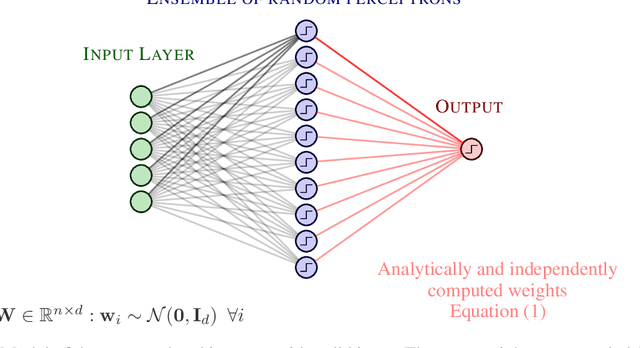
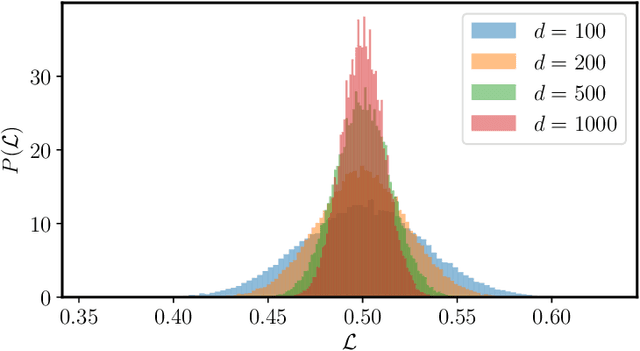
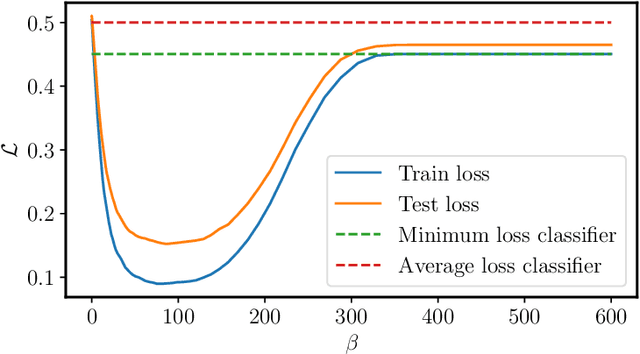
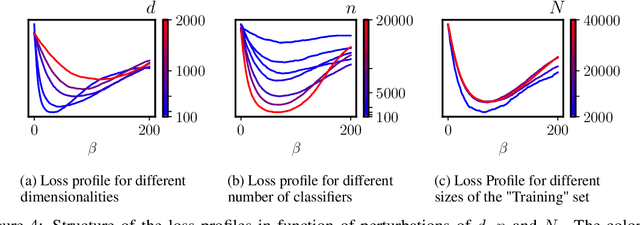
Randomness is ubiquitous in many applications across data science and machine learning. Remarkably, systems composed of random components often display emergent global behaviors that appear deterministic, manifesting a transition from microscopic disorder to macroscopic organization. In this work, we introduce a theoretical model for studying the emergence of collective behaviors in ensembles of random classifiers. We argue that, if the ensemble is weighted through the Gibbs measure defined by adopting the classification loss as an energy, then there exists a finite temperature parameter for the distribution such that the classification is optimal, with respect to the loss (or the energy). Interestingly, for the case in which samples are generated by a Gaussian distribution and labels are constructed by employing a teacher perceptron, we analytically prove and numerically confirm that such optimal temperature does not depend neither on the teacher classifier (which is, by construction of the learning problem, unknown), nor on the number of random classifiers, highlighting the universal nature of the observed behavior. Experiments on the MNIST dataset underline the relevance of this phenomenon in high-quality, noiseless, datasets. Finally, a physical analogy allows us to shed light on the self-organizing nature of the studied phenomenon.