 Add to Chrome
 Add to Firefox
 Add to Edge
FEAST: Retrieval-Augmented Multi-Hierarchical Food Classification for the FoodEx2 System
Mar 03, 2026
Hierarchical text classification (HTC) and extreme multi-label classification (XML) tasks face compounded challenges from complex label interdependencies, data sparsity, and extreme output dimensions. These challenges are exemplified in the European Food Safety Authority's FoodEx2 system-a standardized food classification framework essential for food consumption monitoring and contaminant exposure assessment across Europe. FoodEx2 coding transforms natural language food descriptions into a set of codes from multiple standardized hierarchies, but faces implementation barriers due to its complex structure. Given a food description (e.g., "organic yogurt''), the system identifies its base term ("yogurt''), all the applicable facet categories (e.g., "production method''), and then, every relevant facet descriptors to each category (e.g., "organic production''). While existing models perform adequately on well-balanced and semantically dense hierarchies, no work has been applied on the practical constraints imposed by the FoodEx2 system. The limited literature addressing such real-world scenarios further compounds these challenges. We propose FEAST (Food Embedding And Semantic Taxonomy), a novel retrieval-augmented framework that decomposes FoodEx2 classification into a three-stage approach: (1) base term identification, (2) multi-label facet prediction, and (3) facet descriptor assignment. By leveraging the system's hierarchical structure to guide training and performing deep metric learning, FEASTlearns discriminative embeddings that mitigate data sparsity and improve generalization on rare and fine-grained labels. Evaluated on the multilingual FoodEx2 benchmark, FEAST outperforms the prior European's CNN baseline F1 scores by 12-38 % on rare classes.
* Accepted for publication at ECAI 2025. Please cite the definitive, copyrighted, peer reviewed and edited version of this Article published in ECAI 2025, edited by I. Lynce et al., FAIA, pp. 4169-4176, 2025. DOI: https://doi.org/10.3233/FAIA251309

To Generate or to Retrieve? On the Effectiveness of Artificial Contexts for Medical Open-Domain Question Answering
Mar 04, 2024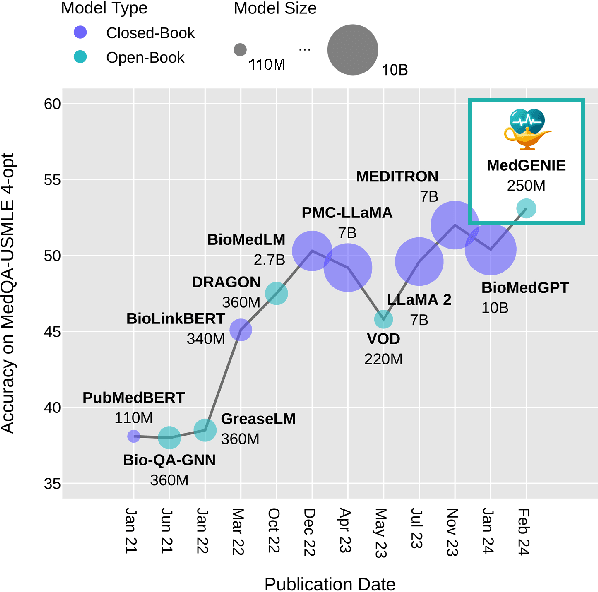
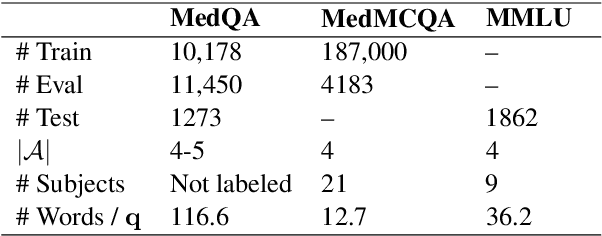
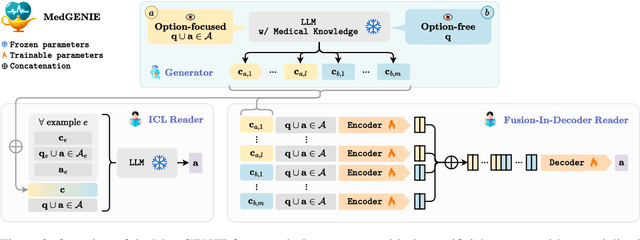
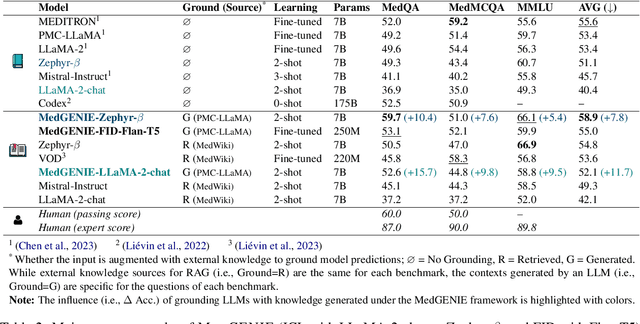
Medical open-domain question answering demands substantial access to specialized knowledge. Recent efforts have sought to decouple knowledge from model parameters, counteracting architectural scaling and allowing for training on common low-resource hardware. The retrieve-then-read paradigm has become ubiquitous, with model predictions grounded on relevant knowledge pieces from external repositories such as PubMed, textbooks, and UMLS. An alternative path, still under-explored but made possible by the advent of domain-specific large language models, entails constructing artificial contexts through prompting. As a result, "to generate or to retrieve" is the modern equivalent of Hamlet's dilemma. This paper presents MedGENIE, the first generate-then-read framework for multiple-choice question answering in medicine. We conduct extensive experiments on MedQA-USMLE, MedMCQA, and MMLU, incorporating a practical perspective by assuming a maximum of 24GB VRAM. MedGENIE sets a new state-of-the-art (SOTA) in the open-book setting of each testbed, even allowing a small-scale reader to outcompete zero-shot closed-book 175B baselines while using up to 706$\times$ fewer parameters. Overall, our findings reveal that generated passages are more effective than retrieved counterparts in attaining higher accuracy.