 Add to Chrome
 Add to Firefox
 Add to Edge
Remember to Forget: Gated Adaptive Positional Encoding
May 11, 2026
Rotary Positional Encoding (RoPE) is widely used in modern large language models. However, when sequences are extended beyond the range seen during training, rotary phases can enter out-of-distribution regimes, leading to spurious long-range alignments, diffuse attention, and degraded retrieval. Existing remedies only partially address these failures, as they often trade local positional resolution for long-context stability. We propose GAPE (Gated Adaptive Positional Encoding), a drop-in augmentation for positional encodings that introduces a content-aware bias directly into the attention logits while preserving the rotary geometry. GAPE decouples distance-based suppression from token importance through a query-dependent gate that contracts irrelevant context and a key-dependent gate that preserves salient distant tokens. We prove that protected tokens remain accessible, while the attention mass assigned to unprotected distant tokens decays as a function of the query gate. We further show that GAPE can be implemented within standard scaled dot-product attention. We validate these properties empirically, finding that GAPE consistently yields sharper attention and improved long-context robustness over rotary baselines across both synthetic retrieval and long-context benchmarks.

Z-SASLM: Zero-Shot Style-Aligned SLI Blending Latent Manipulation
Mar 29, 2025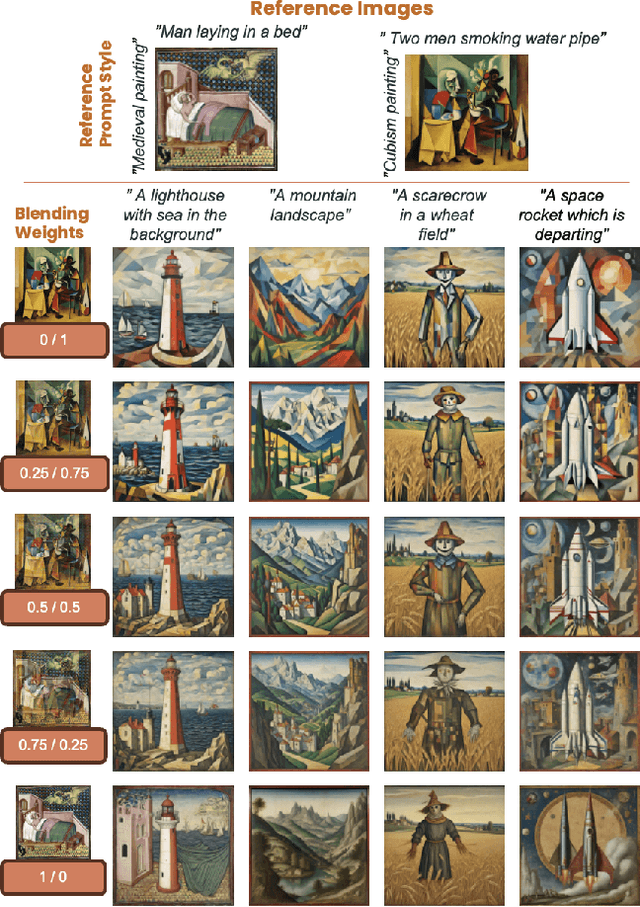
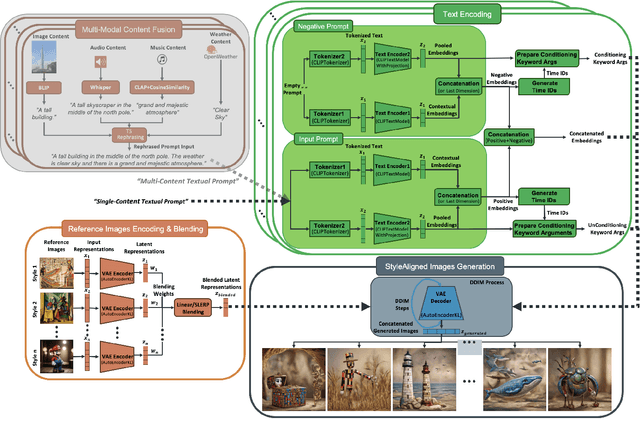
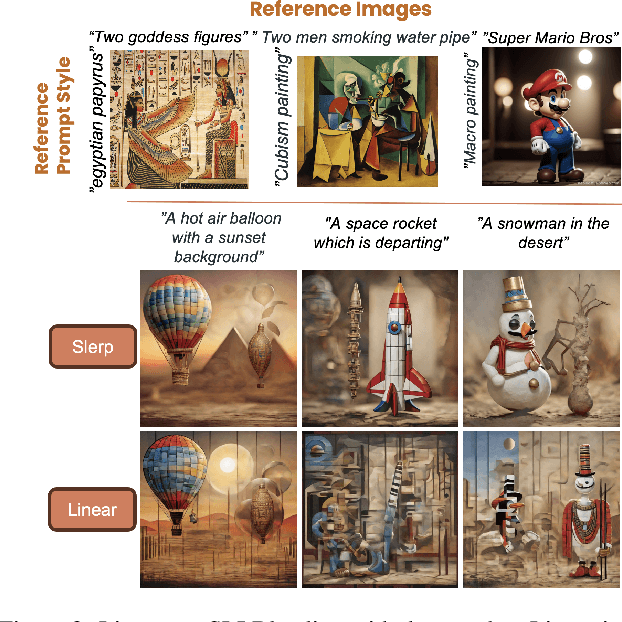
We introduce Z-SASLM, a Zero-Shot Style-Aligned SLI (Spherical Linear Interpolation) Blending Latent Manipulation pipeline that overcomes the limitations of current multi-style blending methods. Conventional approaches rely on linear blending, assuming a flat latent space leading to suboptimal results when integrating multiple reference styles. In contrast, our framework leverages the non-linear geometry of the latent space by using SLI Blending to combine weighted style representations. By interpolating along the geodesic on the hypersphere, Z-SASLM preserves the intrinsic structure of the latent space, ensuring high-fidelity and coherent blending of diverse styles - all without the need for fine-tuning. We further propose a new metric, Weighted Multi-Style DINO ViT-B/8, designed to quantitatively evaluate the consistency of the blended styles. While our primary focus is on the theoretical and practical advantages of SLI Blending for style manipulation, we also demonstrate its effectiveness in a multi-modal content fusion setting through comprehensive experimental studies. Experimental results show that Z-SASLM achieves enhanced and robust style alignment. The implementation code can be found at: https://github.com/alessioborgi/Z-SASLM.