 Add to Chrome
 Add to Firefox
 Add to Edge
ART-VS: Adaptive Resolution Tiling for Vision Transformer Visual Servoing
Jun 17, 2026
Visual servoing with self-supervised Vision Transformer (ViT) features enables training-free robotic positioning with strong generalization, but faces a fundamental trade-off between robustness and precision. Coarse patch-level descriptors provide stable correspondences yet limit positioning accuracy. Increasing image resolution improves precision but yields only marginal robustness gains - under perturbation, high-resolution processing improves convergence success rate from 76.6% to just 81.0% despite 12x more ViT patches. Therefore, we propose Adaptive Resolution Tiling Visual Servoing (ART-VS), a two-phase method that adapts feature granularity to servoing progress: a coarse phase at native ViT resolution for stable alignment, then a tiled high-resolution phase that restricts matching to local neighborhoods improving positioning accuracy. Without any task-specific training, ART-VS achieves 95.4% convergence under perturbation, outperforming standard and full-resolution ViT-based servoing by 18.8 and 14.4 percentage points. Over the former it reduces positioning error by 53%, while running at over 10x higher speed and 27% lower VRAM than the latter. We validate ART-VS across three ViT backbones and demonstrate real-world category-level grasping of unseen object instances, achieving 95/100 on transparent bottles and 98/100 on shoes. Code available under https://art-vs.github.io/.

ReSiReg: Towards Spatially Consistent Semantics in Language-Conditioned Robotic Tasks
Jun 17, 2026Vision-Language Models (VLMs) enable robots to follow open-language instructions. However, dense VLM embeddings have shown to be noisy and lack spatial consistency. This is problematic for robotic applications, which require simultaneous reasoning over semantics and 3D space. We examine spatial structure across recent VLMs and propose ReSiReg, a feature reconstruction method that uses spatially consistent VLM intermediates to improve dense language-grounded retrieval. ReSiReg clusters intermediates into visual prototypes, derives their language descriptors, and reconstructs each patch as a soft mixture of prototype-level language embeddings. We evaluate quantitatively on OVSS and 3D mapping across backbones, and qualitatively in real-world manipulation scenes. Quantitative results show improved dense retrieval; manipulation scenes show more spatially consistent target activations. We further provide a compact 25M dense VLM for robotic applications, substantially smaller than and competitive with ViT-B baselines. Available at https://resireg.github.io
ViT-VS: On the Applicability of Pretrained Vision Transformer Features for Generalizable Visual Servoing
Mar 06, 2025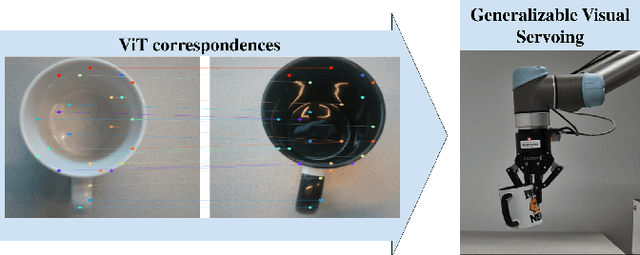
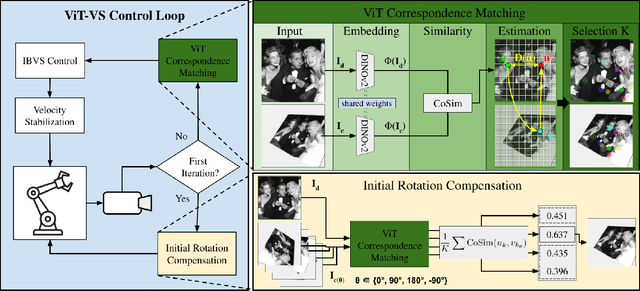

Visual servoing enables robots to precisely position their end-effector relative to a target object. While classical methods rely on hand-crafted features and thus are universally applicable without task-specific training, they often struggle with occlusions and environmental variations, whereas learning-based approaches improve robustness but typically require extensive training. We present a visual servoing approach that leverages pretrained vision transformers for semantic feature extraction, combining the advantages of both paradigms while also being able to generalize beyond the provided sample. Our approach achieves full convergence in unperturbed scenarios and surpasses classical image-based visual servoing by up to 31.2\% relative improvement in perturbed scenarios. Even the convergence rates of learning-based methods are matched despite requiring no task- or object-specific training. Real-world evaluations confirm robust performance in end-effector positioning, industrial box manipulation, and grasping of unseen objects using only a reference from the same category. Our code and simulation environment are available at: https://alessandroscherl.github.io/ViT-VS/