 Add to Chrome
 Add to Firefox
 Add to Edge
GO-GenZip: Goal-Oriented Generative Sampling and Hybrid Compression
Mar 20, 2026
Current network data telemetry pipelines consist of massive streams of fine-grained Key Performance Indicators (KPIs) from multiple distributed sources towards central aggregators, making data storage, transmission, and real-time analysis increasingly unsustainable. This work presents a generative AI (GenAI)-driven sampling and hybrid compression framework that redesigns network telemetry from a goal-oriented perspective. Unlike conventional approaches that passively compress fully observed data, our approach jointly optimizes what to observe and how to encode it, guided by the relevance of information to downstream tasks. The framework integrates adaptive sampling policies, using adaptive masking techniques, with generative modeling to identify patterns and preserve critical features across temporal and spatial dimensions. The selectively acquired data are further processed through a hybrid compression scheme that combines traditional lossless coding with GenAI-driven, lossy compression. Experimental results on real network datasets demonstrate over 50$\%$ reductions in sampling and data transfer costs, while maintaining comparable reconstruction accuracy and goal-oriented analytical fidelity in downstream tasks.

A Generative Approach for Production-Aware Industrial Network Traffic Modeling
Nov 11, 2022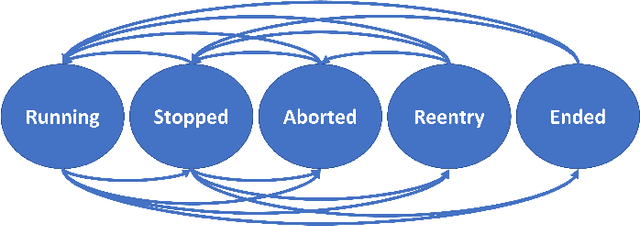
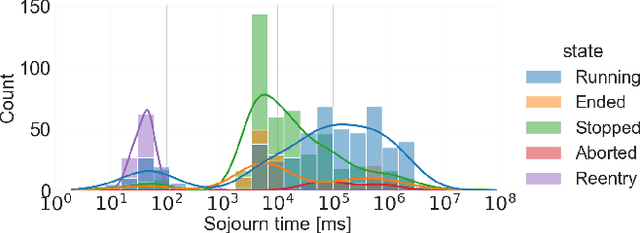
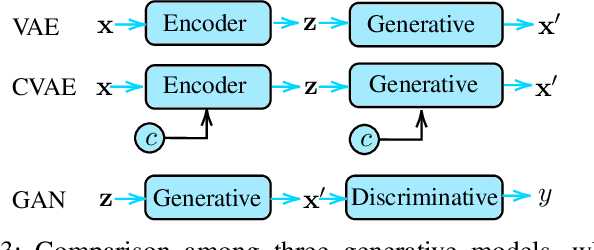
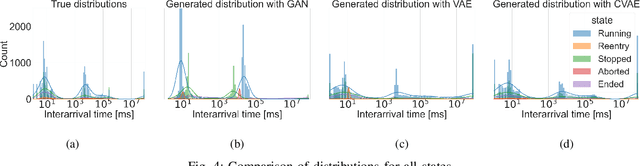
The new wave of digitization induced by Industry 4.0 calls for ubiquitous and reliable connectivity to perform and automate industrial operations. 5G networks can afford the extreme requirements of heterogeneous vertical applications, but the lack of real data and realistic traffic statistics poses many challenges for the optimization and configuration of the network for industrial environments. In this paper, we investigate the network traffic data generated from a laser cutting machine deployed in a Trumpf factory in Germany. We analyze the traffic statistics, capture the dependencies between the internal states of the machine, and model the network traffic as a production state dependent stochastic process. The two-step model is proposed as follows: first, we model the production process as a multi-state semi-Markov process, then we learn the conditional distributions of the production state dependent packet interarrival time and packet size with generative models. We compare the performance of various generative models including variational autoencoder (VAE), conditional variational autoencoder (CVAE), and generative adversarial network (GAN). The numerical results show a good approximation of the traffic arrival statistics depending on the production state. Among all generative models, CVAE provides in general the best performance in terms of the smallest Kullback-Leibler divergence.