 Add to Chrome
 Add to Firefox
 Add to Edge
K-Models: a Flexible and Interpretable Method for Ordinal Clustering with Application to Antigen-Antibody Interaction Profiles
May 14, 2026
Existing clustering methods for functional data often prioritize partitioning accuracy over interpretability, making it challenging to extract meaningful insights when the data-generating process follows a specific underlying structure and an ordinal relationship among clusters is suspected. This work introduces K-Models, a novel framework that integrates ordinal constraints and estimates key underlying elements of the random process generating the observed functional profiles, improving both interpretability and structure identification. The proposed method is evaluated through simulations and real-world applications. In particular, it is tested on Region of Interest (ROI) curves, which represent reaction profiles from a reflectometric sensor monitoring biomolecular interactions, such as antigen-antibody binding. These curves represent changes in reflected light intensity over time at multiple measurement spots with immobilized antigens during analyte exposure, capturing the binding dynamics of the system. The goal is to identify intrinsic signal patterns solely from the observed dynamics, making this dataset an ideal benchmark for assessing the added interpretability of the proposed approach. By incorporating structural assumptions into the clustering process, K-Models enhances interpretability while maintaining performance comparable to state-of-the-art techniques, providing a valuable tool for analyzing functional data with an underlying ordinal structure.

Noise-Adaptive Conformal Classification with Marginal Coverage
Jan 29, 2025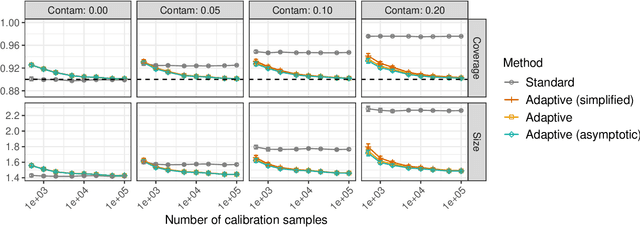
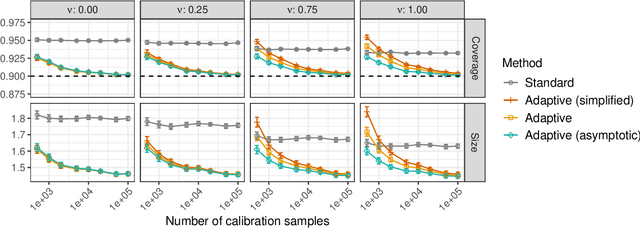
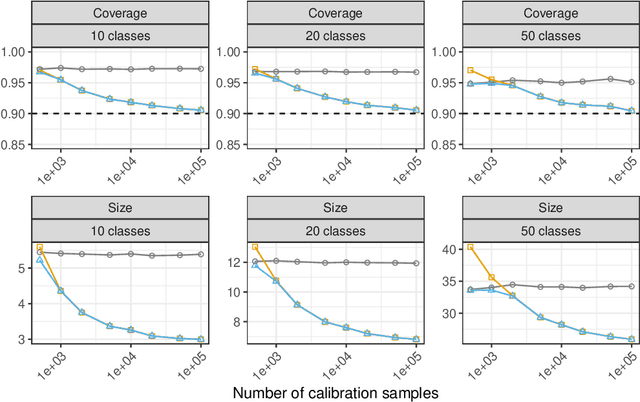
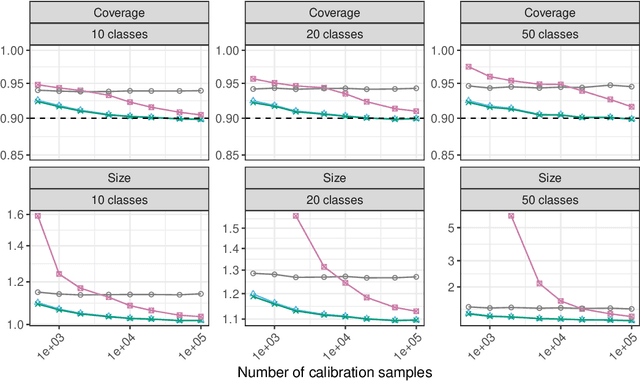
Conformal inference provides a rigorous statistical framework for uncertainty quantification in machine learning, enabling well-calibrated prediction sets with precise coverage guarantees for any classification model. However, its reliance on the idealized assumption of perfect data exchangeability limits its effectiveness in the presence of real-world complications, such as low-quality labels -- a widespread issue in modern large-scale data sets. This work tackles this open problem by introducing an adaptive conformal inference method capable of efficiently handling deviations from exchangeability caused by random label noise, leading to informative prediction sets with tight marginal coverage guarantees even in those challenging scenarios. We validate our method through extensive numerical experiments demonstrating its effectiveness on synthetic and real data sets, including CIFAR-10H and BigEarthNet.