 Add to Chrome
 Add to Firefox
 Add to Edge
Non-Rigid 3D Shape Correspondences: From Foundations to Open Challenges and Opportunities
Apr 01, 2026
Estimating correspondences between deformed shape instances is a long-standing problem in computer graphics; numerous applications, from texture transfer to statistical modelling, rely on recovering an accurate correspondence map. Many methods have thus been proposed to tackle this challenging problem from varying perspectives, depending on the downstream application. This state-of-the-art report is geared towards researchers, practitioners, and students seeking to understand recent trends and advances in the field. We categorise developments into three paradigms: spectral methods based on functional maps, combinatorial formulations that impose discrete constraints, and deformation-based methods that directly recover a global alignment. Each school of thought offers different advantages and disadvantages, which we discuss throughout the report. Meanwhile, we highlight the latest developments in each area and suggest new potential research directions. Finally, we provide an overview of emerging challenges and opportunities in this growing field, including the recent use of vision foundation models for zero-shot correspondence and the particularly challenging task of matching partial shapes.

Denoising Functional Maps: Diffusion Models for Shape Correspondence
Mar 03, 2025
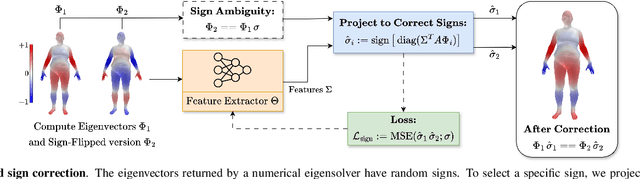
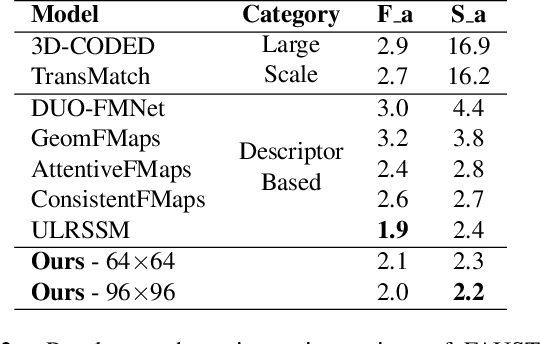
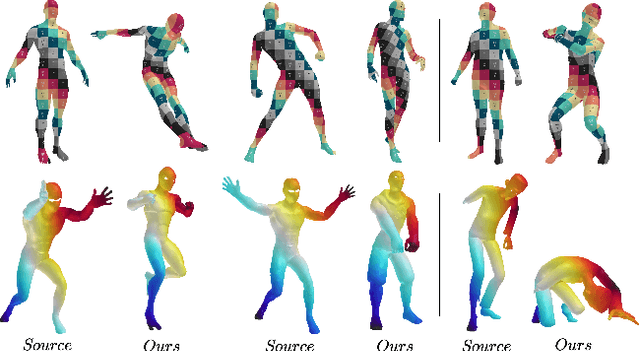
Estimating correspondences between pairs of deformable shapes remains a challenging problem. Despite substantial progress, existing methods lack broad generalization capabilities and require category-specific training data. To address these limitations, we propose a fundamentally new approach to shape correspondence based on denoising diffusion models. In our method, a diffusion model learns to directly predict the functional map, a low-dimensional representation of a point-wise map between shapes. We use a large dataset of synthetic human meshes for training and employ two steps to reduce the number of functional maps that need to be learned. First, the maps refer to a template rather than shape pairs. Second, the functional map is defined in a basis of eigenvectors of the Laplacian, which is not unique due to sign ambiguity. Therefore, we introduce an unsupervised approach to select a specific basis by correcting the signs of eigenvectors based on surface features. Our approach achieves competitive performance on standard human datasets, meshes with anisotropic connectivity, non-isometric humanoid shapes, as well as animals compared to existing descriptor-based and large-scale shape deformation methods.