 Add to Chrome
 Add to Firefox
 Add to Edge
TRIM: Reducing AI-Generated CodeSlop via Agent Trajectory Minimization
Jul 20, 2026
Coding agents are increasingly used to accelerate code generation in many downstream tasks, such as fixing bugs, building applications, and prototyping. However, despite their value as coding assistants, agent-generated code tends to be larger and more verbose than the corresponding human-written implementation. In this work, we show that the cause lies in the agent's own search process: while iterating toward a passing solution, an agent accumulates speculative edits, abandoned hypotheses, and temporary changes that persist into the final patch. This may seem harmless for a single patch, but the problem compounds as agents take responsibility for ever-larger portions of a codebase-a codebase that was once minimal and well-maintained slowly accumulates redundancy faster than it can be cleaned up, drifting to a state that is harder to maintain. Given the magnitude of this problem, we take a step towards alleviating this issue. First, we formally define this phenomenon as CodeSlop-the residual and functionally unnecessary edits commonly seen in AI-generated code. We then introduce our algorithm TRIM (Trajectory-guided Redundancy Identification and Minimization). Rather than minimizing CodeSlop directly, TRIM instead minimizes agent trajectories. As we show empirically, this indirect technique of minimizing CodeSlop is highly effective: TRIM cuts CodeSlop by 17.9%-32.9% across agentic scaffolds, with negligible performance regression. TRIM is also highly efficient, requiring roughly half the validation cost of algorithmic baselines such as Delta Debugging.

CrashFixer: A crash resolution agent for the Linux kernel
Apr 29, 2025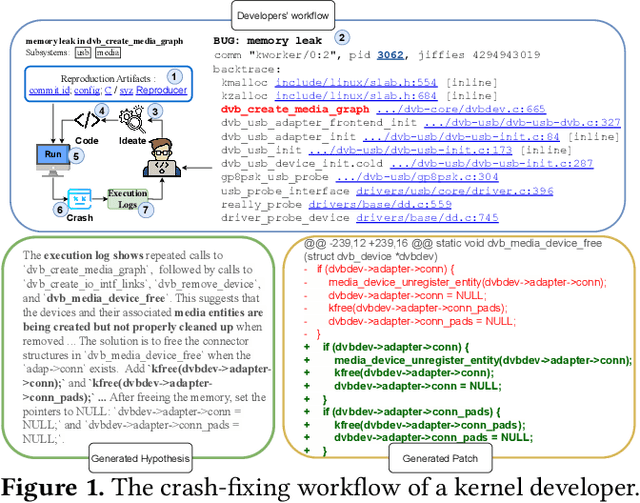
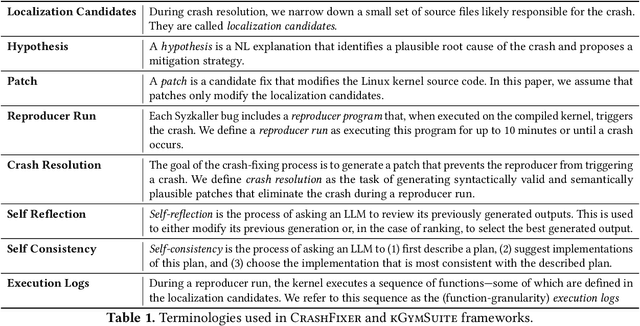
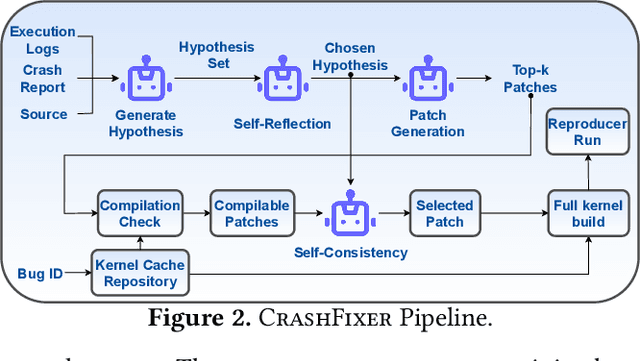
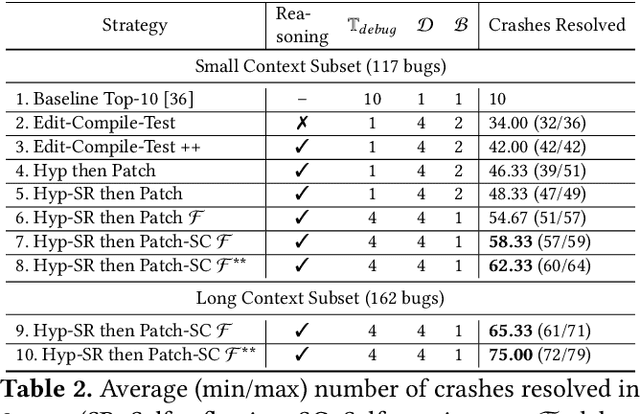
Code large language models (LLMs) have shown impressive capabilities on a multitude of software engineering tasks. In particular, they have demonstrated remarkable utility in the task of code repair. However, common benchmarks used to evaluate the performance of code LLMs are often limited to small-scale settings. In this work, we build upon kGym, which shares a benchmark for system-level Linux kernel bugs and a platform to run experiments on the Linux kernel. This paper introduces CrashFixer, the first LLM-based software repair agent that is applicable to Linux kernel bugs. Inspired by the typical workflow of a kernel developer, we identify the key capabilities an expert developer leverages to resolve a kernel crash. Using this as our guide, we revisit the kGym platform and identify key system improvements needed to practically run LLM-based agents at the scale of the Linux kernel (50K files and 20M lines of code). We implement these changes by extending kGym to create an improved platform - called kGymSuite, which will be open-sourced. Finally, the paper presents an evaluation of various repair strategies for such complex kernel bugs and showcases the value of explicitly generating a hypothesis before attempting to fix bugs in complex systems such as the Linux kernel. We also evaluated CrashFixer's capabilities on still open bugs, and found at least two patch suggestions considered plausible to resolve the reported bug.