 Add to Chrome
 Add to Firefox
 Add to Edge
The Effect of Training Task Diversity on In-Context Learning through the Lens of Low-Dimensional Subspaces
Jun 05, 2026
The transformer's emergent ability to perform in-context learning (ICL) has sparked a wide range of studies designed to understand its underlying mechanisms. Existing works often study how training task diversity, defined either as the number of ICL training task vectors or as the number of function classes from which the task vectors are drawn, shapes both the learning dynamics and generalization capabilities of ICL. While both definitions have uncovered many interesting phenomena, many observations under the latter definition remain theoretically unexplained. This paper presents a minimal analytical model under which these phenomena provably emerge from the properties of the training data. By modeling the training task vectors as a mixture of low-rank Gaussians, we show how training task diversity, defined by the number of non-overlapping columns between subspaces that parameterize the covariance matrices, improves both the generalization and optimization trajectory of ICL with linear attention. In particular, we show that our model can explain (i) why training with task diversity shortens the ICL plateau and (ii) why ICL appears to achieve out-of-distribution generalization. We conclude by empirically demonstrating how our results extend to nonlinear transformers and nonlinear function classes. Overall, our work presents a tractable framework to unify existing observations.

Emergent Low-Rank Training Dynamics in MLPs with Smooth Activations
Feb 05, 2026Recent empirical evidence has demonstrated that the training dynamics of large-scale deep neural networks occur within low-dimensional subspaces. While this has inspired new research into low-rank training, compression, and adaptation, theoretical justification for these dynamics in nonlinear networks remains limited. %compared to deep linear settings. To address this gap, this paper analyzes the learning dynamics of multi-layer perceptrons (MLPs) under gradient descent (GD). We demonstrate that the weight dynamics concentrate within invariant low-dimensional subspaces throughout training. Theoretically, we precisely characterize these invariant subspaces for two-layer networks with smooth nonlinear activations, providing insight into their emergence. Experimentally, we validate that this phenomenon extends beyond our theoretical assumptions. Leveraging these insights, we empirically show there exists a low-rank MLP parameterization that, when initialized within the appropriate subspaces, matches the classification performance of fully-parameterized counterparts on a variety of classification tasks.
MonarchAttention: Zero-Shot Conversion to Fast, Hardware-Aware Structured Attention
May 24, 2025Transformers have achieved state-of-the-art performance across various tasks, but suffer from a notable quadratic complexity in sequence length due to the attention mechanism. In this work, we propose MonarchAttention -- a novel approach to sub-quadratic attention approximation via Monarch matrices, an expressive class of structured matrices. Based on the variational form of softmax, we describe an efficient optimization-based algorithm to compute an approximate projection of softmax attention onto the class of Monarch matrices with $\Theta(N\sqrt{N} d)$ computational complexity and $\Theta(Nd)$ memory/IO complexity. Unlike previous approaches, MonarchAttention is both (1) transferable, yielding minimal performance loss with no additional training, even when replacing every attention layer of the transformer, and (2) hardware-efficient, utilizing the highest-throughput tensor core units on modern GPUs. With optimized kernels, MonarchAttention achieves substantial speed-ups in wall-time over FlashAttention-2: $1.4\times$ for shorter sequences $(N=256)$, $4.5\times$ for medium-length sequences $(N=4K)$, and $8.2\times$ for longer sequences $(N=16K)$. We demonstrate the quality of MonarchAttention on diverse tasks and architectures in vision and language problems, showing that it flexibly and accurately approximates softmax attention in a variety of contexts. Our code is available at https://github.com/cjyaras/monarch-attention.
Out-of-Distribution Generalization of In-Context Learning: A Low-Dimensional Subspace Perspective
May 20, 2025This work aims to demystify the out-of-distribution (OOD) capabilities of in-context learning (ICL) by studying linear regression tasks parameterized with low-rank covariance matrices. With such a parameterization, we can model distribution shifts as a varying angle between the subspace of the training and testing covariance matrices. We prove that a single-layer linear attention model incurs a test risk with a non-negligible dependence on the angle, illustrating that ICL is not robust to such distribution shifts. However, using this framework, we also prove an interesting property of ICL: when trained on task vectors drawn from a union of low-dimensional subspaces, ICL can generalize to any subspace within their span, given sufficiently long prompt lengths. This suggests that the OOD generalization ability of Transformers may actually stem from the new task lying within the span of those encountered during training. We empirically show that our results also hold for models such as GPT-2, and conclude with (i) experiments on how our observations extend to nonlinear function classes and (ii) results on how LoRA has the ability to capture distribution shifts.
Understanding How Nonlinear Layers Create Linearly Separable Features for Low-Dimensional Data
Jan 04, 2025


Deep neural networks have attained remarkable success across diverse classification tasks. Recent empirical studies have shown that deep networks learn features that are linearly separable across classes. However, these findings often lack rigorous justifications, even under relatively simple settings. In this work, we address this gap by examining the linear separation capabilities of shallow nonlinear networks. Specifically, inspired by the low intrinsic dimensionality of image data, we model inputs as a union of low-dimensional subspaces (UoS) and demonstrate that a single nonlinear layer can transform such data into linearly separable sets. Theoretically, we show that this transformation occurs with high probability when using random weights and quadratic activations. Notably, we prove this can be achieved when the network width scales polynomially with the intrinsic dimension of the data rather than the ambient dimension. Experimental results corroborate these theoretical findings and demonstrate that similar linear separation properties hold in practical scenarios beyond our analytical scope. This work bridges the gap between empirical observations and theoretical understanding of the separation capacity of nonlinear networks, offering deeper insights into model interpretability and generalization.
HeMPPCAT: Mixtures of Probabilistic Principal Component Analysers for Data with Heteroscedastic Noise
Jan 25, 2023
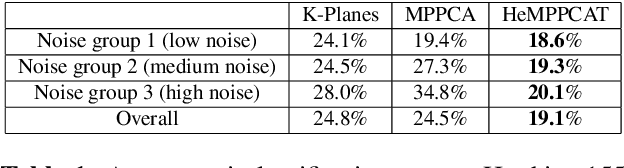
Mixtures of probabilistic principal component analysis (MPPCA) is a well-known mixture model extension of principal component analysis (PCA). Similar to PCA, MPPCA assumes the data samples in each mixture contain homoscedastic noise. However, datasets with heterogeneous noise across samples are becoming increasingly common, as larger datasets are generated by collecting samples from several sources with varying noise profiles. The performance of MPPCA is suboptimal for data with heteroscedastic noise across samples. This paper proposes a heteroscedastic mixtures of probabilistic PCA technique (HeMPPCAT) that uses a generalized expectation-maximization (GEM) algorithm to jointly estimate the unknown underlying factors, means, and noise variances under a heteroscedastic noise setting. Simulation results illustrate the improved factor estimates and clustering accuracies of HeMPPCAT compared to MPPCA.