 Add to Chrome
 Add to Firefox
 Add to Edge
Show, Don't TELL: Explainable AI-Generated Text Detection
May 27, 2026
Research on AI-generated text detection has presented a number of approaches to discern human from AI prose, some of which achieving high in-distribution performance. However, real-world applicability has stalled because their outputs are misaligned with the needs of users, such as professors, who are presented with a numeric score that has no attached explanation. We tackle this issue with a novel architecture, TELL, that bakes explainability from the ground-up. While our system still offers a numerical score like other detectors for comparability, TELL takes a fundamentally different approach where we aim to show the user the "tells" by which the model believes a text is AI or human-written, to empower the user to decide who wrote a text using their own judgment and understanding of the context of the writing and its alleged author. We train TELL on a custom SFT dataset of domain-specific authorship annotations, and further refine the system using GRPO with curriculum learning to improve performance. We achieve competitive performance with state-of-the-art detectors (AUROC 0.927) while natively providing annotations that explain the basis for the detector's decision. We further evaluate the quality of our explanations using a dataset of human annotations and report a high (mean 72.3%) win-rate on annotation concreteness, falsifiability, coherence, plausibility and grounding, allowing users to critically think and decide for themselves. Our work thus reframes the problem of AI-generated text detection in a human-centric perspective and paves the way for a new family of detectors that focus on native explainability.

Fine-Tuning Without Forgetting via Loss-Adaptive Learning Rates
May 19, 2026Fine-tuning large language models on new data improves task performance but degrades capabilities learned during pretraining, a phenomenon known as catastrophic forgetting. Existing methods mitigate this by modifying the fine-tuning objective to suppress high-loss tokens or sequences, but these tokens are essential for learning new tasks, especially those with poor pretraining coverage. In such settings, hard tokens should still contribute to learning, so forgetting must be controlled without suppressing them. We identify a simple mechanism for doing so: per-step forgetting is bounded by the product of the learning rate and the square root of the current training loss. This suggests that high-loss batches are especially prone to inducing forgetting. Motivated by this observation, we introduce FINCH, a loss-adaptive learning-rate schedule that reduces the learning rate on high-loss batches and increases it as the model converges, while leaving the fine-tuning objective unchanged. Across knowledge acquisition, science, and low-resource language adaptation benchmarks, FINCH reduces forgetting by 93% on average while matching the task performance of standard fine-tuning. On Qwen3-4B knowledge acquisition, FINCH cuts TruthfulQA degradation by 5x and reverses HaluEval degradation, while better preserving confidence calibration. Overall, our results show that learning-rate schedules are an effective tool to shape model behavior during fine-tuning, beyond just target-task optimization.
Evading AI-Generated Content Detectors using Homoglyphs
Jun 17, 2024The generation of text that is increasingly human-like has been enabled by the advent of large language models (LLMs). As the detection of AI-generated content holds significant importance in the fight against issues such as misinformation and academic cheating, numerous studies have been conducted to develop reliable LLM detectors. While promising results have been demonstrated by such detectors on test data, recent research has revealed that they can be circumvented by employing different techniques. In this article, homoglyph-based ($a \rightarrow {\alpha}$) attacks that can be used to circumvent existing LLM detectors are presented. The efficacy of the attacks is illustrated by analizing how homoglyphs shift the tokenization of the text, and thus its token loglikelihoods. A comprehensive evaluation is conducted to assess the effectiveness of homoglyphs on state-of-the-art LLM detectors, including Binoculars, DetectGPT, OpenAI's detector, and watermarking techniques, on five different datasets. A significant reduction in the efficiency of all the studied configurations of detectors and datasets, down to an accuracy of 0.5 (random guessing), is demonstrated by the proposed approach. The results show that homoglyph-based attacks can effectively evade existing LLM detectors, and the implications of these findings are discussed along with possible defenses against such attacks.
Prompting LLMs with content plans to enhance the summarization of scientific articles
Dec 15, 2023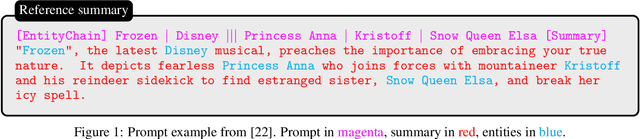
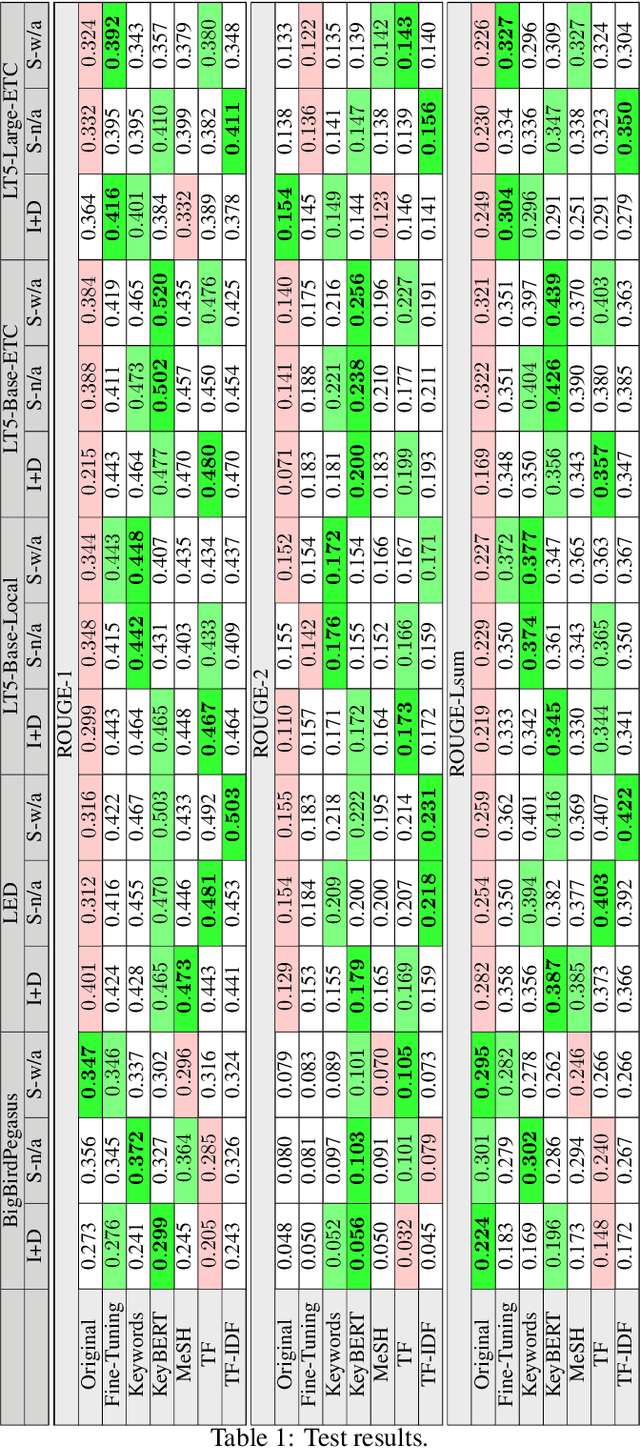
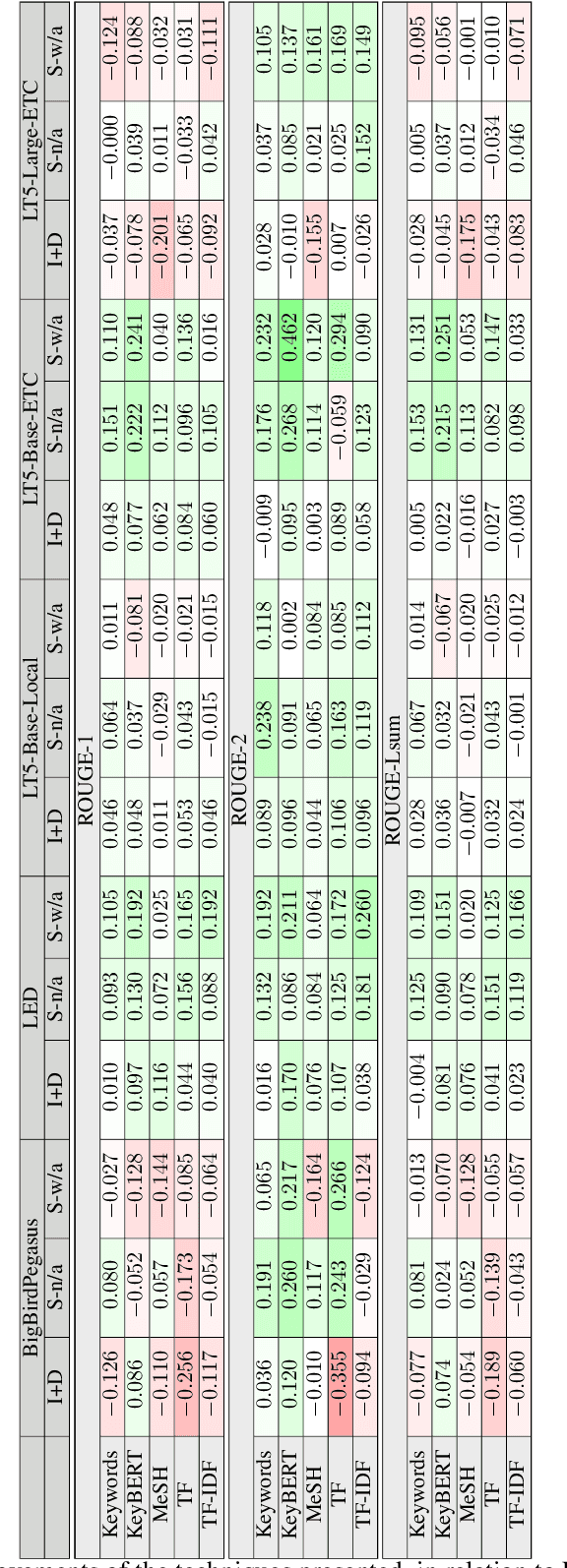
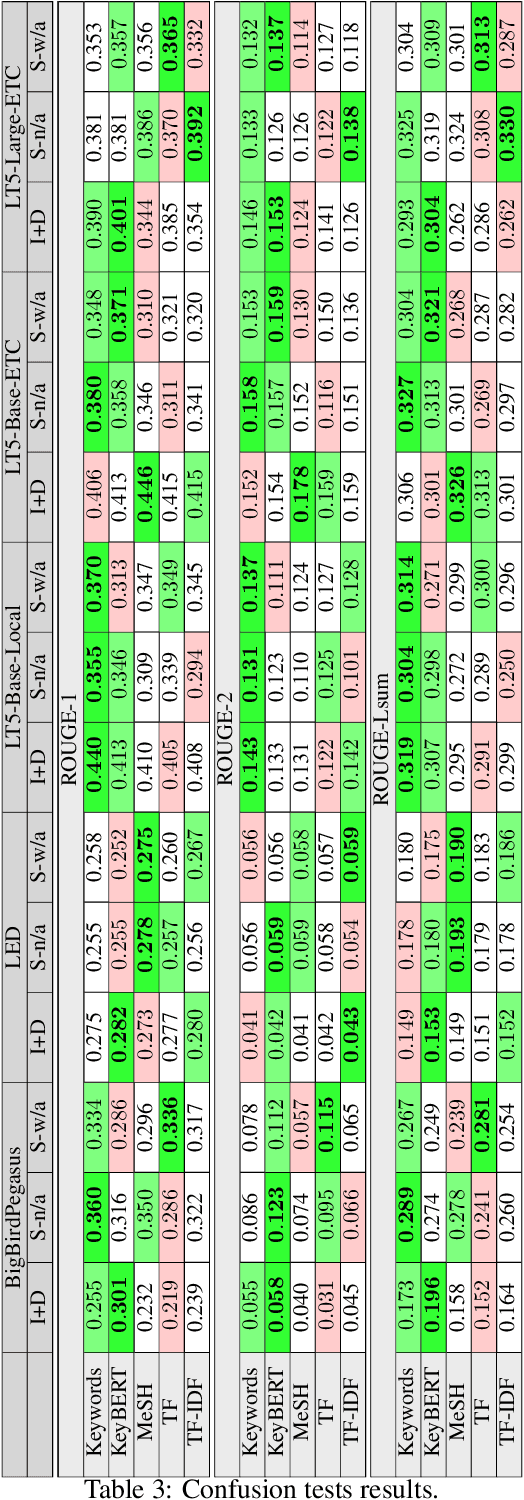
This paper presents novel prompting techniques to improve the performance of automatic summarization systems for scientific articles. Scientific article summarization is highly challenging due to the length and complexity of these documents. We conceive, implement, and evaluate prompting techniques that provide additional contextual information to guide summarization systems. Specifically, we feed summarizers with lists of key terms extracted from articles, such as author keywords or automatically generated keywords. Our techniques are tested with various summarization models and input texts. Results show performance gains, especially for smaller models summarizing sections separately. This evidences that prompting is a promising approach to overcoming the limitations of less powerful systems. Our findings introduce a new research direction of using prompts to aid smaller models.