 Add to Chrome
 Add to Firefox
 Add to Edge
Descriptor: A Hybrid Indoor and Indoor-Outdoor Positioning Multi-Technology Dataset (HYMN)
Apr 22, 2026
This article introduces the HYMN (HYbrid Multi-technology Navigation) dataset: a multi-system, and time synchronized dataset for localization research based on opportunistic signals collected in an indoor-outdoor scenario. HYMN comprises measurement data collected in an industrial hall setting for five different positioning systems including Ultra-Wideband (UWB), Bluetooth Low Energy (BLE), WiFi, 5G, and Global Navigation Satellite System (GNSS). Unlike existing datasets that focus on single technologies or purely indoor/outdoor scenarios, HYMN combines five positioning technologies with explicit coverage of indoor-outdoor transitions, enabling multi-sensor fusion research for seamless localization. Each instance of data is identified through a unique measurement id and it represents time-stamped observations relevant for each system respectively along with the ground truth information. HYMN is designed to support a wide range of localization tasks including multi-sensor fingerprinting, cross-technology fusion, and seamless indoor-outdoor positioning. The synchronized measurements from GNSS and other terrestrial systems enable researchers to investigate how heterogeneous signals complement each other to overcome individual technology limitations such as GNSS degradation in covered areas or terrestrial system variability in dynamic environments.

Grid-based Hybrid 3DMA GNSS and Terrestrial Positioning
Sep 11, 2023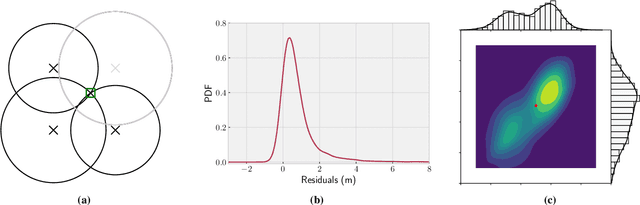
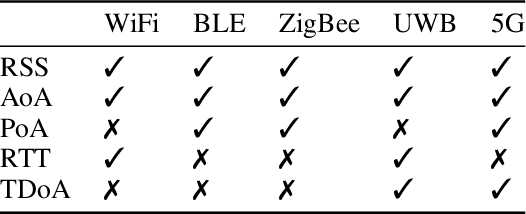
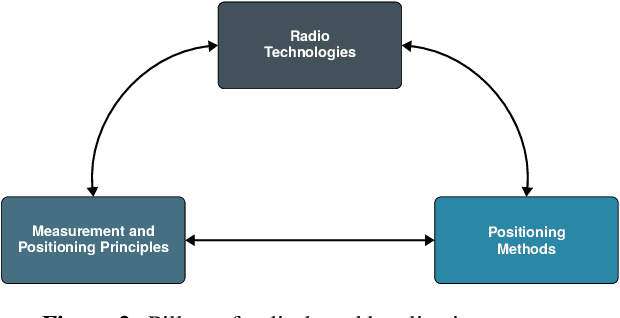
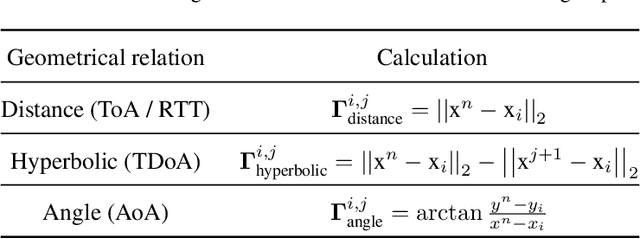
The paper discusses the increasing use of hybridized sensor information for GNSS-based localization and navigation, including the use of 3D map-aided GNSS positioning and terrestrial systems based on different geometric measurement principles. However, both GNSS and terrestrial systems are subject to negative impacts from the propagation environment, which can violate the assumptions of conventionally applied parametric state estimators. Furthermore, dynamic parametric state estimation does not account for multi-modalities within the state space leading to an information loss within the prediction step. In addition, the synchronization of non-deterministic multi-rate measurement systems needs to be accounted. In order to address these challenges, the paper proposes the use of a non-parametric filtering method, specifically a 3DMA multi-epoch Grid Filter, for the tight integration of GNSS and terrestrial signals. Specifically, the fusion of GNSS, Ultra-wide Band (UWB) and vehicle motion data is introduced based on a discrete state representation. Algorithmic challenges, including the use of different measurement models and time synchronization, are addressed. In order to evaluate the proposed method, real-world tests were conducted on an urban automotive testbed in both static and dynamic scenarios. We empirically show that we achieve sub-meter accuracy in the static scenario by averaging a positioning error of $0.64$ m, whereas in the dynamic scenario the average positioning error amounts to $1.62$ m. The paper provides a proof-of-concept of the introduced method and shows the feasibility of the inclusion of terrestrial signals in a 3DMA positioning framework in order to further enhance localization in GNSS-degraded environments.
Potentials of Deterministic Radio Propagation Simulation for AI-Enabled Localization and Sensing
Sep 11, 2023Machine leaning (ML) and artificial intelligence (AI) enable new methods for localization and sensing in next-generation networks to fulfill a wide range of use cases. These approaches rely on learning approaches that require large amounts of training and validation data. This paper addresses the data generation bottleneck to develop and validate such methods by proposing an integrated toolchain based on deterministic channel modeling and radio propagation simulation. The toolchain is demonstrated exemplary for scenario classification to obtain localization-related channel parameters within an aircraft cabin environment.