 Add to Chrome
 Add to Firefox
 Add to Edge
Bayesian quantum sensing using graybox machine learning
Jan 24, 2026
Quantum sensors offer significant advantages over classical devices in spatial resolution and sensitivity, enabling transformative applications across materials science, healthcare, and beyond. Their practical performance, however, is often constrained by unmodelled effects, including noise, imperfect state preparation, and non-ideal control fields. In this work, we report the first experimental implementation of a graybox modelling strategy for a solid-state open quantum system. The graybox framework integrates a physics-based system model with a data-driven description of experimental imperfections, achieving higher fidelity than purely analytical (whitebox) approaches while requiring fewer training resources than fully deep-learning models. We experimentally validate the method on the task of estimating a static magnetic field using a single-spin quantum sensor, performing Bayesian inference with a graybox model trained on prior experimental data. Using roughly 10,000 training datapoints, the graybox model yields several orders of magnitude improvement in mean squared error over the corresponding physics-only model. These results are broadly applicable to a wide range of quantum sensing platforms, not limited to single-spin systems, and are particularly valuable for real-time adaptive protocols, where model inaccuracies can otherwise lead to suboptimal control and degraded performance.

Quantum Feature Space of a Qubit Coupled to an Arbitrary Bath
May 07, 2025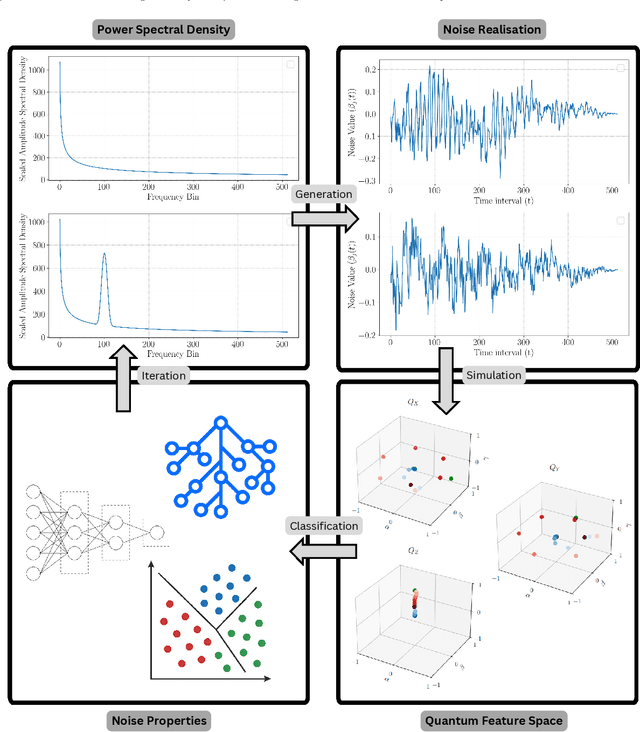


Qubit control protocols have traditionally leveraged a characterisation of the qubit-bath coupling via its power spectral density. Previous work proposed the inference of noise operators that characterise the influence of a classical bath using a grey-box approach that combines deep neural networks with physics-encoded layers. This overall structure is complex and poses challenges in scaling and real-time operations. Here, we show that no expensive neural networks are needed and that this noise operator description admits an efficient parameterisation. We refer to the resulting parameter space as the \textit{quantum feature space} of the qubit dynamics resulting from the coupled bath. We show that the Euclidean distance defined over the quantum feature space provides an effective method for classifying noise processes in the presence of a given set of controls. Using the quantum feature space as the input space for a simple machine learning algorithm (random forest, in this case), we demonstrate that it can effectively classify the stationarity and the broad class of noise processes perturbing a qubit. Finally, we explore how control pulse parameters map to the quantum feature space.