 Add to Chrome
 Add to Firefox
 Add to Edge
Encrypted Neural Networks without Overflows
May 21, 2026
Fully homomorphic encryption (FHE) enables private inference by evaluating neural networks on encrypted data. In this way, we can delegate the computation to a third party server without ever revealing the user's data. Currently, the CKKS scheme is the backbone of most efficient FHE implementations, but it only supports addition, multiplication, and array rotation operations, thus requiring all activation functions of the neural network to be approximated by polynomials within a certain interval, imposing strict design tolerances. In this paper, we demonstrate for the first time that this scheme is vulnerable to overflow attacks, i.e., seemingly benign inputs that can exceed such tolerances of the FHE circuit, thereby causing corrupt and unusable outputs. To avoid them, we propose a formal verification technique that computes certified bounds on the ranges of all neurons in the network. By construction, our method eliminates overflows and, in our experiments, removed observed overflows on all benchmarks, reducing failure rates from up to 47% to 0%. Moreover, our overflow-free solution is compatible with most CKKS-based frameworks, as it allows to simply substitute standard polynomials by polynomials with rigorously designed ranges.

A Discrete Particle Swarm Optimizer for the Design of Cryptographic Boolean Functions
Jan 09, 2024A Particle Swarm Optimizer for the search of balanced Boolean functions with good cryptographic properties is proposed in this paper. The algorithm is a modified version of the permutation PSO by Hu, Eberhart and Shi which preserves the Hamming weight of the particles positions, coupled with the Hill Climbing method devised by Millan, Clark and Dawson to improve the nonlinearity and deviation from correlation immunity of Boolean functions. The parameters for the PSO velocity equation are tuned by means of two meta-optimization techniques, namely Local Unimodal Sampling (LUS) and Continuous Genetic Algorithms (CGA), finding that CGA produces better results. Using the CGA-evolved parameters, the PSO algorithm is then run on the spaces of Boolean functions from $n=7$ to $n=12$ variables. The results of the experiments are reported, observing that this new PSO algorithm generates Boolean functions featuring similar or better combinations of nonlinearity, correlation immunity and propagation criterion with respect to the ones obtained by other optimization methods.
Evolutionary Construction of Perfectly Balanced Boolean Functions
Feb 16, 2022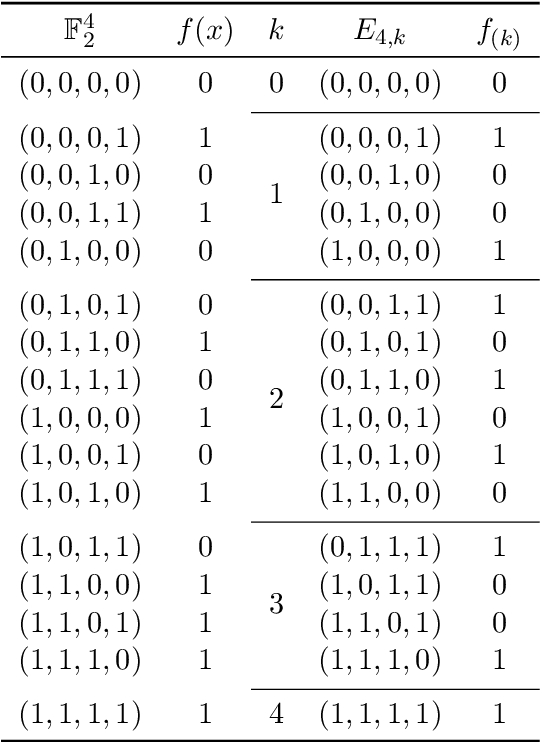
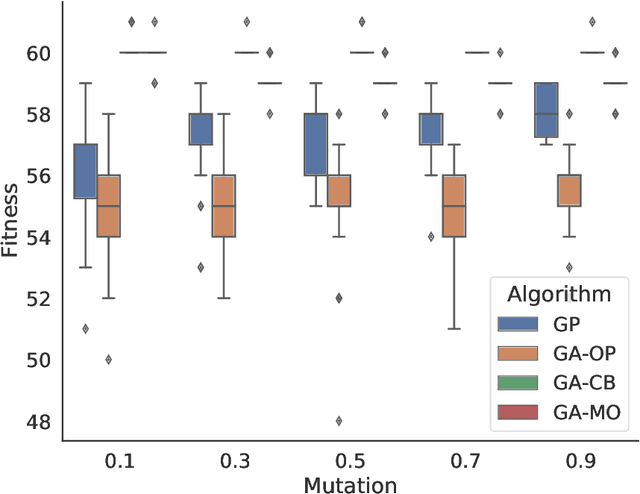
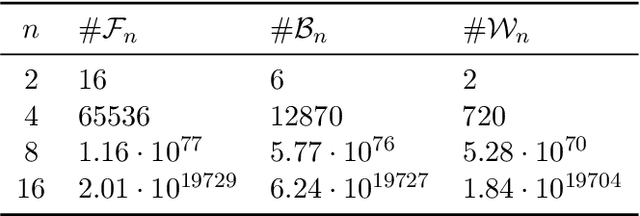
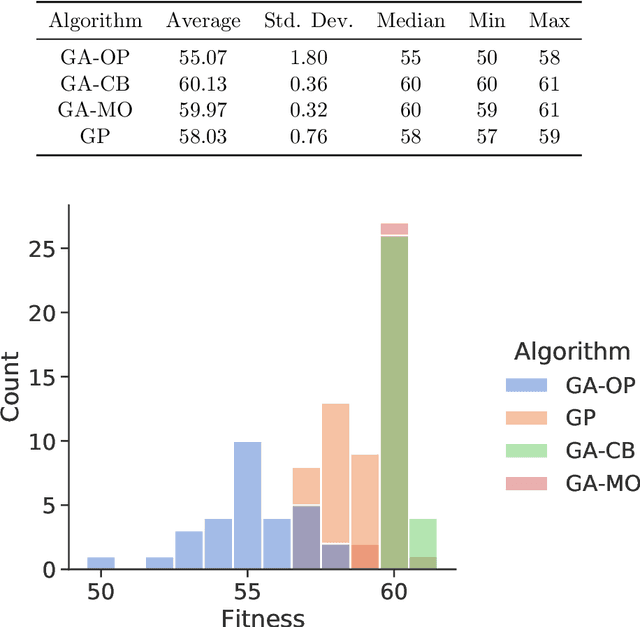
Finding Boolean functions suitable for cryptographic primitives is a complex combinatorial optimization problem, since they must satisfy several properties to resist cryptanalytic attacks, and the space is very large, which grows super exponentially with the number of input variables. Recent research has focused on the study of Boolean functions that satisfy properties on restricted sets of inputs due to their importance in the development of the FLIP stream cipher. In this paper, we consider one such property, perfect balancedness, and investigate the use of Genetic Programming (GP) and Genetic Algorithms (GA) to construct Boolean functions that satisfy this property along with a good nonlinearity profile. We formulate the related optimization problem and define two encodings for the candidate solutions, namely the truth table and the weightwise balanced representations. Somewhat surprisingly, the results show that GA with the weightwise balanced representation outperforms GP with the classical truth table phenotype in finding highly nonlinear WPB functions. This finding is in stark contrast to previous findings on the evolution of globally balanced Boolean functions, where GP always performs best.
On the Difficulty of Evolving Permutation Codes
Nov 25, 2021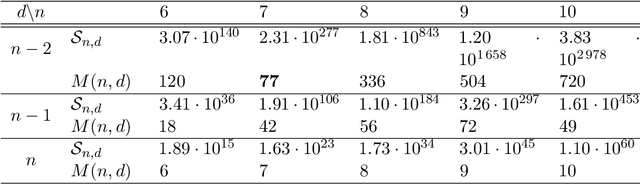
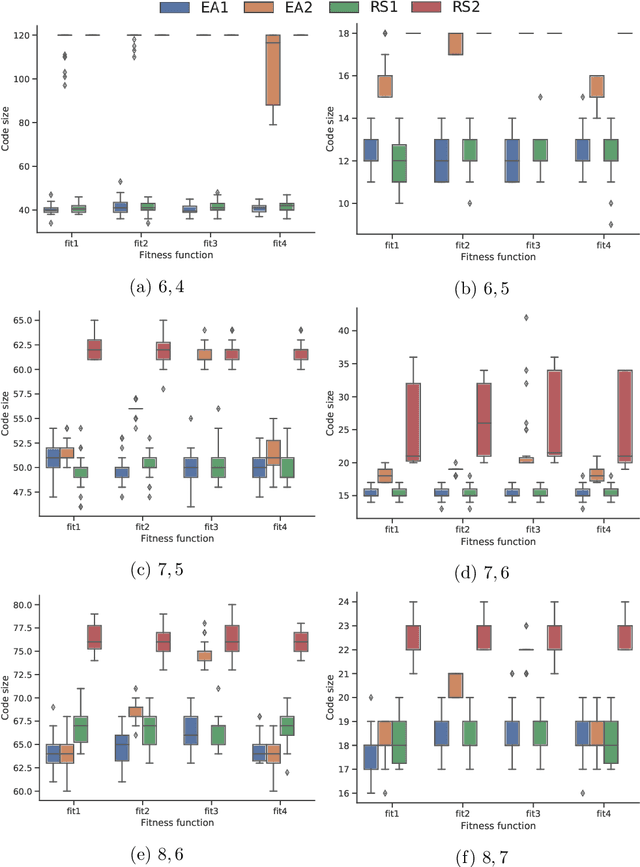
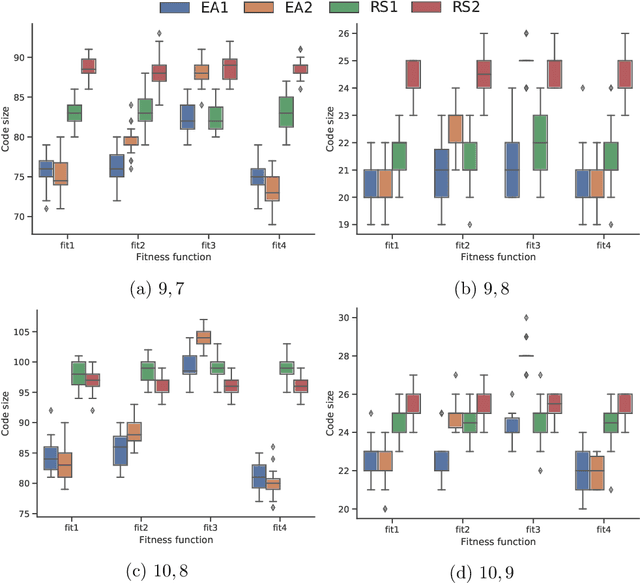
Combinatorial designs provide an interesting source of optimization problems. Among them, permutation codes are particularly interesting given their applications in powerline communications, flash memories, and block ciphers. This paper addresses the design of permutation codes by evolutionary algorithms (EA) by developing an iterative approach. Starting from a single random permutation, new permutations satisfying the minimum distance constraint are incrementally added to the code by using a permutation-based EA. We investigate our approach against four different fitness functions targeting the minimum distance requirement at different levels of detail and with two different policies concerning code expansion and pruning. We compare the results achieved by our EA approach to those of a simple random search, remarking that neither method scales well with the problem size.
Evolutionary Algorithms for Designing Reversible Cellular Automata
May 25, 2021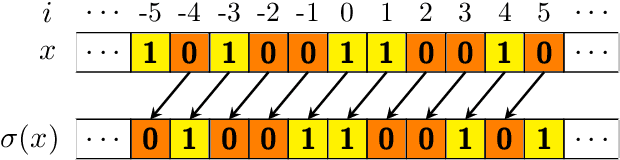
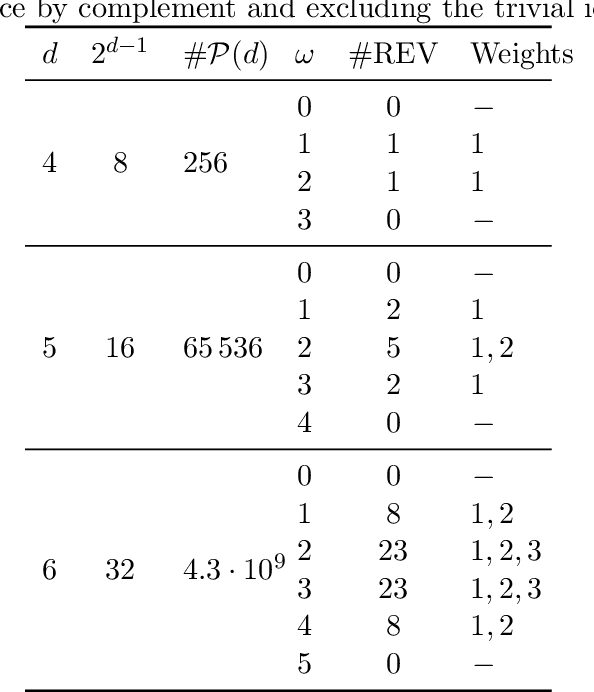
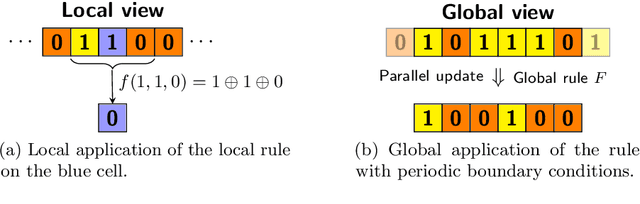
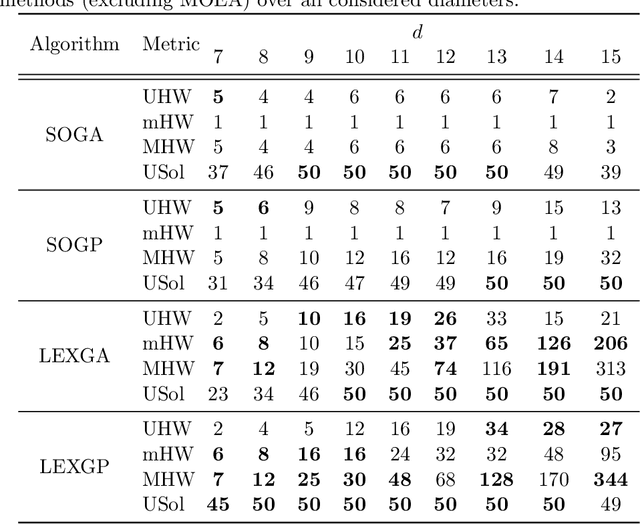
Reversible Cellular Automata (RCA) are a particular kind of shift-invariant transformations characterized by a dynamics composed only of disjoint cycles. They have many applications in the simulation of physical systems, cryptography and reversible computing. In this work, we formulate the search of a specific class of RCA -- namely, those whose local update rules are defined by conserved landscapes -- as an optimization problem to be tackled with Genetic Algorithms (GA) and Genetic Programming (GP). In particular, our experimental investigation revolves around three different research questions, which we address through a single-objective, a multi-objective, and a lexicographic approach. The results obtained from our experiments corroborate the previous findings and shed new light on 1) the difficulty of the associated optimization problem for GA and GP, 2) the relevance of conserved landscape CA in the domain of cryptography and reversible computing, and 3) the relationship between the reversibility property and the Hamming weight.