 Add to Chrome
 Add to Firefox
 Add to Edge
Quantifying Concentration Phenomena of Mean-Field Transformers in the Low-Temperature Regime
May 11, 2026
Transformers with self-attention modules as their core components have become an integral architecture in modern large language and foundation models. In this paper, we study the evolution of tokens in deep encoder-only transformers at inference time which is described in the large-token limit by a mean-field continuity equation. Leveraging ideas from the convergence analysis of interacting multi-particle systems, with particles corresponding to tokens, we prove that the token distribution rapidly concentrates onto the push-forward of the initial distribution under a projection map induced by the key, query, and value matrices, and remains metastable for moderate times. Specifically, we show that the Wasserstein distance of the two distributions scales like $\sqrt{{\log(β+1)}/β}\exp(Ct)+\exp(-ct)$ in terms of the temperature parameter $β^{-1}\to 0$ and inference time $t\geq 0$. For the proof, we establish Lyapunov-type estimates for the zero-temperature equation, identify its limit as $t\to\infty$, and employ a stability estimate in Wasserstein space together with a quantitative Laplace principle to couple the two equations. Our result implies that for time scales of order $\logβ$ the token distribution concentrates at the identified limiting distribution. Numerical experiments confirm this and, beyond that, complement our theory by showing that for finite $β$ and large $t$ the dynamics enter a different terminal phase, dominated by the spectrum of the value matrix.

Time-Delayed Transformers for Data-Driven Modeling of Low-Dimensional Dynamics
Feb 09, 2026We propose the time-delayed transformer (TD-TF), a simplified transformer architecture for data-driven modeling of unsteady spatio-temporal dynamics. TD-TF bridges linear operator-based methods and deep sequence models by showing that a single-layer, single-head transformer can be interpreted as a nonlinear generalization of time-delayed dynamic mode decomposition (TD-DMD). The architecture is deliberately minimal, consisting of one self-attention layer with a single query per prediction and one feedforward layer, resulting in linear computational complexity in sequence length and a small parameter count. Numerical experiments demonstrate that TD-TF matches the performance of strong linear baselines on near-linear systems, while significantly outperforming them in nonlinear and chaotic regimes, where it accurately captures long-term dynamics. Validation studies on synthetic signals, unsteady aerodynamics, the Lorenz '63 system, and a reaction-diffusion model show that TD-TF preserves the interpretability and efficiency of linear models while providing substantially enhanced expressive power for complex dynamics.
Exact Sequence Classification with Hardmax Transformers
Feb 04, 2025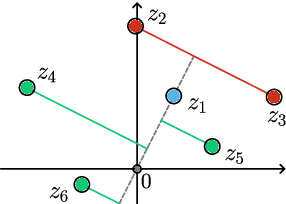

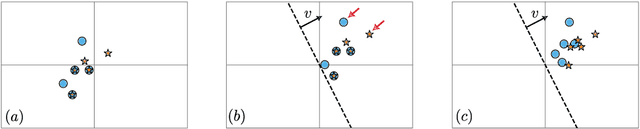
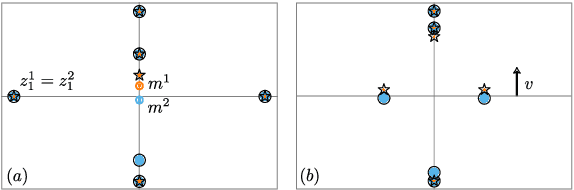
We prove that hardmax attention transformers perfectly classify datasets of $N$ labeled sequences in $\mathbb{R}^d$, $d\geq 2$. Specifically, given $N$ sequences with an arbitrary but finite length in $\mathbb{R}^d$, we construct a transformer with $\mathcal{O}(N)$ blocks and $\mathcal{O}(Nd)$ parameters perfectly classifying this dataset. Our construction achieves the best complexity estimate to date, independent of the length of the sequences, by innovatively alternating feed-forward and self-attention layers and by capitalizing on the clustering effect inherent to the latter. Our novel constructive method also uses low-rank parameter matrices within the attention mechanism, a common practice in real-life transformer implementations. Consequently, our analysis holds twofold significance: it substantially advances the mathematical theory of transformers and it rigorously justifies their exceptional real-world performance in sequence classification tasks.
Clustering in pure-attention hardmax transformers and its role in sentiment analysis
Jun 26, 2024Transformers are extremely successful machine learning models whose mathematical properties remain poorly understood. Here, we rigorously characterize the behavior of transformers with hardmax self-attention and normalization sublayers as the number of layers tends to infinity. By viewing such transformers as discrete-time dynamical systems describing the evolution of points in a Euclidean space, and thanks to a geometric interpretation of the self-attention mechanism based on hyperplane separation, we show that the transformer inputs asymptotically converge to a clustered equilibrium determined by special points called leaders. We then leverage this theoretical understanding to solve sentiment analysis problems from language processing using a fully interpretable transformer model, which effectively captures `context' by clustering meaningless words around leader words carrying the most meaning. Finally, we outline remaining challenges to bridge the gap between the mathematical analysis of transformers and their real-life implementation.