 Add to Chrome
 Add to Firefox
 Add to Edge
Sensorless Four-Channel Control Architecture Using Inverse Dynamics Modeling for Human-Scale Bilateral Teleoperation
Jul 01, 2026
The four-channel teleoperation architecture is a well-established framework for achieving transparency in bilateral systems. However, its performance in human-scale teleoperation is limited by high inertia, modeling challenges, and reliance on noisy and costly force/torque sensors. This paper introduces a sensorless four-channel architecture based on inverse dynamics modeling. The controller is implemented and validated on a customized WAM bilateral teleoperation setup. Experiments demonstrate that the proposed approach outperforms conventional two- and four-channel schemes as well as transparency-enhancement methods, improving position and force tracking, reducing operator effort, and increasing maximum transmittable impedance without external sensors. A door-opening case study involving sustained whole-body contact along the manipulator further demonstrates the effectiveness of the method in realistic human-scale manipulation tasks.

Reinforcement Learning Based Safe Decision Making for Highway Autonomous Driving
May 13, 2021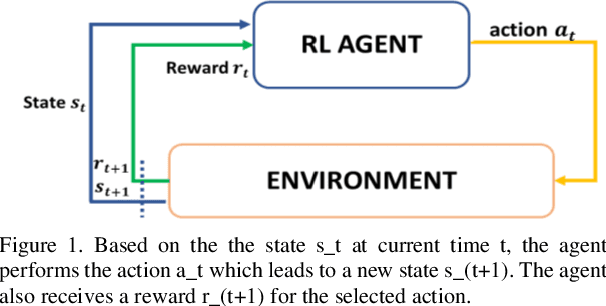
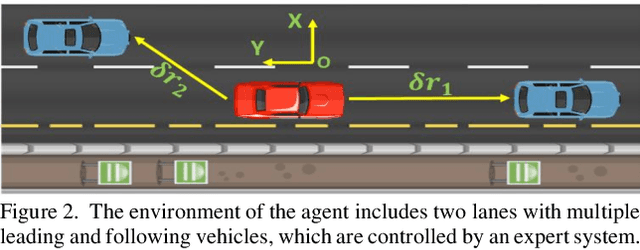
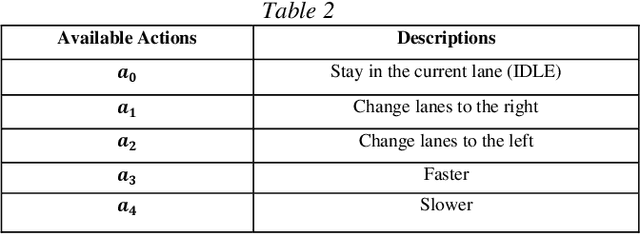
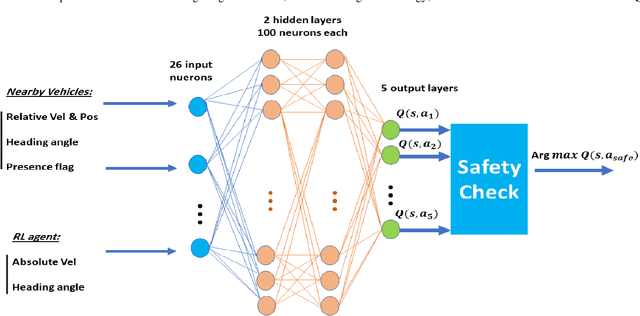
In this paper, we develop a safe decision-making method for self-driving cars in a multi-lane, single-agent setting. The proposed approach utilizes deep reinforcement learning (RL) to achieve a high-level policy for safe tactical decision-making. We address two major challenges that arise solely in autonomous navigation. First, the proposed algorithm ensures that collisions never happen, and therefore accelerate the learning process. Second, the proposed algorithm takes into account the unobservable states in the environment. These states appear mainly due to the unpredictable behavior of other agents, such as cars, and pedestrians, and make the Markov Decision Process (MDP) problematic when dealing with autonomous navigation. Simulations from a well-known self-driving car simulator demonstrate the applicability of the proposed method