 Add to Chrome
 Add to Firefox
 Add to Edge
Large AI Models in Dental Healthcare: From General-Purpose Systems to Domain-Specific Foundation Models
Jun 03, 2026
Background: Oral diseases affect nearly 3.5 billion people worldwide, yet the comparative clinical potential of large-scale AI models in dentistry remains poorly understood. Three distinct model categories have emerged: language-generative models, discriminative vision foundation models, and dental-specific foundation models, with no unified review examining their relationships and collective limitations. Methods: Following PRISMA-ScR guidelines, we systematically searched four databases (PubMed, Google Scholar, Scopus, arXiv), screened independently by two reviewers. After applying inclusion/exclusion criteria, 97 studies (2020-2026) were included. We propose a two-dimensional classification framework organizing models by architectural paradigm and dental specialization degree. Results: Language-generative models excel at text-based tasks (clinical reasoning, licensing exams, patient communication) but show inconsistent performance on image-dependent diagnostics. Adapted SAM and CLIP variants achieve strong tooth segmentation and lesion detection results. Dental-specific models (DentVFM, DentVLM, OralGPT) demonstrate strongest performance on complex multimodal tasks. Integrated pipelines consistently outperform single-model approaches. A data asymmetry is observed: dental-specific pretraining concentrates almost entirely in the vision domain, reflecting scarce large-scale dental text corpora. Conclusions: General-purpose and dental-specific models play complementary roles; the most effective systems combine both within structured pipelines. Safe autonomous deployment requires resolving three persistent barriers: hallucination in generative models, limited annotated dental datasets, and absent standardized clinical evaluation benchmarks.

Using Large Language Models to Automate Category and Trend Analysis of Scientific Articles: An Application in Ophthalmology
Aug 31, 2023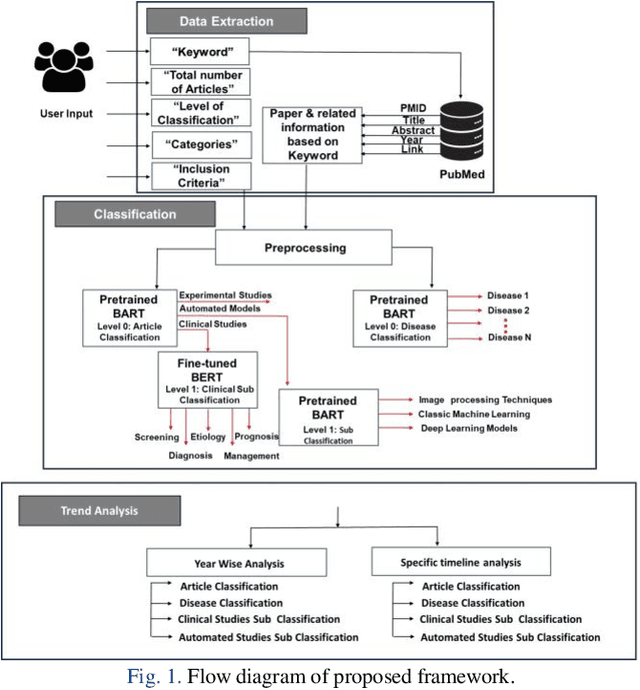
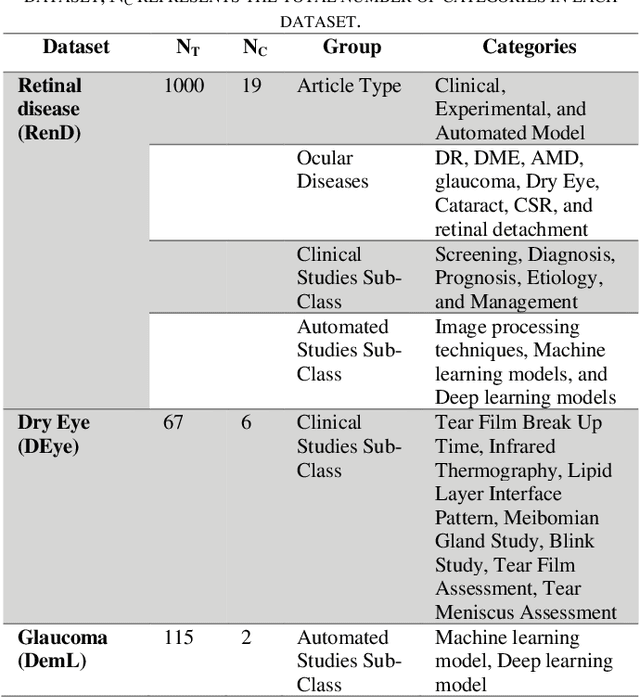
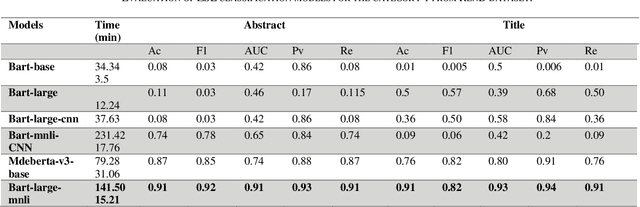
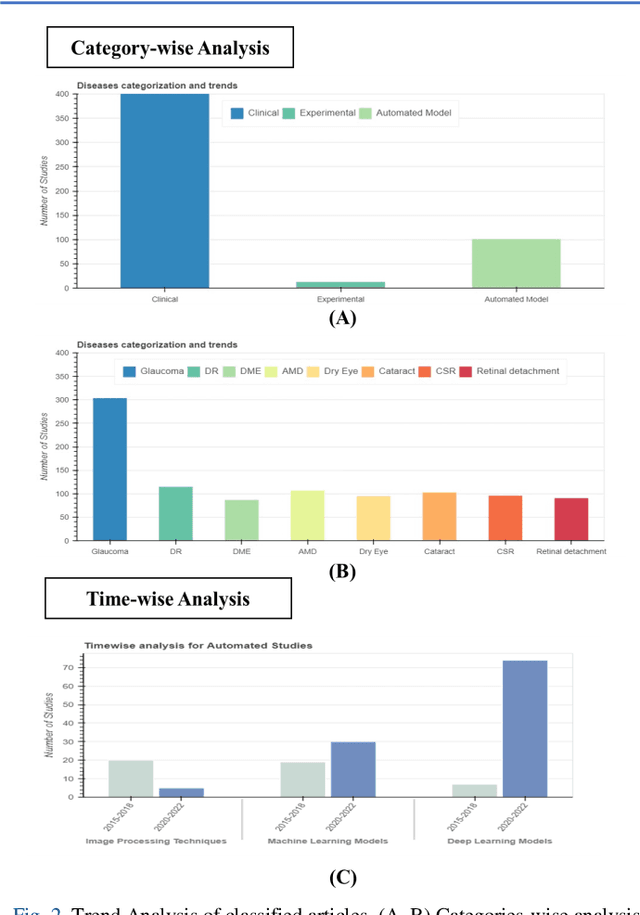
Purpose: In this paper, we present an automated method for article classification, leveraging the power of Large Language Models (LLM). The primary focus is on the field of ophthalmology, but the model is extendable to other fields. Methods: We have developed a model based on Natural Language Processing (NLP) techniques, including advanced LLMs, to process and analyze the textual content of scientific papers. Specifically, we have employed zero-shot learning (ZSL) LLM models and compared against Bidirectional and Auto-Regressive Transformers (BART) and its variants, and Bidirectional Encoder Representations from Transformers (BERT), and its variant such as distilBERT, SciBERT, PubmedBERT, BioBERT. Results: The classification results demonstrate the effectiveness of LLMs in categorizing large number of ophthalmology papers without human intervention. Results: To evalute the LLMs, we compiled a dataset (RenD) of 1000 ocular disease-related articles, which were expertly annotated by a panel of six specialists into 15 distinct categories. The model achieved mean accuracy of 0.86 and mean F1 of 0.85 based on the RenD dataset. Conclusion: The proposed framework achieves notable improvements in both accuracy and efficiency. Its application in the domain of ophthalmology showcases its potential for knowledge organization and retrieval in other domains too. We performed trend analysis that enables the researchers and clinicians to easily categorize and retrieve relevant papers, saving time and effort in literature review and information gathering as well as identification of emerging scientific trends within different disciplines. Moreover, the extendibility of the model to other scientific fields broadens its impact in facilitating research and trend analysis across diverse disciplines.