 Add to Chrome
 Add to Firefox
 Add to Edge
Beyond Independent Optimization: Compression, MoE Routing, and Quantization Interactions in Multimodal Edge Intelligence
Jul 23, 2026
Efficient multimodal inference is increasingly constrained not only by model quality or FLOP count, but also by the cost of preserving, moving, routing, caching, and quantizing multimodal representations under latency, memory, and energy constraints. This paper reviews recent advances in efficient vision-language and multimodal large language models, covering visual token compression, video token management, KV-cache optimization, Mixture-of-Experts (MoE) routing, low-bit quantization, edge deployment, and hardware-aware benchmarking. We argue that these techniques cannot be treated as independent optimizations. Visual token compression alters downstream feature distributions and MoE routing decisions, routing behavior affects expert utilization and quantization sensitivity, quantized router logits influence expert assignment, KV-cache policies determine retained multimodal evidence, and hardware constraints often transform computational savings into memory and communication bottlenecks. We organize the literature around these interactions and identify key design trade-offs, including accuracy versus token budget, static versus adaptive compression, sparse routing efficiency versus expert collapse, and low-bit inference versus modality-specific degradation. Finally, we introduce Temporal Routing Consistency as a diagnostic for video MoE models and highlight open research directions in routing-aware compression, cross-modal cache management, hardware-aware co-design, and unified benchmarking for multimodal edge intelligence.

A Deep Reinforcement Learning Approach for Adaptive Traffic Routing in Next-gen Networks
Feb 07, 2024
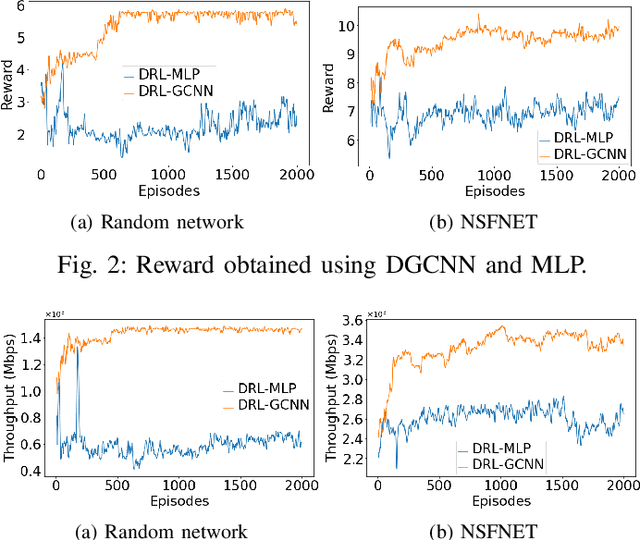


Next-gen networks require significant evolution of management to enable automation and adaptively adjust network configuration based on traffic dynamics. The advent of software-defined networking (SDN) and programmable switches enables flexibility and programmability. However, traditional techniques that decide traffic policies are usually based on hand-crafted programming optimization and heuristic algorithms. These techniques make non-realistic assumptions, e.g., considering static network load and topology, to obtain tractable solutions, which are inadequate for next-gen networks. In this paper, we design and develop a deep reinforcement learning (DRL) approach for adaptive traffic routing. We design a deep graph convolutional neural network (DGCNN) integrated into the DRL framework to learn the traffic behavior from not only the network topology but also link and node attributes. We adopt the Deep Q-Learning technique to train the DGCNN model in the DRL framework without the need for a labeled training dataset, enabling the framework to quickly adapt to traffic dynamics. The model leverages q-value estimates to select the routing path for every traffic flow request, balancing exploration and exploitation. We perform extensive experiments with various traffic patterns and compare the performance of the proposed approach with the Open Shortest Path First (OSPF) protocol. The experimental results show the effectiveness and adaptiveness of the proposed framework by increasing the network throughput by up to 7.8% and reducing the traffic delay by up to 16.1% compared to OSPF.