 Add to Chrome
 Add to Firefox
 Add to Edge
Robust Transfer Learning with Side Information
Mar 09, 2026
Robust Markov Decision Processes (MDPs) address environmental shift through distributionally robust optimization (DRO) by finding an optimal worst-case policy within an uncertainty set of transition kernels. However, standard DRO approaches require enlarging the uncertainty set under large shifts, which leads to overly conservative and pessimistic policies. In this paper, we propose a framework for transfer under environment shift that derives a robust target-domain policy via estimate-centered uncertainty sets, constructed through constrained estimation that integrates limited target samples with side information about the source-target dynamics. The side information includes bounds on feature moments, distributional distances, and density ratios, yielding improved kernel estimates and tighter uncertainty sets. The side information includes bounds on feature moments, distributional distances, and density ratios, yielding improved kernel estimates and tighter uncertainty sets. Error bounds and convergence results are established for both robust and non-robust value functions. Moreover, we provide a finite-sample guarantee on the learned robust policy and analyze the robust sub-optimality gap. Under mild low-dimensional structure on the transition model, the side information reduces this gap and improves sample efficiency. We assess the performance of our approach across OpenAI Gym environments and classic control problems, consistently demonstrating superior target-domain performance over state-of-the-art robust and non-robust baselines.

Distributionally Robust Domain Adaptation
Oct 30, 2022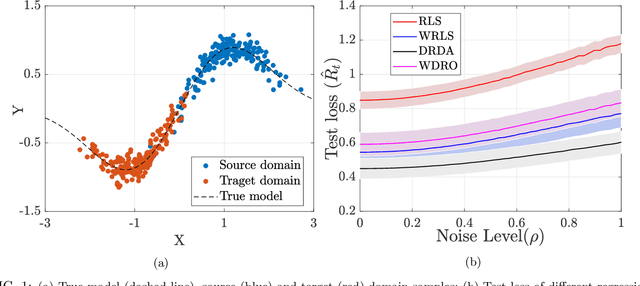
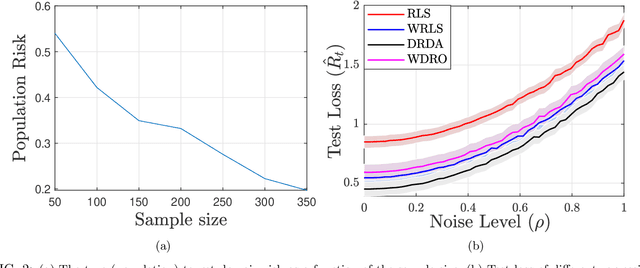

Domain Adaptation (DA) has recently received significant attention due to its potential to adapt a learning model across source and target domains with mismatched distributions. Since DA methods rely exclusively on the given source and target domain samples, they generally yield models that are vulnerable to noise and unable to adapt to unseen samples from the target domain, which calls for DA methods that guarantee the robustness and generalization of the learned models. In this paper, we propose DRDA, a distributionally robust domain adaptation method. DRDA leverages a distributionally robust optimization (DRO) framework to learn a robust decision function that minimizes the worst-case target domain risk and generalizes to any sample from the target domain by transferring knowledge from a given labeled source domain sample. We utilize the Maximum Mean Discrepancy (MMD) metric to construct an ambiguity set of distributions that provably contains the source and target domain distributions with high probability. Hence, the risk is shown to upper bound the out-of-sample target domain loss. Our experimental results demonstrate that our formulation outperforms existing robust learning approaches.