 Add to Chrome
 Add to Firefox
 Add to Edge
Performance Analysis of Millimeter Wave Radar Waveforms for Integrated Sensing and Communication
Feb 10, 2026
Next-generation intelligent transportation systems require both sensing and communication between road users. However, deploying separate radars and communication devices involves the allocation of individual frequency bands and hardware platforms. Integrated sensing and communication (ISAC) offers a robust solution to the challenges of spectral congestion by utilizing a shared waveform, hardware, and spectrum for both localization of mobile users and communication. Various waveforms, including phase-modulated continuous waves (PMCW) and frequency-modulated continuous waves (FMCW), have been explored for target localization using traditional radar. On the other hand, new protocols such as the IEEE 802.11ad have been proposed to support wideband communication between vehicles. This paper compares both traditional radar and communication candidate waveforms for ISAC to detect single-point and extended targets. We show that the response of FMCW to mobile targets is poorer than that of PMCW. However, the IEEE 802.11ad radar outperforms PMCW radar and FMCW radar. Additionally, the radar signal processing algorithms are implemented on Zynq system-on-chip through hardware-software co-design and fixed-point analysis to evaluate their computational complexity in real-world implementations.

Orthogonal Circular Polarized Transmitter and Receiver Antennas for Mitigation of Mutual Coupling in Monostatic Radars
Feb 10, 2026Through-wall radar systems require compact, wideband and high gain antennas for detecting targets. Building walls introduce considerable attenuation on the radar signals. When the transmitted power is raised to compensate the through-wall attenuation, the direct coupling between the transmitter and receiver can saturate the receiver because of which weaker reflections off the target may remain undetected. In this paper, we propose using transmitter and receiver antennas of orthogonal circular polarization to reduce the direct coupling between the transmitter and receiver while retaining the first bounce off the target. In our paper, we demonstrate that the quadrafilar helical antenna (QHA) is a good candidate for this operation since it is characterized by a small size, wide frequency band of operation, high gain and low axial ratio over a wide field of view. We compare the reduced mutual coupling between the transmitter and receiver elements for the oppositely polarized QHA antennas with other commonly used through-wall radar antennas such as the Vivaldi and horn antennas. The system is tested in through-wall conditions.
Motion Compensation for Multiple-Input-Multiple-Output Inverse Synthetic Aperture Imaging of Automotive Targets
Feb 10, 2026Inverse synthetic aperture radar (ISAR) images generated from single-channel automotive radar data provide critical information about the shape and size of automotive targets. However, the quality of ISAR images degrades due to road clutter and when translational and higher order rotational motions of the targets are not suitably compensated. One method to enhance the signal-to-clutter-and-noise ratio (SCNR) of the systems is to leverage the advantages of the multiple-input-multiple-output (MIMO) framework available in commercial automotive radars to generate MIMO-ISAR images. While substantial research has been devoted to motion compensation of single-channel ISAR images, the effectiveness of these methods for MIMO-ISAR has not been studied extensively. This paper analyzes the performance of three popular motion compensation techniques - entropy minimization, cross-correlation, and phase gradient autofocus - on MIMO-ISAR. The algorithms are evaluated on the measurement data collected using Texas Instruments millimeter-wave MIMO radar. The results indicate that the cross-correlation MOCOMP performs better than the other two MOCOMP algorithms in the MIMO configuration, with an overall improvement of 36%.
Radar Operating Metrics and Network Throughput for Integrated Sensing and Communications in Millimeter-wave Urban Environments
Feb 09, 2026Millimeter wave integrated sensing and communication (ISAC) systems are being researched for next-generation intelligent transportation systems. Here, radar and communication functionalities share a common spectrum and hardware resources in a time-multiplexed manner. The objective of the radar is to first scan the angular search space and detect and localize mobile users/targets in the presence of discrete clutter scatterers. Subsequently, this information is used to direct highly directional beams toward these mobile users for communication service. The choice of radar parameters such as the radar duty cycle and the corresponding beamwidth are critical for realizing high communication throughput. In this work, we use the stochastic geometry-based mathematical framework to analyze the radar operating metrics as a function of diverse radar, target, and clutter parameters and subsequently use these results to study the network throughput of the ISAC system. The results are validated through Monte Carlo simulations.
* 6 pages, 7 figures
IEEE 802.11ad-Aided 5-D Sensing with a UAV Swarm in Urban Environment
Feb 09, 2026Aerial base stations mounted on unmanned aerial vehicles (UAVs) support next-generation wireless networks in challenging environments such as urban areas, disaster zones, and remote locations. Further, UAV swarms overcome the challenges of limited battery life and other operational constraints of a single UAV. However, tracking mobile users on the ground by each UAV and the corresponding synchronization between the UAVs is a significant issue that must be addressed before this framework can be deployed in reality. Incorporating additional sensing capabilities to facilitate this additional requirement would introduce significant overhead in terms of hardware, cost, and power to each UAV. Instead, we propose an integrated sensing and communications-enabled swarm UAV system, based on the millimeter-wave IEEE 802.11ad protocol. Further, we show that our proposed system is capable of five-dimensional (5-D) ground target sensing (range, Doppler velocity, azimuth, elevation, and polarization) in an urban environment. Numerical experiments using realistic models demonstrate and validate the performance of 5-D sensing using our proposed 802-11ad-aided UAV system.
* 5 pages and 4 figures
Beam Alignment in Multipath Environments for Integrated Sensing and Communication using Bandit Learning
Feb 09, 2026Prior works have explored multi-armed bandit (MAB) algorithms for the selection of optimal beams for millimeter-wave (mmW) communications between base station and mobile users. However, when the number of beams is large, the existing MAB algorithms are characterized by long exploration times, resulting in poor overall communication throughput. In this work, we propose augmenting the upper confidence bound (UCB) based MAB with integrated sensing and communication (ISAC) to address this limitation. The premise of the work is that the radar and communication functionalities share the same field-of-view and that communication mobile users are detected by the radar as mobile targets. The radar information is used for significantly reducing the number of candidate beams for the UCB, resulting in an overall reduction in the exploration time. Further, the radar information is used to estimate the realignment time in quasi-stationary scenarios. We have realized the MAB and radar signal processing algorithms on the system on chip (SoC) via hardware-software co-design (HSCD) and fixed-point analysis. We demonstrate the significant gain in execution time using accelerators. The simulations consider complex propagation channels involving direct and multipath, with simple and extended radar targets in the presence of significant static clutter. The resulting experiments show that the proposed ISAC-based MAB achieves a 35% reduction in the overall exploration time and 1.4 factor higher throughput as compared to the conventional MAB that is based only on communications.
* 15 pages, 10 figures and 7 tables
Radar Enhanced Multi-Armed Bandit for Rapid Beam Selection in Millimeter Wave Communications
Jun 29, 2023Multi-arm bandit (MAB) algorithms have been used to learn optimal beams for millimeter wave communication systems. Here, the complexity of learning the optimal beam linearly scales with the number of beams, leading to high latency when there are a large number of beams. In this work, we propose to integrate radar with communication to enhance the MAB learning performance by searching only those beams where the radar detects a scatterer. Further, we use radar to distinguish the beams that show mobile targets from those which indicate the presence of static clutter, thereby reducing the number of beams to scan. Simulations show that our proposed radar-enhanced MAB reduces the exploration time by searching only the beams with distinct radar mobile targets resulting in improved throughput.
Hardware Software Co-Design Based Reconfigurable Radar Signal Processing Accelerator for Joint Radar-Communication System
Mar 03, 2023Millimeter wave (mmW) codesigned 802.11ad-based joint radar communication (JRC) systems have been identified as a potential solution for realizing high bandwidth connected vehicles for next-generation intelligent transportation systems. The radar functionality within the JRC enables accurate detection and localization of mobile targets, which can significantly speed up the selection of the optimal high-directional narrow beam required for mmW communications between the base station and mobile target. To bring JRC to reality, a radar signal processing (RSP) accelerator, co-located with the wireless communication physical layer (PHY), on edge platforms is desired. In this work, we discuss the three-dimensional digital hardware RSP framework for 802.11ad-based JRC to detect the range, azimuth, and Doppler velocity of multiple targets. We present a novel efficient reconfigurable architecture for RSP on multi-processor system-on-chip (MPSoC) via hardware-software co-design, word-length optimization, and serial-parallel configurations. We demonstrate the functional correctness of the proposed fixed-point architecture and significant savings in resource utilization (~40-70), execution time (1.5x improvement), and power consumption (50%) over floating-point architecture. The acceleration on hardware offers a 120-factor improvement in execution time over the benchmark Quad-core processor. The proposed architecture enables on-the-fly reconfigurability to support different azimuth precision and Doppler velocity resolution, offering a real-time trade-off between functional accuracy and detection time. We demonstrate end-to-end RSP on MPSoC with a user-friendly graphical user interface (GUI).
IEEE 802.11ad Based Joint Radar Communication Transceiver: Design, Prototype and Performance Analysis
Sep 09, 2022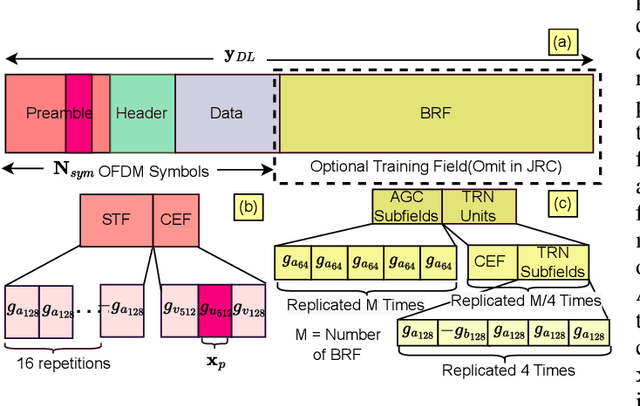
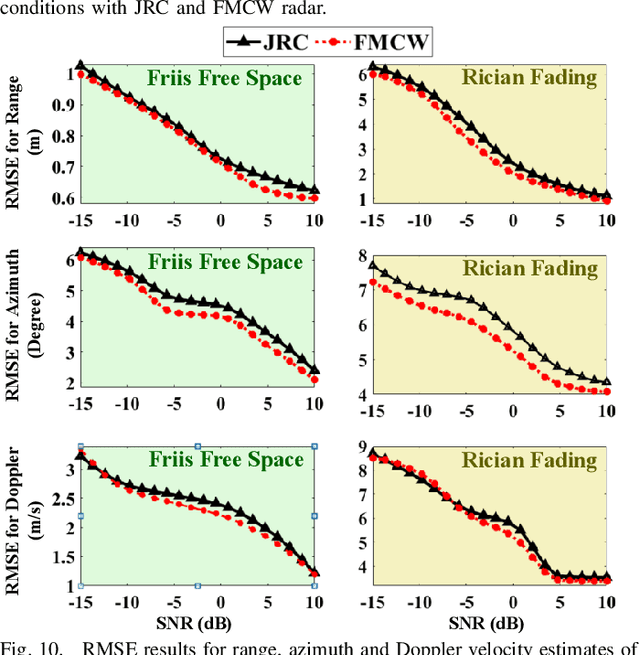
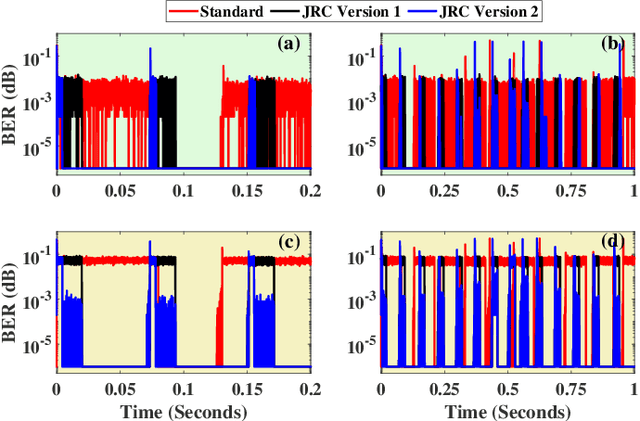
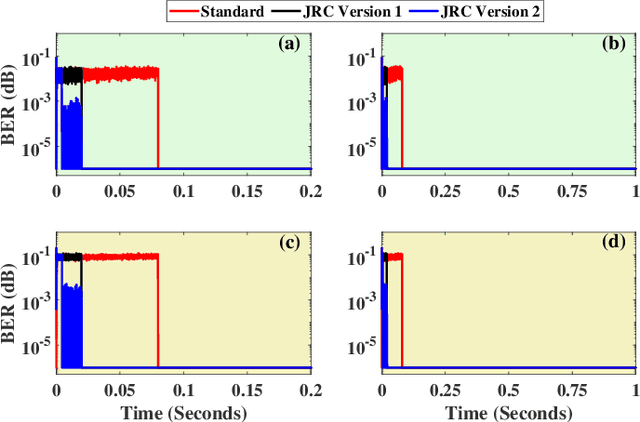
Rapid beam alignment is required to support high gain millimeter wave (mmW) communication links between a base station (BS) and mobile users (MU). The standard IEEE 802.11ad protocol enables beam alignment at the BS and MU through a lengthy beam training procedure accomplished through additional packet overhead. However, this results in reduced latency and throughput. Auxiliary radar functionality embedded within the communication protocol has been proposed in prior literature to enable rapid beam alignment of communication beams without the requirement of channel overheads. In this work, we propose a complete architectural framework of a joint radar-communication wireless transceiver wherein radar based detection of MU is realized to enable subsequent narrow beam communication. We provide a software prototype implementation with transceiver design details, signal models and signal processing algorithms. The prototype is experimentally evaluated with realistic simulations in free space and Rician propagation conditions and demonstrated to accelerate the beam alignment by a factor of four while reducing the overall bit error rate (BER) resulting in significant improvement in throughput with respect to standard 802.11ad. Likewise, the radar performance is found to be comparable to commonly used mmW radars.
Sparsity Based Autoencoders for Denoising Cluttered Radar Signatures
Jan 29, 2021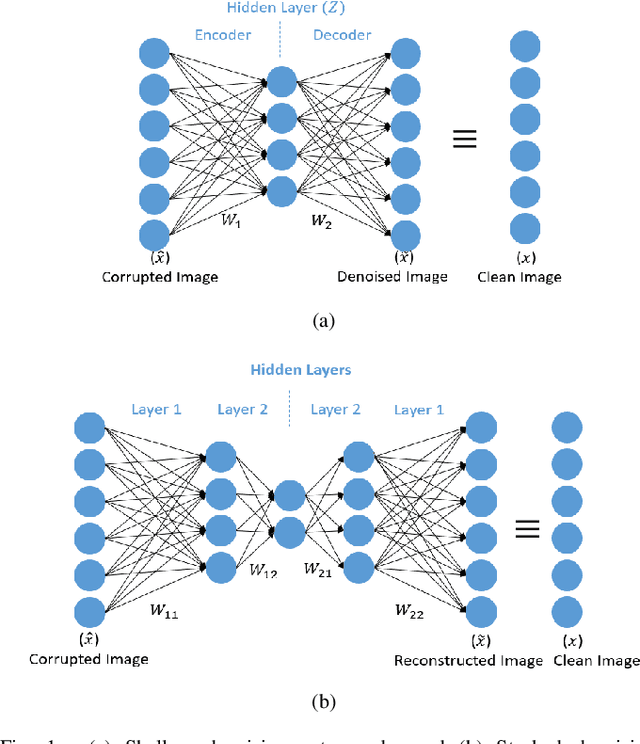
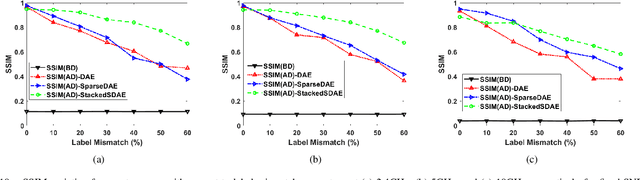
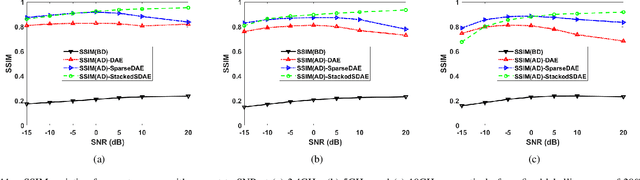
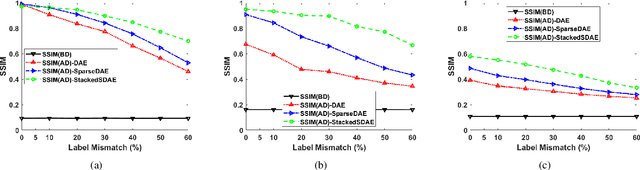
Narrowband and broadband indoor radar images significantly deteriorate in the presence of target dependent and independent static and dynamic clutter arising from walls. A stacked and sparse denoising autoencoder (StackedSDAE) is proposed for mitigating wall clutter in indoor radar images. The algorithm relies on the availability of clean images and corresponding noisy images during training and requires no additional information regarding the wall characteristics. The algorithm is evaluated on simulated Doppler-time spectrograms and high range resolution profiles generated for diverse radar frequencies and wall characteristics in around-the-corner radar (ACR) scenarios. Additional experiments are performed on range-enhanced frontal images generated from measurements gathered from a wideband RF imaging sensor. The results from the experiments show that the StackedSDAE successfully reconstructs images that closely resemble those that would be obtained in free space conditions. Further, the incorporation of sparsity and depth in the hidden layer representations within the autoencoder makes the algorithm more robust to low signal to noise ratio (SNR) and label mismatch between clean and corrupt data during training than the conventional single layer DAE. For example, the denoised ACR signatures show a structural similarity above 0.75 to clean free space images at SNR of -10dB and label mismatch error of 50%.