 Add to Chrome
 Add to Firefox
 Add to Edge
The Price of Reasoning: Cost-Quality Tradeoffs in Reinforcement Learning for Neural Machine Translation
Jul 21, 2026
Reinforcement learning with verifiable rewards (RLVR) has been established as a viable paradigm for the post-training of Large Language Models (LLMs), including downstream tasks, such as Neural Machine Translation (NMT). With the latest research indicating that RLVR could be the preferred training method for translating legal documents due to the induced reasoning capabilities, it raises the question whether it is really attributed to the reasoning or more generally to the training paradigm. We investigate the importance of including the model's reasoning trace in the generated responses during both training and inference by systematically omitting it from one of the phases. Our experiments show that including the reasoning, specifically during inference, has a positive effect on the overall translation quality. Furthermore, we recognise that the reasoning leads to an increase in output tokens, hence we study the cost-quality tradeoff between the increased computational demands and the improved translation quality.

Reasoning Before Translation: Enhancing Legal Machine Translation with Structured Reasoning
Jul 21, 2026Neural machine translation (NMT) in the legal domain is a linguistically and conceptually demanding task, primarily due to the complexity of legal language and the high level of precision it requires. The recent emergence of reasoning-capable language models opens new possibilities for tackling such challenges. They add to a set of other previously proposed techniques to enhance the translation quality, which includes supervised fine-tuning and reinforcement learning. In this work, we perform a comparison between these various approaches. More particularly, we evaluate small language models such as Qwen3.5 4B, Qwen3.5 9B, and Gemma 3 12B enhanced with various re-training paradigms and compare their performances against frontier reasoning models. We focus on the Swiss legal system, which -- with its unique multilingual statutes -- offers a particularly challenging testbed for reasoning-augmented models. Our results show that the quality of small ``base'' models can be greatly enhanced, and that reinforcement learning with verifiable rewards can be applied to NMT in the legal domain and surpasses the translation quality of supervised fine-tuning. The performance of enhanced small models is close to the one of state-of-the-art reasoning models yet remains inferior. We also note that re-training paradigms yield diminishing returns as model size increase. The code and models are publicly available at https://github.com/aixiuxiuxiu/Legal-MT-SFT-RL.
Blackbird's language matrices : a new benchmark to investigate disentangled generalisation in neural networks
May 22, 2022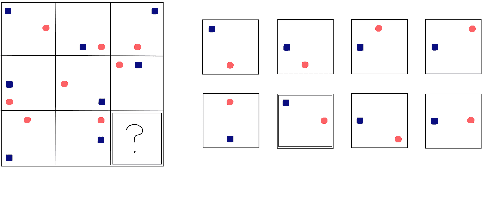
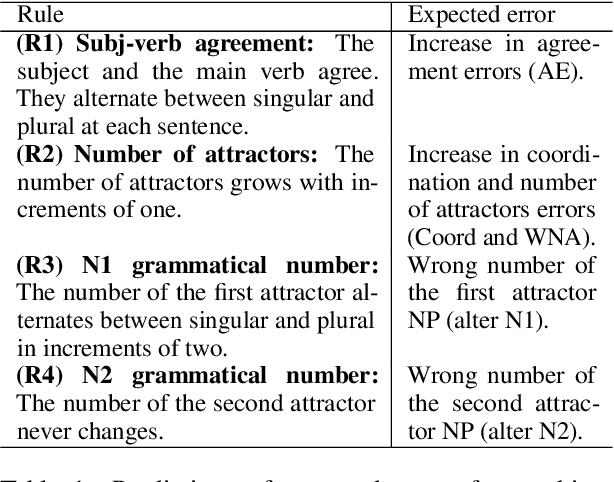
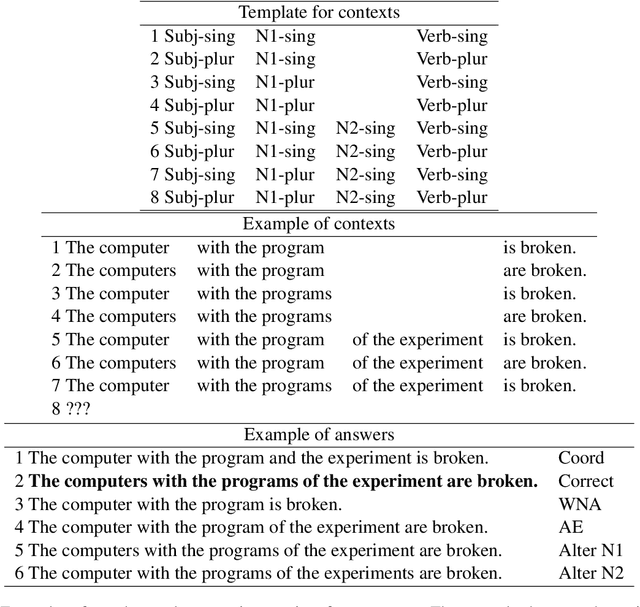
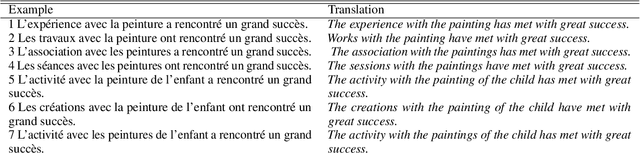
Current successes of machine learning architectures are based on computationally expensive algorithms and prohibitively large amounts of data. We need to develop tasks and data to train networks to reach more complex and more compositional skills. In this paper, we illustrate Blackbird's language matrices (BLMs), a novel grammatical dataset developed to test a linguistic variant of Raven's progressive matrices, an intelligence test usually based on visual stimuli. The dataset consists of 44800 sentences, generatively constructed to support investigations of current models' linguistic mastery of grammatical agreement rules and their ability to generalise them. We present the logic of the dataset, the method to automatically construct data on a large scale and the architecture to learn them. Through error analysis and several experiments on variations of the dataset, we demonstrate that this language task and the data that instantiate it provide a new challenging testbed to understand generalisation and abstraction.
Representation of Constituents in Neural Language Models: Coordination Phrase as a Case Study
Sep 10, 2019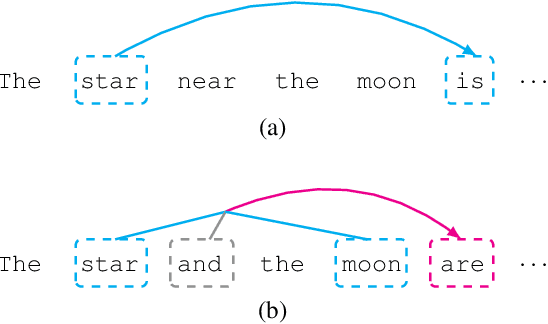
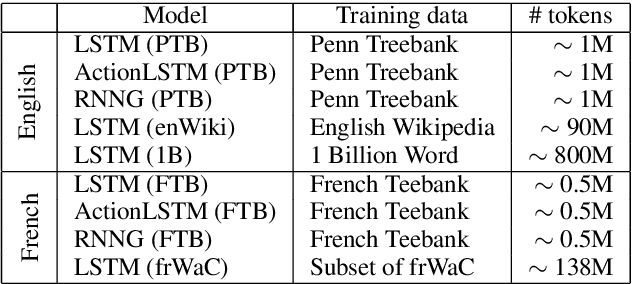
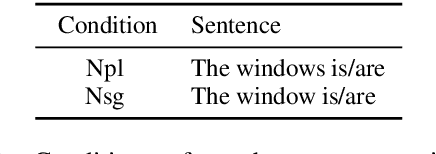
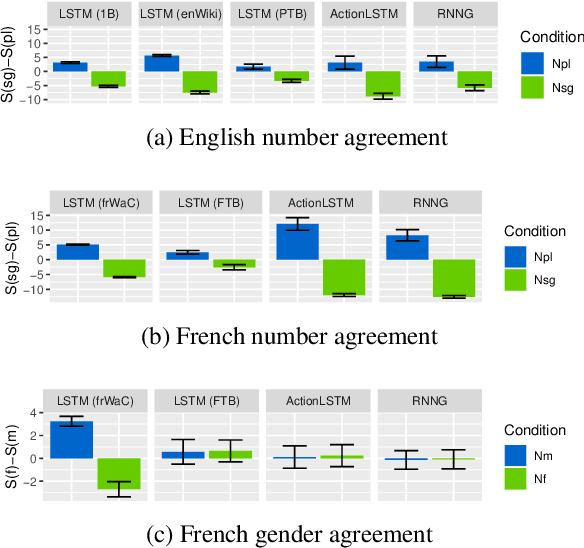
Neural language models have achieved state-of-the-art performances on many NLP tasks, and recently have been shown to learn a number of hierarchically-sensitive syntactic dependencies between individual words. However, equally important for language processing is the ability to combine words into phrasal constituents, and use constituent-level features to drive downstream expectations. Here we investigate neural models' ability to represent constituent-level features, using coordinated noun phrases as a case study. We assess whether different neural language models trained on English and French represent phrase-level number and gender features, and use those features to drive downstream expectations. Our results suggest that models use a linear combination of NP constituent number to drive CoordNP/verb number agreement. This behavior is highly regular and even sensitive to local syntactic context, however it differs crucially from observed human behavior. Models have less success with gender agreement. Models trained on large corpora perform best, and there is no obvious advantage for models trained using explicit syntactic supervision.