 Add to Chrome
 Add to Firefox
 Add to Edge
RIS-assisted Multiuser MISO Transmission and the Impact of Imperfect Channel Estimation
May 11, 2026
This paper proposes the joint design of reconfigurable intelligent surfaces (RIS) and zero-forcing (ZF) precoding for the downlink (DL) multiuser multiple-input single-output (MU-MISO) setup in millimeter-wave (mmWave) bands, where ZF is particularly attractive due to its ability to suppress inter-user interference by exploiting the large antenna arrays and sparse directional channels characteristic of mmWave systems. This ensures efficient spatial multiplexing with manageable complexity, making ZF a practical and in modern 5G/6G deployments. However, a careful design is necessary to overcome potential rank deficiency in the channel matrix. For the MU-MISO case, rank deficiency may arise if users exhibit significantly different channel gains or if, being in far-field, they are aligned with the position of the transmitter. On the other hand, the deployment of a RIS introduces artificial scattering which can shape the radio environment to address those situations. We explore the joint design under perfect channel knowledge, assess the impact of imperfect channel estimation on the bit error rate (BER) and propose a robust design of pilot transmissions that equalizes multiuser interference across users in the presence of channel errors in the precoder design. This evaluation shows the advantages of optimized RIS-aided ZF MU-MISO communication for the DL of wireless systems.
* This work has been accepted for publication in IEEE Communications Letters. The final published version is available via IEEE Xplore

Beyond Diagonal RIS-assisted MIMO Transmission: Beamforming Gain and Capacity Optimization
Dec 09, 2025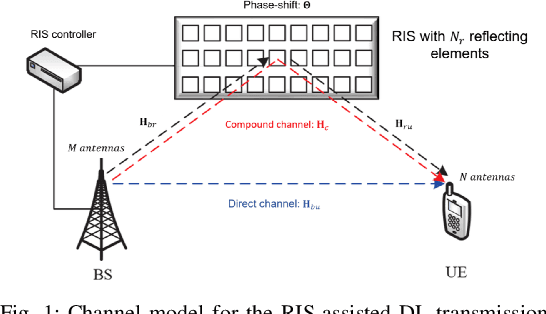
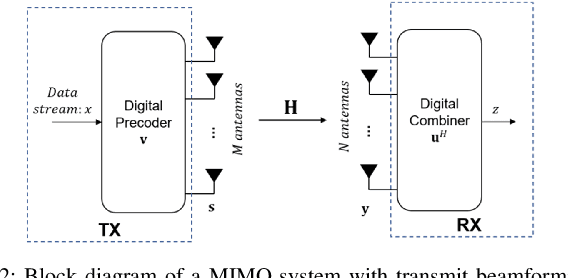
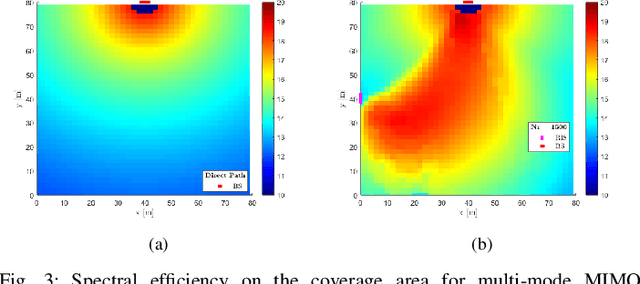
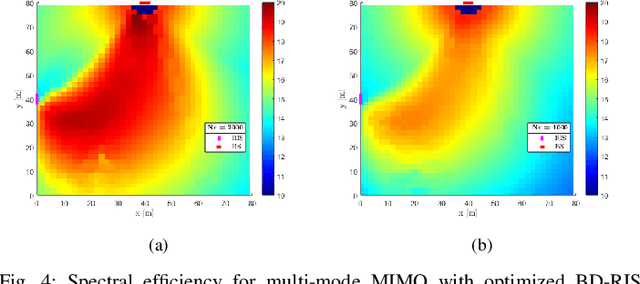
Reconfigurable Intelligent Surfaces (RIS) have emerged as a transformative technology in wireless communications, offering unprecedented control over signal propagation. This study focuses on passive beyond diagonal reconfigurable intelligent surface (BD-RIS), which has been proposed to generalize conventional diagonal RIS, in Multiple-Input Multiple-Output (MIMO) downlink (DL) communication systems. We compare the performance of transmit beamforming (TxBF) and MIMO capacity transmission with waterfilling power allocation in the millimeter wave (mmWave) band, where propagation primarily occurs under line-of-sight (LOS) conditions. In the lack of closed-form expressions for the optimal RIS elements in either case, our approach adopts a gradient-based optimization approach requiring lower complexity than the solution in arXiv:2406.02170. Numerical results reveal that BD-RIS significantly outperforms traditional diagonal RIS in terms of spectral efficiency and coverage
Contextual Bandits and Reconfigurable Intelligent Surfaces for Predictive LTM Handover Decisions
Dec 09, 2025This article addresses the challenge of optimizing handover (HO) in next-generation wireless networks by integrating Reconfigurable Intelligent Surfaces (RIS), predicting received signal power, and utilizing learning-based decision-making. A conventional reactive HO mechanism, such as lower-layer triggered mobility (LTM), is enhanced through linear prediction to anticipate link degradation. Additionally, the use of RIS helps to mitigate signal blockage and extend coverage. An online trained non-linear Contextual Multi-Armed Bandit (CMAB) agent selects target gNBs based on context features, which reduces unnecessary HO and signaling overhead. Extensive simulations evaluate eight combinations of these techniques under realistic mobility and channel conditions. Results show that CMAB and RSRP prediction consistently reduce the number of HO, ping-pong rate and cell preparations, while RIS improves link reliability.