 Add to Chrome
 Add to Firefox
 Add to Edge
Beyond Diagonal RIS-assisted MIMO Transmission: Beamforming Gain and Capacity Optimization
Paper and Code
Dec 09, 2025
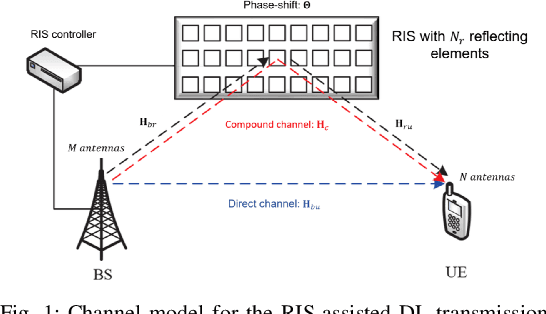
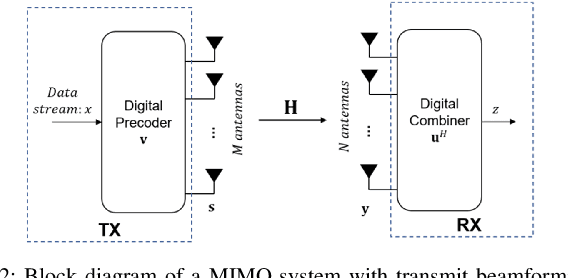
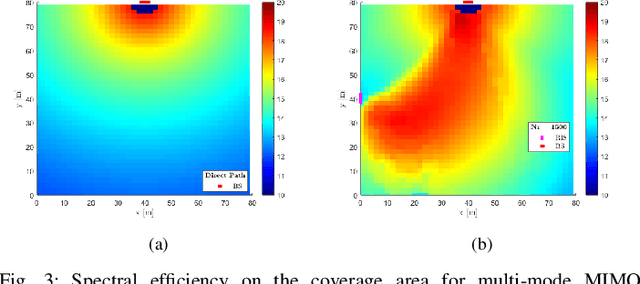
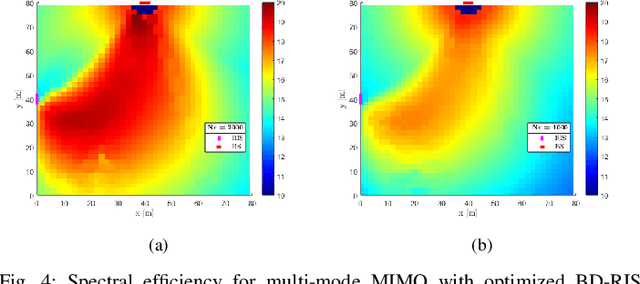
Reconfigurable Intelligent Surfaces (RIS) have emerged as a transformative technology in wireless communications, offering unprecedented control over signal propagation. This study focuses on passive beyond diagonal reconfigurable intelligent surface (BD-RIS), which has been proposed to generalize conventional diagonal RIS, in Multiple-Input Multiple-Output (MIMO) downlink (DL) communication systems. We compare the performance of transmit beamforming (TxBF) and MIMO capacity transmission with waterfilling power allocation in the millimeter wave (mmWave) band, where propagation primarily occurs under line-of-sight (LOS) conditions. In the lack of closed-form expressions for the optimal RIS elements in either case, our approach adopts a gradient-based optimization approach requiring lower complexity than the solution in arXiv:2406.02170. Numerical results reveal that BD-RIS significantly outperforms traditional diagonal RIS in terms of spectral efficiency and coverage
