 Add to Chrome
 Add to Firefox
 Add to Edge
LENS: LLM-guided Environment Simplification for Planning and Control in Clutter
Jul 22, 2026
Despite recent advances in general-purpose robotic manipulation, real-world multi-object clutter remains challenging to handle for today's prevalent approaches. The problem scales in complexity due to more objects and collisions, more unpredictable contact physics, distractors, and task ambiguity. Bridging this gap to real-world deployment requires effective scene abstractions; yet today, producing such abstractions requires extensive task-specific manual engineering, which does not scale. These abstractions are costly to generate and difficult to adjust or fine-tune. We instead propose a plug-and-play fix to automatically generate scene-specific, task-specific, adaptively updating abstractions on top of existing planning and control stacks. LLM-guided Environment Simplification (LENS) produces a de-cluttered abstracted scene representation by merging (e.g., stacked objects) or pruning (e.g., distant objects) scene entities in a closed loop in response to task progress. These dynamic, task-relevant abstractions are versatile and easy to use. In our experiments, we show that LENS improves classical planning, model-based control, and a vision-language-action model, across a diverse set of highly cluttered manipulation scenes. Project website: https://lens-2026.github.io/.

Delay-Aware Diffusion Policy: Bridging the Observation-Execution Gap in Dynamic Tasks
Dec 08, 2025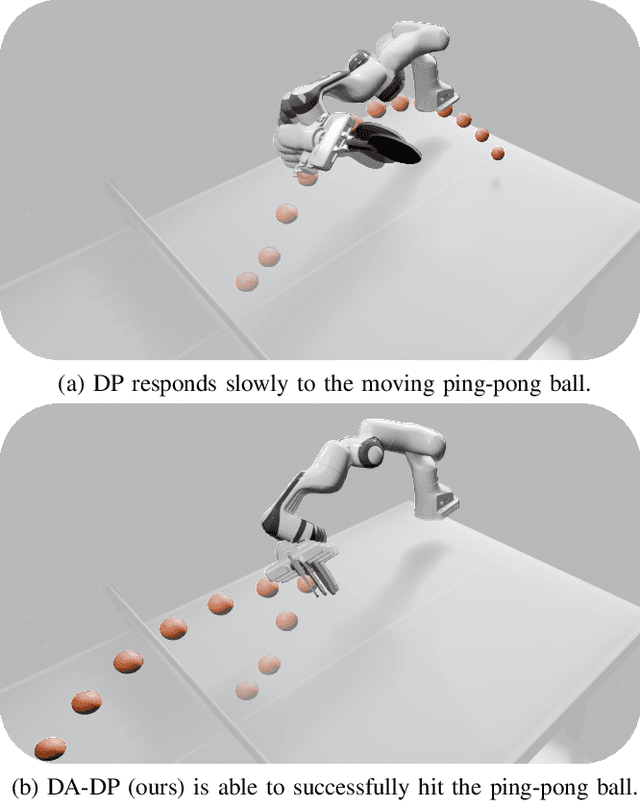
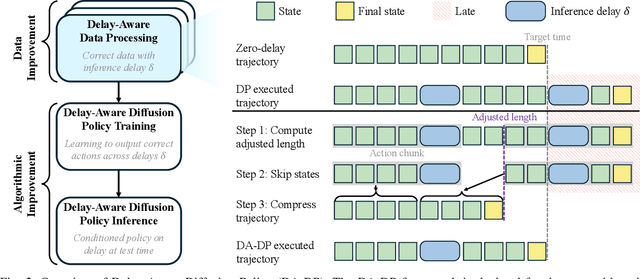
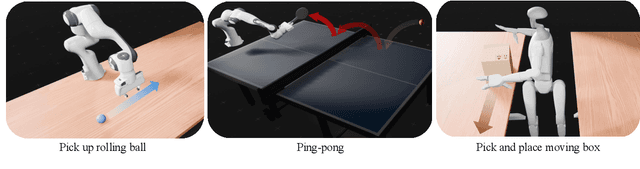
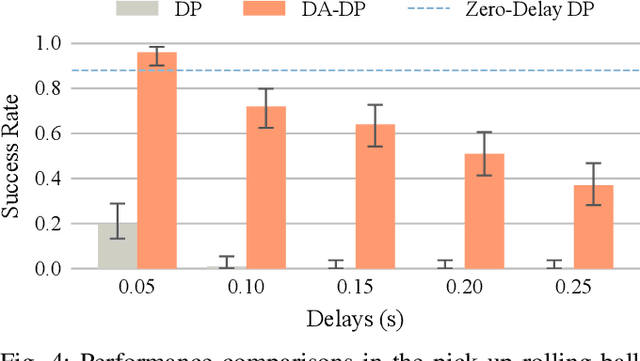
As a robot senses and selects actions, the world keeps changing. This inference delay creates a gap of tens to hundreds of milliseconds between the observed state and the state at execution. In this work, we take the natural generalization from zero delay to measured delay during training and inference. We introduce Delay-Aware Diffusion Policy (DA-DP), a framework for explicitly incorporating inference delays into policy learning. DA-DP corrects zero-delay trajectories to their delay-compensated counterparts, and augments the policy with delay conditioning. We empirically validate DA-DP on a variety of tasks, robots, and delays and find its success rate more robust to delay than delay-unaware methods. DA-DP is architecture agnostic and transfers beyond diffusion policies, offering a general pattern for delay-aware imitation learning. More broadly, DA-DP encourages evaluation protocols that report performance as a function of measured latency, not just task difficulty.
StageACT: Stage-Conditioned Imitation for Robust Humanoid Door Opening
Sep 16, 2025Humanoid robots promise to operate in everyday human environments without requiring modifications to the surroundings. Among the many skills needed, opening doors is essential, as doors are the most common gateways in built spaces and often limit where a robot can go. Door opening, however, poses unique challenges as it is a long-horizon task under partial observability, such as reasoning about the door's unobservable latch state that dictates whether the robot should rotate the handle or push the door. This ambiguity makes standard behavior cloning prone to mode collapse, yielding blended or out-of-sequence actions. We introduce StageACT, a stage-conditioned imitation learning framework that augments low-level policies with task-stage inputs. This effective addition increases robustness to partial observability, leading to higher success rates and shorter completion times. On a humanoid operating in a real-world office environment, StageACT achieves a 55% success rate on previously unseen doors, more than doubling the best baseline. Moreover, our method supports intentional behavior guidance through stage prompting, enabling recovery behaviors. These results highlight stage conditioning as a lightweight yet powerful mechanism for long-horizon humanoid loco-manipulation.