 Add to Chrome
 Add to Firefox
 Add to Edge
PG-KINN: A Physics-Informed Petrov-Galerkin Kolmogorov-Arnold Network for Solving Forward and Inverse PDEs
Jul 22, 2026
Physics-informed learning of partial differential equations (PDEs) has been dominated by multilayer perceptrons (MLPs), whose spectral bias and dense parameterization limit both accuracy and interpretability. Kolmogorov Arnold Networks (KANs) mitigate these limitations because their learnable spline activations are structurally aligned with the piecewise-polynomial bases of classical discretizations. However, the way a PDE is cast into a loss functional is as decisive as the choice of approximator: strong-form residual minimization requires high-order derivatives and heavily weighted losses, the energy (Bubnov-Galerkin) form is restricted to self-adjoint operators and, as we show, collapses to a trivial solution for parameter-identification problems, and boundary integral forms require a known fundamental solution. We propose PG-KINN, a physics-informed KAN built on a Petrov-Galerkin formulation in which the trial space is a KAN and the test space is an independent, compactly supported, piecewise-polynomial space evaluated with Gauss-Legendre quadrature. Integration by parts lowers the differentiation order while retaining applicability to general non-self-adjoint, nonlinear, and inverse problems; the localized test functions turn the global residual into a set of element-wise weak residuals with favorable conditioning. On a suite of benchmarks spanning crack singularities, stress concentration, Neo-Hookean hyperelasticity, inverse parameter identification in heterogeneous media, and complex geometries, PG-KINN consistently outperforms legacy MLP baselines and state-of-the-art KAN-based strong/energy/inverse formulations (PIKAN). These results position the Petrov-Galerkin coupling of KAN trial spaces and polynomial test spaces as a robust and accurate route for AI-based computational mechanics.

Hermite Neural Network Simulation for Solving the 2D Schrodinger Equation
Feb 16, 2024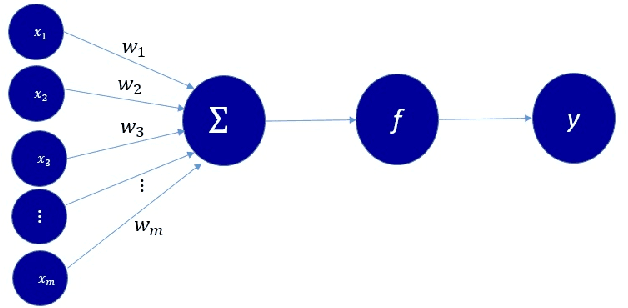
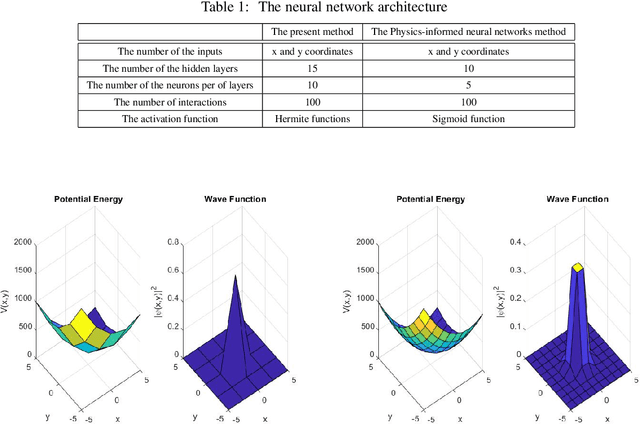
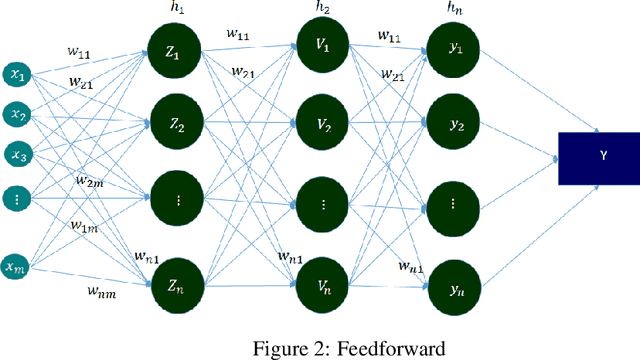
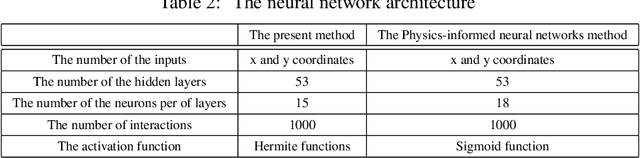
The Schrodinger equation is a mathematical equation describing the wave function's behavior in a quantum-mechanical system. It is a partial differential equation that provides valuable insights into the fundamental principles of quantum mechanics. In this paper, the aim was to solve the Schrodinger equation with sufficient accuracy by using a mixture of neural networks with the collocation method base Hermite functions. Initially, the Hermite functions roots were employed as collocation points, enhancing the efficiency of the solution. The Schrodinger equation is defined in an infinite domain, the use of Hermite functions as activation functions resulted in excellent precision. Finally, the proposed method was simulated using MATLAB's Simulink tool. The results were then compared with those obtained using Physics-informed neural networks and the presented method.