 Add to Chrome
 Add to Firefox
 Add to Edge
Learning plug-in surrogate endpoints for randomized experiments
May 12, 2026
Surrogate endpoints are used in place of long-term outcomes in randomized experiments when observing the real outcome for a large enough cohort is prohibitively expensive or impractical. A short-term surrogate is good if the result of an experiment using the surrogate is predictive of the result of a hypothetical study using the real outcome. Much attention has been paid to formalizing this property in causal terms, but most criteria are unidentifiable and cannot be turned into practical algorithms for learning surrogate endpoints from data. To address this, we study plug-in composite surrogates, functions of post-treatment variables that may be substituted directly for the primary outcome in a randomized experiment. We propose two methods for learning plug-in surrogates that maximize effect predictiveness, and characterize the possibility of finding endpoints that yield unbiased effect estimates in representative scenarios. Finally, in both synthetic experiments with known effects and in data from a real-world experiment, we find that our method, based on directly modeling the surrogate effect, returns plug-in endpoints more predictive of the primary effect than established methods.

Identifiable latent bandits: Combining observational data and exploration for personalized healthcare
Jul 29, 2024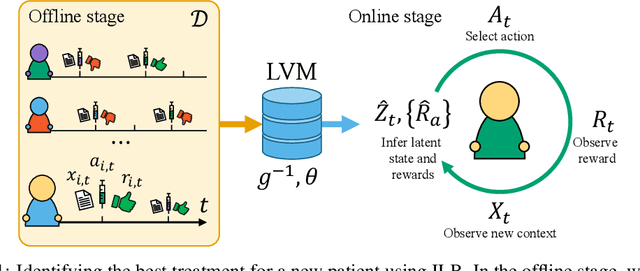
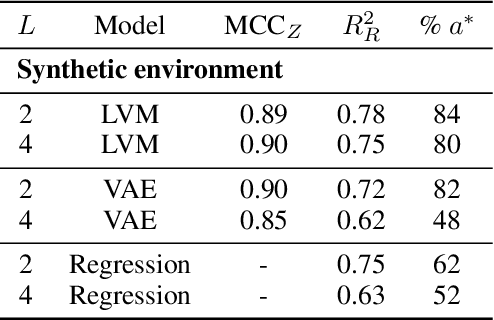
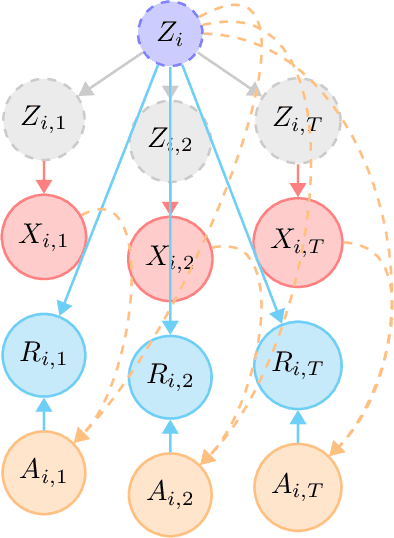
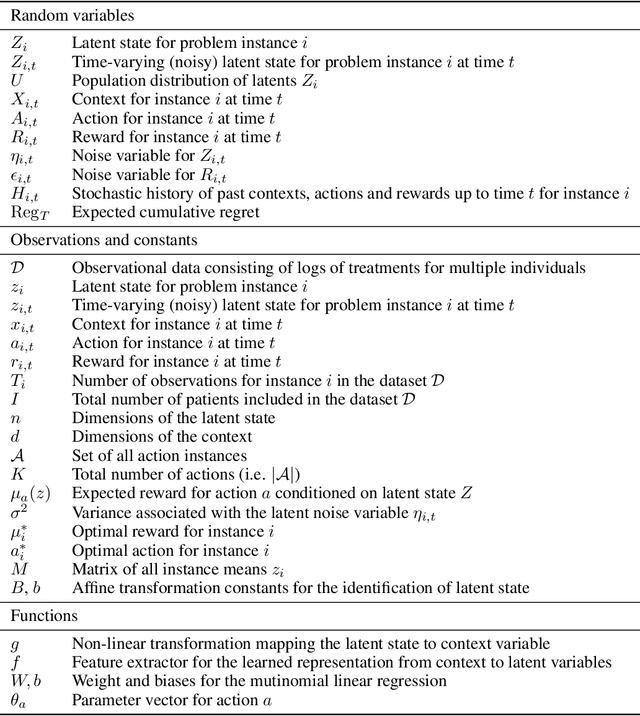
Bandit algorithms hold great promise for improving personalized decision-making but are notoriously sample-hungry. In most health applications, it is infeasible to fit a new bandit for each patient, and observable variables are often insufficient to determine optimal treatments, ruling out applying contextual bandits learned from multiple patients. Latent bandits offer both rapid exploration and personalization beyond what context variables can reveal but require that a latent variable model can be learned consistently. In this work, we propose bandit algorithms based on nonlinear independent component analysis that can be provably identified from observational data to a degree sufficient to infer the optimal action in a new bandit instance consistently. We verify this strategy in simulated data, showing substantial improvement over learning independent multi-armed bandits for every instance.