 Add to Chrome
 Add to Firefox
 Add to Edge
Evaluating SSL and ViViT Architectures for Cross-Corpus Audio MOS Prediction via LODO Validation
Jul 11, 2026
Automatic Mean Opinion Score (MOS) prediction is essential for evaluating large-scale synthetic speech and audio enhancement systems, yet models frequently struggle with domain shift. This study presents a comprehensive benchmarking of three architectural frameworks: Frozen Self-Supervised Learning (SSL-FRZ), Fine-Tuned SSL (SSL-FT), and a Video Vision Transformer (ViViT). Evaluation is conducted in two phases: Part I utilizes a consolidated corpus of 130,000 samples across 19 diverse datasets, while Part II focuses on a purified 17-dataset English-only corpus. To assess robustness, a systematic Leave-One-Dataset-Out (LODO) protocol is employed to quantify the generalization gap between seen and unseen distributions. Finally, the top-performing model is benchmarked against 18 state-of-the-art (SOTA) metrics using the ARECHO framework. Results demonstrate that an English-only purified corpus consistently yields higher predictive precision across all architectures. While SSL-FT achieves the highest performance on seen validation data, the SSL-FRZ model provides superior robustness on unseen distributions, achieving a competitive Mean Squared Error (MSE) of 0.36 on the URGENT 2024 benchmark-closely matching domain-optimized SOTA metrics (MSE 0.30). Although the ViViT architecture remains below SSL-based models in total capacity, it delivers stable results in English-only trials. LODO results confirm that while models perform significantly better on seen samples, frozen SSL embeddings combined with deep Transformer encoders offer the most stable and scalable solution for universal speech quality assessment. To support further research, the top-performing English-only SSL-Transformer model and weights are made publicly available via Hugging Face.

Fusion of Camera Model and Source Device Specific Forensic Methods for Improved Tamper Detection
Feb 24, 2020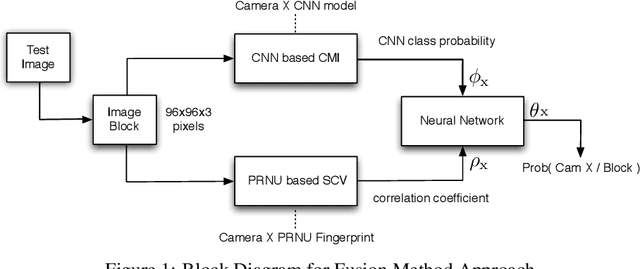
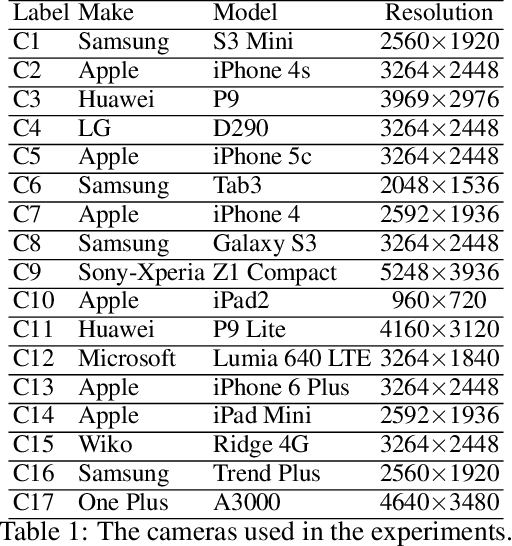

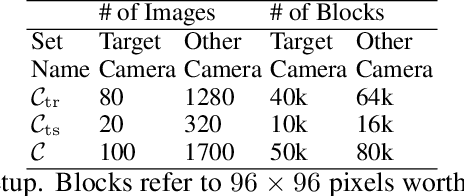
PRNU based camera recognition method is widely studied in the image forensic literature. In recent years, CNN based camera model recognition methods have been developed. These two methods also provide solutions to tamper localization problem. In this paper, we propose their combination via a Neural Network to achieve better small-scale tamper detection performance. According to the results, the fusion method performs better than underlying methods even under high JPEG compression. For forgeries as small as 100$\times$100 pixel size, the proposed method outperforms the state-of-the-art, which validates the usefulness of fusion for localization of small-size image forgeries. We believe the proposed approach is feasible for any tamper-detection pipeline using the PRNU based methodology.
Deep Learning Based Vehicle Make-Model Classification
Aug 23, 2018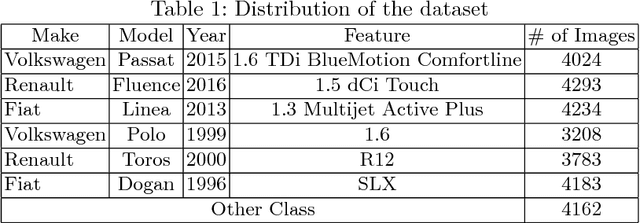
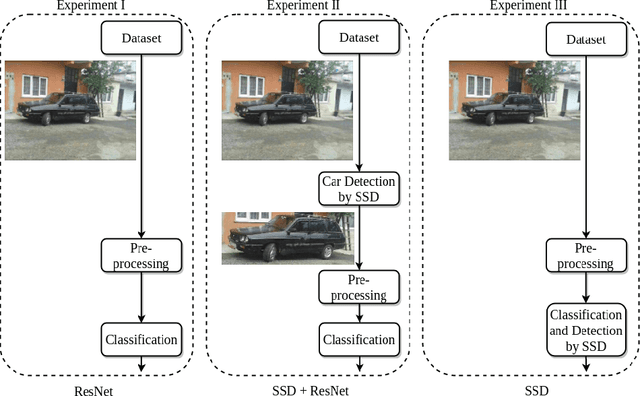
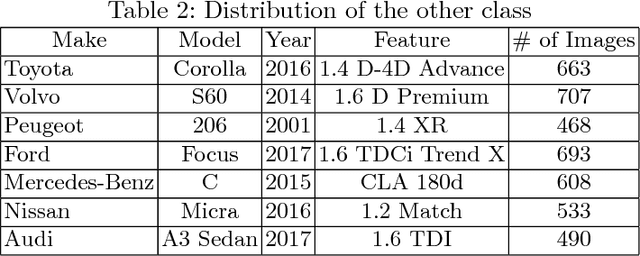
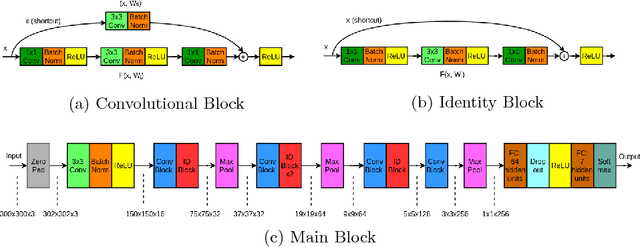
This paper studies the problems of vehicle make & model classification. Some of the main challenges are reaching high classification accuracy and reducing the annotation time of the images. To address these problems, we have created a fine-grained database using online vehicle marketplaces of Turkey. A pipeline is proposed to combine an SSD (Single Shot Multibox Detector) model with a CNN (Convolutional Neural Network) model to train on the database. In the pipeline, we first detect the vehicles by following an algorithm which reduces the time for annotation. Then, we feed them into the CNN model. It is reached approximately 4% better classification accuracy result than using a conventional CNN model. Next, we propose to use the detected vehicles as ground truth bounding box (GTBB) of the images and feed them into an SSD model in another pipeline. At this stage, it is reached reasonable classification accuracy result without using perfectly shaped GTBB. Lastly, an application is implemented in a use case by using our proposed pipelines. It detects the unauthorized vehicles by comparing their license plate numbers and make & models. It is assumed that license plates are readable.