 Add to Chrome
 Add to Firefox
 Add to Edge
Concept Drift Adaptation Using Self-Supervised and Reinforcement Learning In Android Malware Detection
May 22, 2026
Android malware detectors often degrade after deployment because of concept drift, while full retraining at each maintenance step is costly. We propose a chronological adaptive maintenance framework that models deployment-time maintenance as a sequential decision problem. The framework learns a stable latent representation through self-supervised learning during initialization, freezes the encoder, measures latent drift in the fixed representation space, and performs lightweight downstream adaptation using a trainable adapter and classification head. A proximal policy optimization controller selects low-cost maintenance actions based on the detector state, including current utility, retention on a fixed memory set, latent drift indicators, and update cost. We evaluate the framework under a causal deployment-style protocol on emulator and real Android malware datasets with static and dynamic features. Results show that the RL controller provides a strong cost-aware adaptation strategy, consistently remaining among the top-performing policies while achieving a favorable balance between temporal performance, memory retention, and maintenance cost under non-stationary deployment conditions.

Adversarial Vulnerability Under Temporal Concept Drift: A Longitudinal Study of Android Malware Detection
May 22, 2026We present a longitudinal, drift-aware evaluation of adversarial robustness across more than a decade of Android applications using static and dynamic feature representations extracted from emulator and real-device executions. The dataset is organized into yearly slices and evaluated under three deployment protocols that emulate realistic learning scenarios: (1) same-year training and testing, (2) cross-year deployment without model updates, and (3) expanding-window retraining with cumulative historical data. Across multiple classifier families, adversarial examples are generated using FGSM and SPSA under feasibility constraints. We measure clean performance, Adversarial Accuracy (AA), Attack Success Rate (ASR), and introduce temporal linkage metrics -- RobustDrop, $Δ$ASR, and Adversarial Amplification Factor (AAF) -- to quantify the relationship between distribution shift and robustness degradation.nResults show that temporal separation is associated with reduced adversarial robustness under the evaluated transfer-based feature-space setting. As the train-test gap increases, clean accuracy and adversarial accuracy decline, while attack success exhibits configuration-dependent increases, particularly under FGSM perturbations and static features. Expanding-window retraining mitigates, but does not eliminate, robustness loss under continued distributional evolution. These findings indicate that temporal drift should be considered when assessing the long-term robustness of intelligent detection systems under evolving data distributions and highlight the need for drift-aware robustness assessment frameworks in long-lived adversarial environments.
Enhancing Reliability in LLM-Based Secure Code Generation
May 22, 2026Large language models (LLMs) are widely used for code generation, but their security reliability remains inconsistent across languages and prompting strategies. Existing prompt engineering improves functional correctness but rarely ensures consistent security outcomes. We introduce the \textit{Mitigation-Aware Chain-of-Thought (MA-CoT)} framework, which embeds task-specific CWE mitigation guidance and language-aware safeguards to reduce recurring vulnerabilities in generated code. We evaluate MA-CoT across three LLMs (gpt-5, claude-4.5, gemini-2.5), three programming languages (C, Java, Python), and four prompting strategies (Vanilla, Zero-shot, CoT, MA-CoT) on a 200-task primary dataset, with external validation on LLMSecEval. Using static analysis with expert validation, MA-CoT reduces total security findings from 92 to 39 (57.6\%) on the primary dataset and from 73 to 4 (94.5\%) on LLMSecEval. High-severity findings (Blocker + Critical) drop from 90 to 39 (56.7\%) and from 45 to 2 (95.6\%), respectively. Across both datasets, MA-CoT is the only strategy that consistently improves security reliability; Zero-shot and CoT are less reliable and may increase vulnerability, especially in C. We further introduce a strict layered attribution of vulnerability drivers (language-core vs. stack layers) and show that residual risk concentrates in hardening-oriented patterns (e.g., OS- and toolchain-dependent), motivating secure-by-construction primitives alongside prompting.
An Empirical Evaluation of LLM-Generated Code Security Across Prompting Methods
May 22, 2026The growing use of Large Language Models (LLMs) for automated code generation has enhanced software development efficiency, but often at the cost of security. Generated code frequently overlooks critical concerns, leaving it vulnerable to issues such as weak encryption and improper input validation. To investigate this problem, we present a comprehensive empirical evaluation of the security quality of LLM-generated code across five LLMs and four programming languages (Java, C++, C, and Python), examining the impact of multiple prompt engineering methods. We introduce a weaknesses-aware zero-shot chain-of-thought (WA-0CoT) prompting strategy that enriches prompts with security context using CWE mappings to guide model reasoning. Our empirical analysis, supported by chi-square tests, finds no statistically significant reductions in vulnerability frequency or density across prompt methods. However, prompting strategies, including WA-0CoT, systematically influence the compositional distribution of CWE categories, with effects varying by programming language. These findings suggest that while security-aware prompting alters the structure of generated weaknesses, prompt engineering alone is insufficient to reliably reduce overall vulnerability levels. The results highlight the importance of language-aware and model-aware prompt design when evaluating the security properties of LLM-generated code.
A Quasi-Experimental Developer Study of Security Training in LLM-Assisted Web Application Development
Apr 20, 2026This paper presents a controlled quasi-experimental developer study examining whether a layer-based security training package is associated with improved security quality in LLM-assisted implementation of an identity-centric Java Spring Boot backend. The study uses a mixed design with a within-subject pre-training versus post-training comparison and an exploratory between-subject expertise factor. Twelve developers completed matched runs under a common interface, fixed model configuration, counterbalanced task sets, and a shared starter project. Security outcomes were assessed via independent manual validation of submitted repositories by the first and second authors. The primary participant-level endpoint was a severity-weighted validated-weakness score. The post-training condition showed a significant paired reduction under an exact Wilcoxon signed-rank test ($p = 0.0059$). In aggregate, validated weaknesses decreased from 162 to 111 (31.5\%), the severity-weighted burden decreased from 432 to 267 (38.2\%), and critical findings decreased from 24 to 5 (79.2\%). The largest reductions were in authorization and object access (53.3\%) and in authentication, credential policy, and recovery weaknesses (44.7\%). Session and browser trust-boundary issues showed minimal change, while sensitive-data and cryptographic weaknesses showed only marginal improvement. These results suggest that, under the tested conditions, post-training runs reduce validated security burden in LLM-assisted backend development without modifying the model. They do not support replacing secure defaults, static analysis, expert review, or operational hardening.
Empirical Evaluation of Concept Drift in ML-Based Android Malware Detection
Jul 30, 2025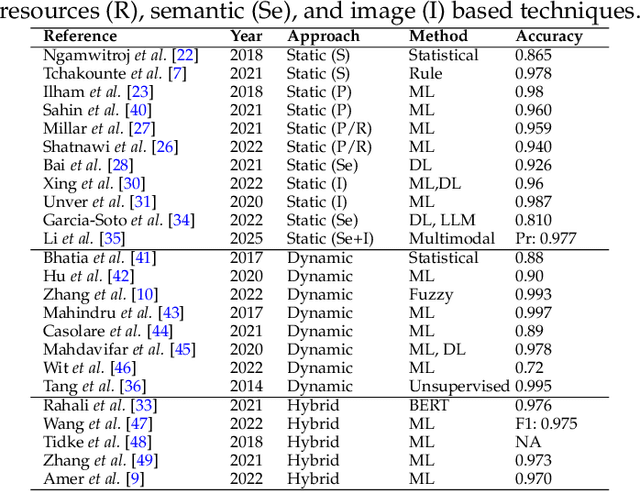
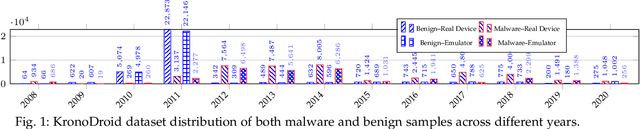
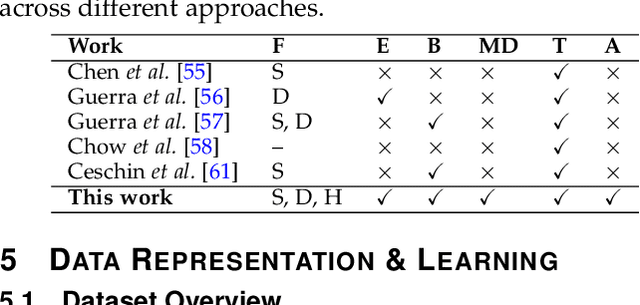
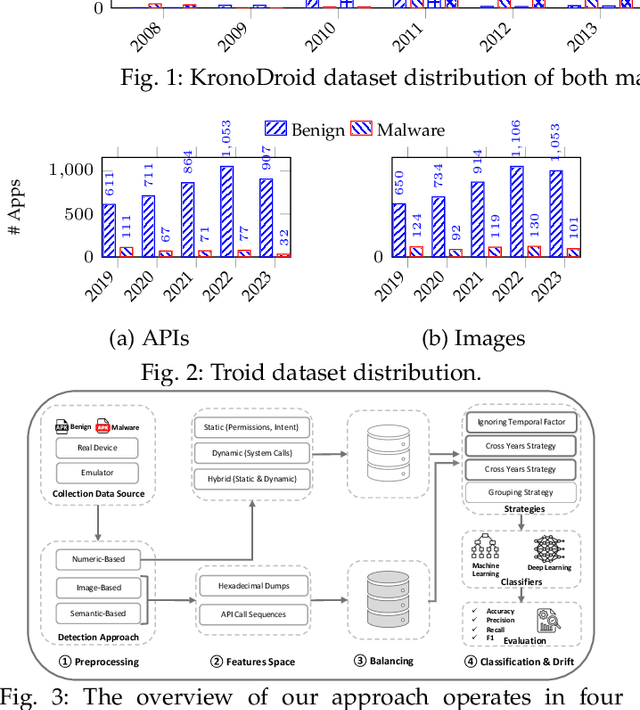
Despite outstanding results, machine learning-based Android malware detection models struggle with concept drift, where rapidly evolving malware characteristics degrade model effectiveness. This study examines the impact of concept drift on Android malware detection, evaluating two datasets and nine machine learning and deep learning algorithms, as well as Large Language Models (LLMs). Various feature types--static, dynamic, hybrid, semantic, and image-based--were considered. The results showed that concept drift is widespread and significantly affects model performance. Factors influencing the drift include feature types, data environments, and detection methods. Balancing algorithms helped with class imbalance but did not fully address concept drift, which primarily stems from the dynamic nature of the malware landscape. No strong link was found between the type of algorithm used and concept drift, the impact was relatively minor compared to other variables since hyperparameters were not fine-tuned, and the default algorithm configurations were used. While LLMs using few-shot learning demonstrated promising detection performance, they did not fully mitigate concept drift, highlighting the need for further investigation.
Understanding Concept Drift with Deprecated Permissions in Android Malware Detection
Jul 29, 2025Permission analysis is a widely used method for Android malware detection. It involves examining the permissions requested by an application to access sensitive data or perform potentially malicious actions. In recent years, various machine learning (ML) algorithms have been applied to Android malware detection using permission-based features and feature selection techniques, often achieving high accuracy. However, these studies have largely overlooked important factors such as protection levels and the deprecation or restriction of permissions due to updates in the Android OS -- factors that can contribute to concept drift. In this study, we investigate the impact of deprecated and restricted permissions on the performance of machine learning models. A large dataset containing 166 permissions was used, encompassing more than 70,000 malware and benign applications. Various machine learning and deep learning algorithms were employed as classifiers, along with different concept drift detection strategies. The results suggest that Android permissions are highly effective features for malware detection, with the exclusion of deprecated and restricted permissions having only a marginal impact on model performance. In some cases, such as with CNN, accuracy improved. Excluding these permissions also enhanced the detection of concept drift using a year-to-year analysis strategy. Dataset balancing further improved model performance, reduced low-accuracy instances, and enhanced concept drift detection via the Kolmogorov-Smirnov test.