 Add to Chrome
 Add to Firefox
 Add to Edge
Hybrid Responsible AI-Stochastic Approach for SLA Compliance in Multivendor 6G Networks
Feb 10, 2026
The convergence of AI and 6G network automation introduces new challenges in maintaining transparency, fairness, and accountability across multivendor management systems. Although closed-loop AI orchestration improves adaptability and self-optimization, it also creates a responsibility gap, where violations of SLAs cannot be causally attributed to specific agents or vendors. This paper presents a hybrid responsible AI-stochastic learning framework that embeds fairness, robustness, and auditability directly into the network control loop. The framework integrates RAI games with stochastic optimization, enabling dynamic adversarial reweighting and probabilistic exploration across heterogeneous vendor domains. An RAAP continuously records AI-driven decision trajectories and produces dual accountability reports: user-level SLA summaries and operator-level responsibility analytics. Experimental evaluations on synthetic two-class multigroup datasets demonstrate that the proposed hybrid model improves the accuracy of the worst group by up to 10.5\%. Specifically, hybrid RAI achieved a WGAcc of 60.5\% and an AvgAcc of 72.7\%, outperforming traditional RAI-GA (50.0\%) and ERM (21.5\%). The audit mechanism successfully traced 99\% simulated SLA violations to the AI entities responsible, producing both vendor and agent-level accountability indices. These results confirm that the proposed hybrid approach enhances fairness and robustness as well as establishes a concrete accountability framework for autonomous SLA assurance in multivendor 6G networks.

Closing the Responsibility Gap in AI-based Network Management: An Intelligent Audit System Approach
Feb 08, 2025Existing network paradigms have achieved lower downtime as well as a higher Quality of Experience (QoE) through the use of Artificial Intelligence (AI)-based network management tools. These AI management systems, allow for automatic responses to changes in network conditions, lowering operation costs for operators, and improving overall performance. While adopting AI-based management tools enhance the overall network performance, it also introduce challenges such as removing human supervision, privacy violations, algorithmic bias, and model inaccuracies. Furthermore, AI-based agents that fail to address these challenges should be culpable themselves rather than the network as a whole. To address this accountability gap, a framework consisting of a Deep Reinforcement Learning (DRL) model and a Machine Learning (ML) model is proposed to identify and assign numerical values of responsibility to the AI-based management agents involved in any decision-making regarding the network conditions, which eventually affects the end-user. A simulation environment was created for the framework to be trained using simulated network operation parameters. The DRL model had a 96% accuracy during testing for identifying the AI-based management agents, while the ML model using gradient descent learned the network conditions at an 83% accuracy during testing.
Distributed Traffic Control in Complex Dynamic Roadblocks: A Multi-Agent Deep RL Approach
Dec 31, 2024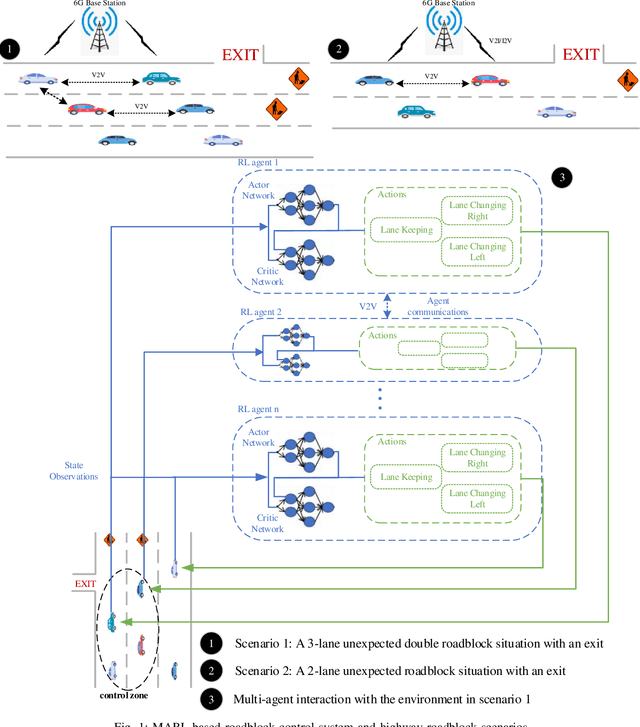

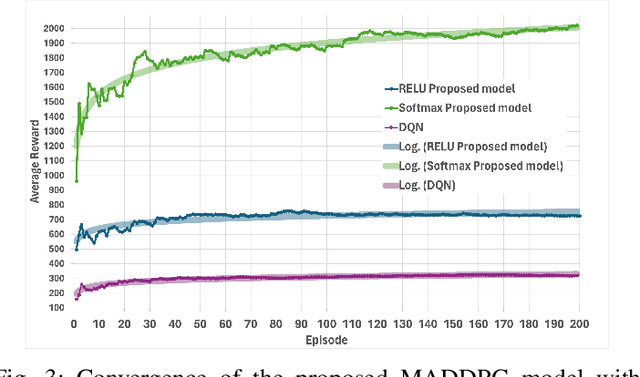
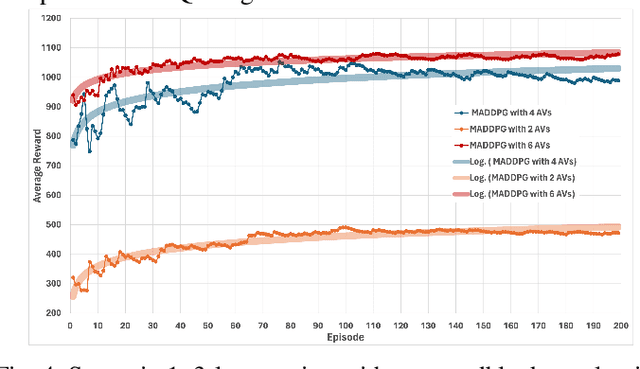
Autonomous Vehicles (AVs) represent a transformative advancement in the transportation industry. These vehicles have sophisticated sensors, advanced algorithms, and powerful computing systems that allow them to navigate and operate without direct human intervention. However, AVs' systems still get overwhelmed when they encounter a complex dynamic change in the environment resulting from an accident or a roadblock for maintenance. The advanced features of Sixth Generation (6G) technology are set to offer strong support to AVs, enabling real-time data exchange and management of complex driving maneuvers. This paper proposes a Multi-Agent Reinforcement Learning (MARL) framework to improve AVs' decision-making in dynamic and complex Intelligent Transportation Systems (ITS) utilizing 6G-V2X communication. The primary objective is to enable AVs to avoid roadblocks efficiently by changing lanes while maintaining optimal traffic flow and maximizing the mean harmonic speed. To ensure realistic operations, key constraints such as minimum vehicle speed, roadblock count, and lane change frequency are integrated. We train and test the proposed MARL model with two traffic simulation scenarios using the SUMO and TraCI interface. Through extensive simulations, we demonstrate that the proposed model adapts to various traffic conditions and achieves efficient and robust traffic flow management. The trained model effectively navigates dynamic roadblocks, promoting improved traffic efficiency in AV operations with more than 70% efficiency over other benchmark solutions.
Zero-touch realization of Pervasive Artificial Intelligence-as-a-service in 6G networks
Jul 21, 2023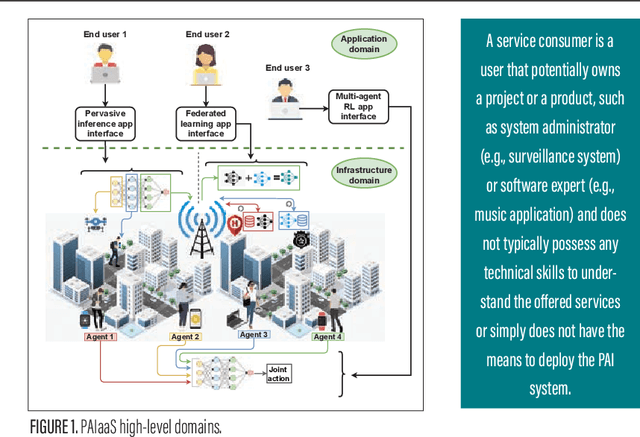
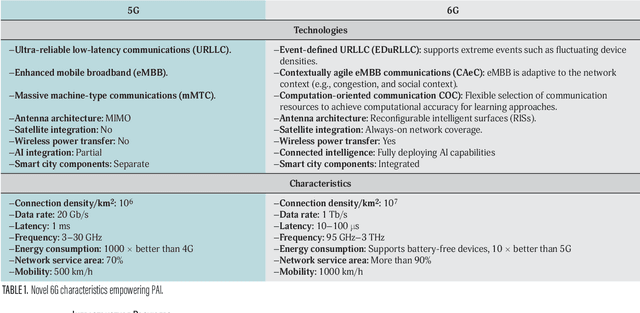
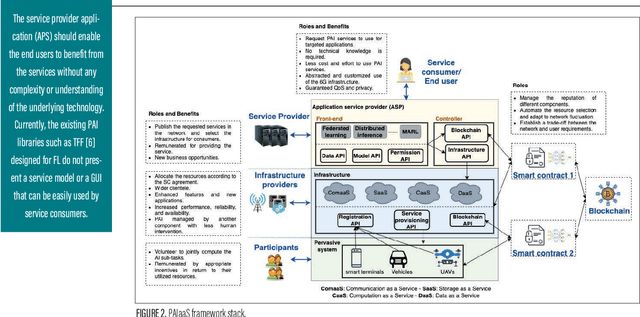
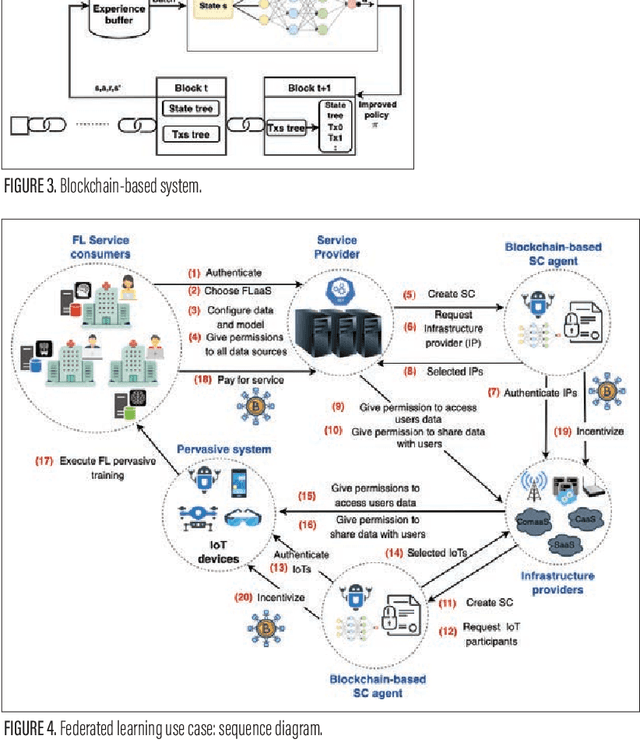
The vision of the upcoming 6G technologies, characterized by ultra-dense network, low latency, and fast data rate is to support Pervasive AI (PAI) using zero-touch solutions enabling self-X (e.g., self-configuration, self-monitoring, and self-healing) services. However, the research on 6G is still in its infancy, and only the first steps have been taken to conceptualize its design, investigate its implementation, and plan for use cases. Toward this end, academia and industry communities have gradually shifted from theoretical studies of AI distribution to real-world deployment and standardization. Still, designing an end-to-end framework that systematizes the AI distribution by allowing easier access to the service using a third-party application assisted by a zero-touch service provisioning has not been well explored. In this context, we introduce a novel platform architecture to deploy a zero-touch PAI-as-a-Service (PAIaaS) in 6G networks supported by a blockchain-based smart system. This platform aims to standardize the pervasive AI at all levels of the architecture and unify the interfaces in order to facilitate the service deployment across application and infrastructure domains, relieve the users worries about cost, security, and resource allocation, and at the same time, respect the 6G stringent performance requirements. As a proof of concept, we present a Federated Learning-as-a-service use case where we evaluate the ability of our proposed system to self-optimize and self-adapt to the dynamics of 6G networks in addition to minimizing the users' perceived costs.
* IEEE Communications Magazine