 Add to Chrome
 Add to Firefox
 Add to Edge
AutoJourn: Multi-Perspective Summarisation, Bias Detection and Bias Neutralisation for LLM-Generated News in Automated Journalism
Jul 21, 2026
We present AutoJourn, a demonstration system for multi-perspective news generation and bias-aware evaluation using large language models (LLMs). The system tackles three core challenges in responsible automated journalism: extracting diverse perspectives from unstructured social media discussions, generating summaries that preserve viewpoint diversity, and detecting or mitigating bias in AI-generated news. The pipeline integrates advanced prompt engineering with optional retrieval augmentation to produce semantically diverse perspective sets, a multi-perspective summarisation module that merges conflicting viewpoints into balanced summaries, and a bias analysis suite supporting sentence-level bias detection and type classification in the generated news article, and automatic neutralisation. Users can inspect perspective clusters, compare stance-specific summaries, generate news articles, and apply bias-aware rewrites directly in the interface. We evaluate each component with intrinsic metrics -- semantic diversity, summary quality, and bias reduction and show improvements over strong baselines while maintaining content fidelity. A live, publicly accessible demo accompanies the paper to facilitate reproducibility and further research on socially responsible automated journalism.

To Bias or Not to Bias: Detecting bias in News with bias-detector
May 19, 2025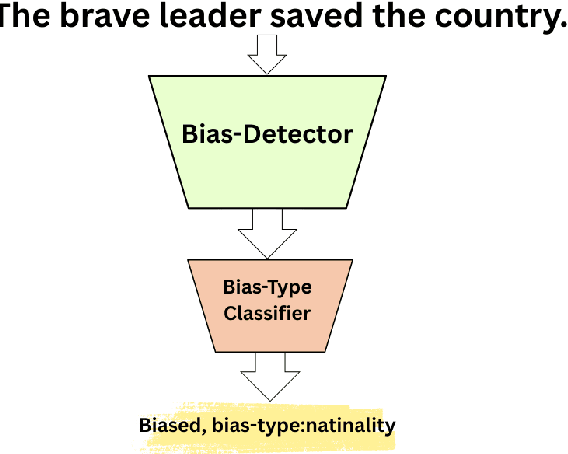
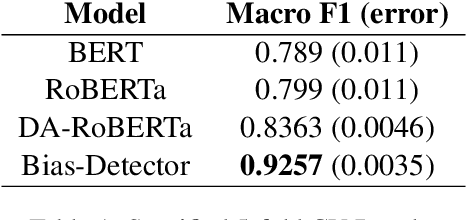
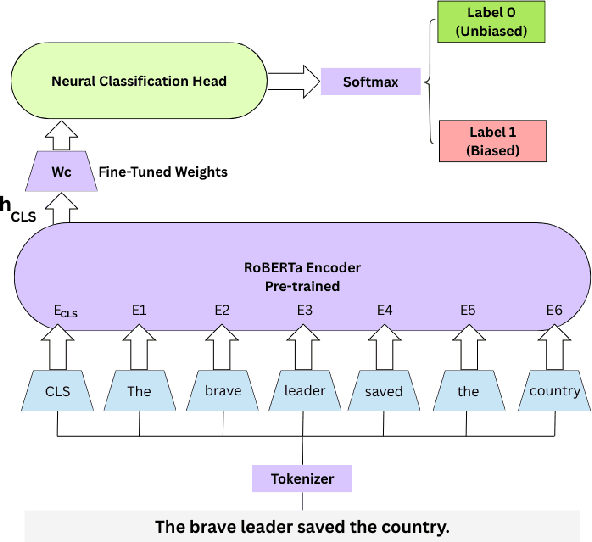
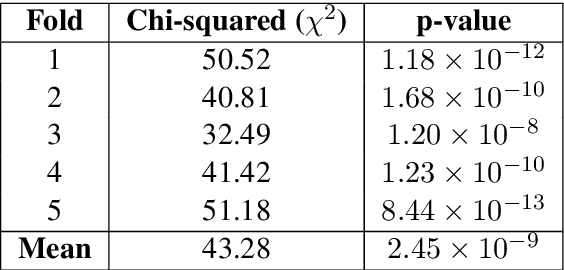
Media bias detection is a critical task in ensuring fair and balanced information dissemination, yet it remains challenging due to the subjectivity of bias and the scarcity of high-quality annotated data. In this work, we perform sentence-level bias classification by fine-tuning a RoBERTa-based model on the expert-annotated BABE dataset. Using McNemar's test and the 5x2 cross-validation paired t-test, we show statistically significant improvements in performance when comparing our model to a domain-adaptively pre-trained DA-RoBERTa baseline. Furthermore, attention-based analysis shows that our model avoids common pitfalls like oversensitivity to politically charged terms and instead attends more meaningfully to contextually relevant tokens. For a comprehensive examination of media bias, we present a pipeline that combines our model with an already-existing bias-type classifier. Our method exhibits good generalization and interpretability, despite being constrained by sentence-level analysis and dataset size because of a lack of larger and more advanced bias corpora. We talk about context-aware modeling, bias neutralization, and advanced bias type classification as potential future directions. Our findings contribute to building more robust, explainable, and socially responsible NLP systems for media bias detection.